

Published: October 28, 2026
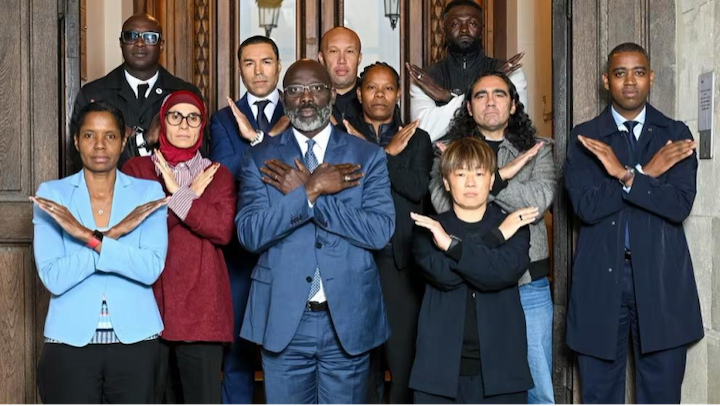
PARIS, France — The FIFA Players’ Voice Panel, led by honorary captain and former Liberian President George Weah, has pledged to intensify efforts to combat racism and discrimination in football, declaring that its first year of work marks only the beginning of a broader campaign.
The panel reaffirmed its commitment after a meeting at FIFA’s Paris office, where members reviewed anti-racism initiatives for the 2026 FIFA World Cup and discussed strategies to strengthen the fight against discrimination at future tournaments.
“This is only the beginning. There is much more to come,” the panel said in a statement issued after the meeting.
Established in September 2025, the Players’ Voice Panel comprises 16 former male and female players representing 14 FIFA member associations and all six continental confederations. It advises FIFA on anti-racism strategies, contributes to educational programs, and recommends reforms based on members’ experiences in football.
The panel operates under FIFA’s Global Stand Against Racism initiative, which promotes a zero-tolerance approach to racism in the sport.
In its statement, the panel said its members bring independent perspectives and experience to the fight against racism and offer constructive recommendations to FIFA.
The group also emphasized that its mandate focuses exclusively on combating racism and discrimination in football, adding that it would soon present a comprehensive annual review outlining its achievements and future priorities.
Speaking after the meeting, Weah said more action was needed to eliminate racism from the game.
“We need to do more and more can be done, and that’s what the meeting was all about here in Paris. So, we get together; we understand what more needs to be done,” Weah said.
“Our determination to eradicate racism from football remains stronger than ever.”
Weah, who became the first African to win FIFA World Player of the Year in 1995, served as Liberia’s president from 2018 to 2024.
The meeting also examined plans to reinforce FIFA’s anti-racism message at upcoming events, including the FIFA Congress in March and the 2027 FIFA Women’s World Cup in Brazil.
Education was another key focus, with panel members receiving a presentation on FIFA’s Football for Schools program from its director, Franck Castillo. The initiative uses football to help children worldwide develop life skills and promotes inclusion, aligning with the panel’s educational objectives.
Members also reviewed the work of FIFA’s Social Media Protection Service, which seeks to protect the mental health of players and other participants in FIFA tournaments by identifying and addressing abusive and potentially harmful online content.
During the 2026 FIFA World Cup, the service analyzed more than 17.1 million social media posts and comments, identified 240,000 as abusive and blocked more than 7 million potentially harmful or spam comments.
FIFA also escalated more than 2,900 accounts for investigation, with 786 cases referred directly to law enforcement.
The figures underscore the scale of online abuse facing football and FIFA’s efforts to impose real-world consequences for digital misconduct.
FIFA Deputy Chief Member Associations Gelson Fernandes and Gerd Dembowski, the organization’s head of human rights and anti-discrimination, attended the meeting in person and online. Both serve as part of the panel’s secretariat on behalf of FIFA.
As the panel prepares to publish its first annual review, its members have reiterated their commitment to strengthening anti-racism efforts and ensuring that discrimination has no place in football.




Discussion about this post