


Published: November 16, 2026
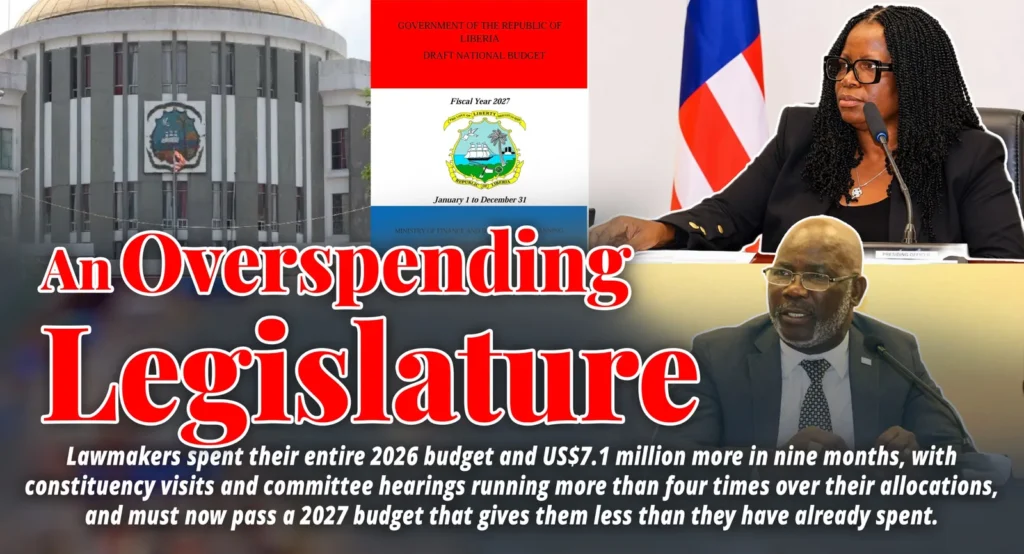
MONROVIA — The National Legislature spent US$64.3 million over nine months, exceeding its 2026 budget by US$7.1 million. Now it must pass a 2027 budget that gives it US$6.1 million less than it has already spent this year.
The figures are in the draft National Budget for Fiscal Year 2027, which the Executive sent to the Legislature on Nov. 6. The book’s spending-entity table puts the Legislature’s approved 2026 budget at US$57.18 million. By Sept. 30 it had spent US$64.26 million, 112 percent of the year’s allocation with a quarter of the year still to run. For all of 2027, the draft gives it US$58.2 million.

In those nine months, the Legislature outspent the Ministry of Education, which had used US$50.34 million. Spread across the 103 members of the House and Senate, the Legislature’s spending comes to about US$624,000 per lawmaker.
Employee compensation, including lawmakers’ pay, stood at US$24.47 million against an approved US$25.79 million, roughly on schedule. The overruns came from the allowances, transfers and activities that come with being a lawmaker.
Constituency visits led the way. The Legislature budgeted US$1.12 million for them this year and had spent US$6.23 million by September, more than five times the allocation and about US$60,000 per member. Transfers for committee hearings, budgeted at US$1.41 million, reached US$6.46 million.
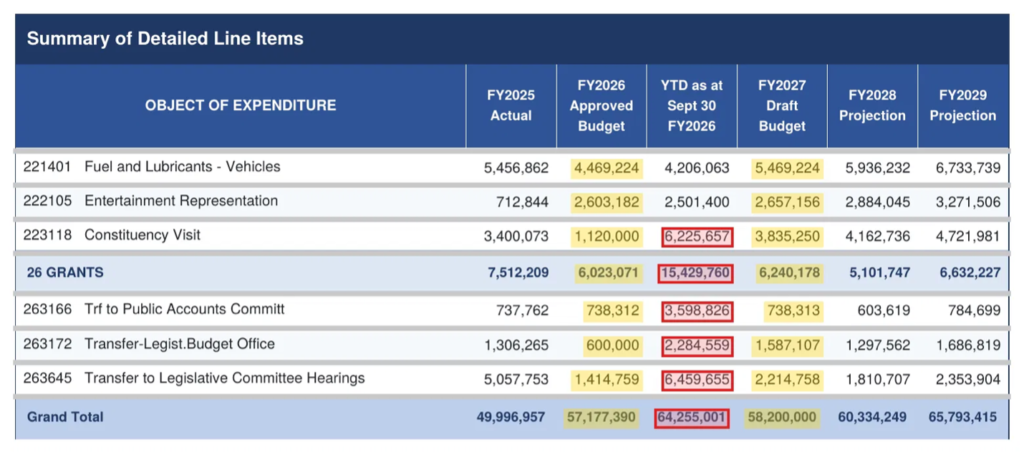
The Public Accounts Committee examines how the rest of government spends public money. It was budgeted to receive US$738,312 and received US$3.6 million, nearly five times as much. The Legislative Budget Office, budgeted at US$600,000, received US$2.28 million.
Altogether, the Legislature’s grants and transfers were budgeted at US$6.02 million and stood at US$15.43 million by Sept. 30, about two and a half times the appropriation.
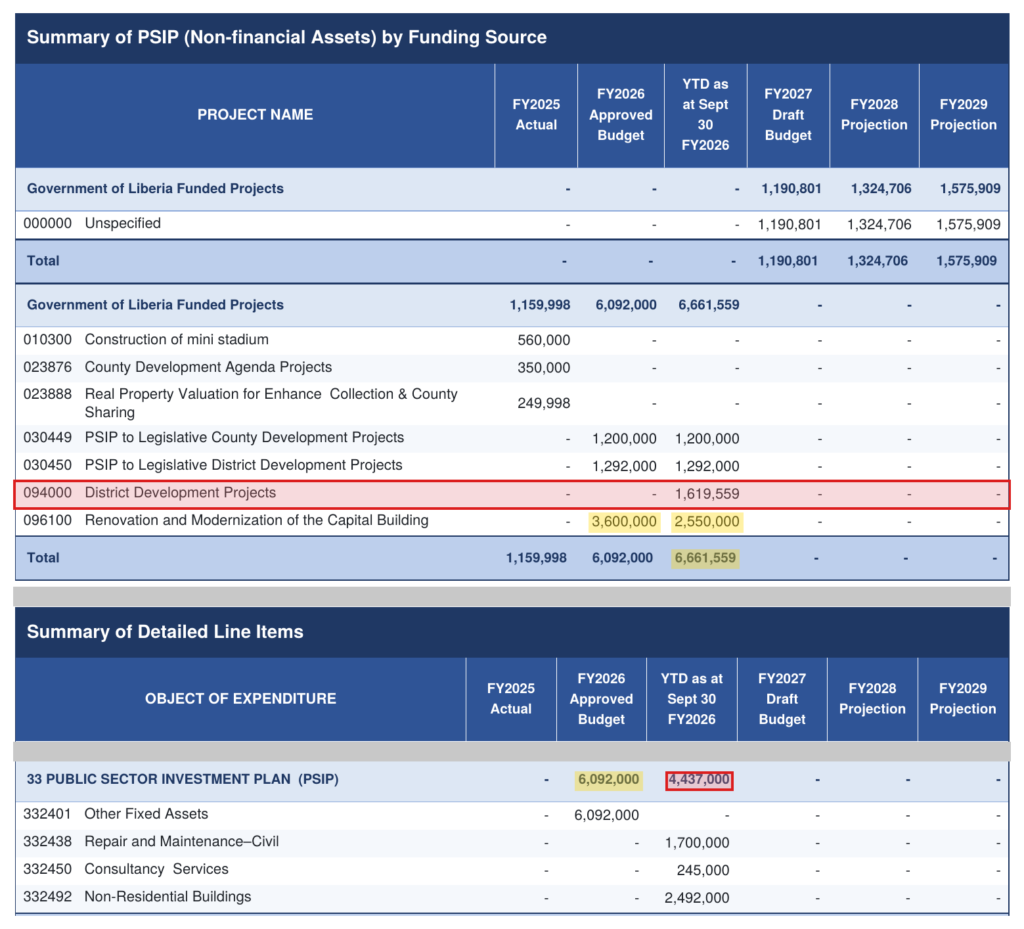
One line was spent with no budget. The Legislature spent US$1.62 million on “District Development Projects,” a line that shows no approved amount in the table. That came on top of US$1.2 million for county development projects and US$1.29 million for district development projects, both budgeted and fully spent. The Capitol renovation, budgeted at US$3.6 million, had drawn US$2.55 million. The 2027 draft has no line for it.
The overruns sit awkwardly beside lawmakers’ own complaints. In October, more than 40 House members boycotted the reopening of the session, a protest The Liberian Investigator reported at the time, saying they were owed constituency visitation, district project, fuel and medical allowances.
“Members have yet to receive various allowances and benefits intended to support their legislative and constituency responsibilities,” Rep. Moima Briggs Mensah of Bong County told The New Dawn. House Speaker Richard Nagbe Koon said he had met Finance Minister Augustine Kpehe Ngafuan about the payments.
Yet the budget book suggests the constituency visit line had already been paid out more than five times over by the end of September.
The 2027 draft does not assume the pattern will continue. It sets constituency visits at US$3.84 million, more than three times this year’s allocation but far below what was actually spent. Committee hearings get US$2.21 million, and the Public Accounts Committee transfer returns to US$738,313. Fuel for lawmakers’ vehicles, budgeted at US$4.47 million this year, rises to US$5.47 million. Spending on goods and services overall rises to US$24.32 million from US$18.72 million, including US$2.66 million for entertainment and representation.
That leaves lawmakers two choices. They can pass a figure they have already outrun and are likely to outrun again. Or they can raise their own allocation during review, at the expense of other spending in a budget that already depends on a 26.5 percent rise in tax collections.
The draft does not say how the extra US$7.1 million was paid for, or under what authority it was released. The appropriation law sets each entity’s spending ceiling. The Public Financial Management Act lets the finance ministry move money between lines and entities, and a contingency reserve covers emergencies. The ministry’s mid-year review, covering January to June, recorded US$6.53 million reallocated under Section 33 of the act and US$10.02 million paid out of the contingency reserve. It reported no entity spending above its appropriation, which suggests the Legislature’s overrun built up in the third quarter.
The Legislature is not alone. The National Security Agency had spent US$30.18 million by September against an approved US$24.69 million, or 122 percent. The Ministry of Youth and Sports was at 117 percent.
The Legislature’s own figures also disagree with each other. Its project table shows US$6.66 million spent on development projects and the Capitol renovation as of September. Its summary table puts capital spending at US$4.44 million. The draft does not explain the US$2.2 million difference.
So the Legislature will scrutinize a budget that records its own spending. Its Public Accounts Committee, which received nearly five times its budgeted transfer this year, will also examine whether every other ministry and agency stayed within its budget.




Discussion about this post