


Published: November 18, 2026
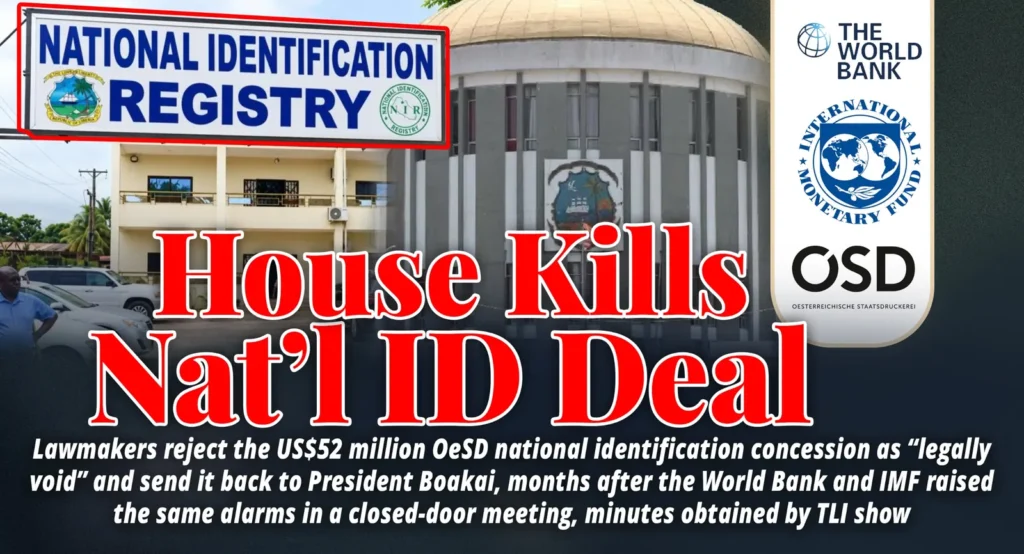
MONROVIA — The House of Representatives has rejected the US$52 million national identification concession with Austria’s OeSD International GmbH and sent it back to President Joseph Nyuma Boakai for renegotiation, after a joint committee found the agreement “legally void” under Liberia’s procurement rules and warned it would cost the state money and compromise control of citizens’ biometric data.
By Lennart Dodoo and Gibson Gee
The vote puts lawmakers on the same side as Liberia’s largest development partners. Minutes of a June meeting, obtained by The Liberian Investigator, show that the World Bank told the government the country could register its entire population in the identification system it already owns for far less, and that the IMF warned the concession could saddle the state with future debt. Officials at that meeting agreed that no further approvals should proceed until the deal had been reviewed. It went to the Legislature anyway.
The House Joint Committee on Investment and Concessions and Ways, Means, Finance and Budget said its review found more than 40 distinct defects in the agreement, including critical sovereignty concerns, and that “several of the critical defects represent statutory violations that occurred prior to execution and cannot be cured by legislative ratification.”
“The GOL-OeSD International NIDCRVS concession agreement is legally void under Liberian procurement regulations, strips the National Identification Registry of its core statutory mandate, compromises the biometric sovereignty of the Liberian people and exposes the Republic to severe net fiscal losses,” the committee concluded.
The decision leaves Liberia without a working path to restart national ID issuance, which the National Identification Registry suspended in June 2025. Fewer than 800,000 people in the country hold a national ID card, according to the registry.
Signed Before It Was Discussed
The committee’s report says the agreement was signed April 30, 2026. That is nearly two months before the June 26 meeting at the Ministry of Finance and Development Planning, where, according to the minutes, the acting finance minister described the public-private partnership as “currently under negotiation” and asked participants to weigh it against a donor-funded alternative.
The minutes record a “High-Level Stakeholder Meeting on the National Identification Registry (NIR) Financing Approach,” chaired by the deputy minister for fiscal affairs, acting as finance minister. It brought together the NIR, the Liberia Revenue Authority, the National Elections Commission, the government’s chief information officer, a presidential adviser, the World Bank, the IMF and the United Nations Development Programme. Development partners had raised concerns about the concession and asked for the meeting, the minutes say.
The World Bank said a technical assessment under its ID4D initiative had concluded that nationwide registration “could be achieved using the existing system at an estimated cost significantly lower than originally anticipated, while maintaining Government ownership and avoiding direct costs to citizens.” It warned that a new PPP model “could fundamentally alter the technical architecture and financing assumptions” behind investments already made under the World Bank-financed Governance Reform and Accountability Transformation, or GREAT, Project.
The IMF said it was not opposed to PPPs in principle but questioned whether the deal complied with Liberia’s PPP procurement framework, whether it gave a private company too much control over national identity data, and whether it was truly self-financing. If revenues fell short, it warned, “Government could ultimately be required to assume additional financial obligations under the concession.”
UNDP said Liberia’s voter registration drives showed the state could register much of the population itself. The chief information officer warned that the system must not become “a stand-alone proprietary system.”
The NIR’s executive director defended the deal at the meeting, saying it was designed so a private investor would finance nationwide registration before the 2029 elections and recover its money over time, given the government’s fiscal constraints.
The meeting ended with agreement that the government “should undertake a comprehensive review of all available financing options before making a final decision,” and that the NIR would circulate the draft agreement to government institutions and development partners for review “prior to any further negotiations or approvals.” The Liberian Investigator could not establish whether that review took place.
A Bidding Order Ignored
The committee’s central finding is that the government never ran the competition the law required.
According to the report, the Public Procurement and Concessions Commission declined a request for a sole-source contract in May 2025. On July 7, 2025, it formally rejected restricted bidding and directed the NIR to proceed through open international competitive bidding and submit a formal concession plan. The committee said that directive was not followed.
It found that the agreement lacks a certificate of concession under PPCC Regulation 53.4, without which, it said, a concession is void. It also challenged the use of the unsolicited proposal process, saying competitive bidding was required because other firms had submitted proposals before the commission’s approval. The report names competing expressions of interest from firms including Dynamic Global Technologies, Lake Piso Solutions and MRT.
At a Nov. 11 hearing, three Liberian firms, MWETANA Consulting and Technology Group, Lake Piso Solutions and Dynamic Global Technologies, told lawmakers they could build a modern biometric ID system for less than US$20 million, The Liberian Investigator reported.
The committee held hearings on Oct. 28, Nov. 4 and Nov. 11 after the agreement was referred to it on Oct. 15.
The State Would Carry the Costs
The committee said that despite being presented as investor-financed, the deal would leave the government responsible for much of the supporting infrastructure, including civil works for data center facilities, IT hardware, generators, connectivity, personnel and secure transportation.
It estimated the government would bear nearly all mass-enrollment operating costs, about US$4.5 million a year in in-kind contributions, and projected a net loss to the state of US$7.6 million over the 10-year concession. There was no independent value-for-money assessment, it said.
Under the revenue-sharing arrangement, which also involves Ecobank, OeSD would receive 65% of designated revenue and the government 35%. The committee questioned provisions that could let the company keep benefiting after recovering its investment.
The findings closely track the IMF’s June warning that the government could end up carrying the financial burden of a deal sold as self-financing.
Data and Mandate
The system would hold fingerprints, photographs and other personal records of Liberian citizens and residents in a centralized platform combining national identification, civil registration and vital statistics.
The committee said the agreement would strip the NIR of core statutory functions and questioned provisions on the handling of sensitive national data. It also flagged clauses touching work and resident permits, which by law fall under the Ministry of Labour and the Liberia Immigration Service.
The NIR has said citizens’ biometric data would remain the property of the Liberian government.
The Vote
After the chief clerk read the report, Rep. J. Marvin Cole moved that plenary receive and endorse it.
“I want to use this occasion to tell the joint committee thank you for the checkpoint erected before this group of people,” Cole said, praising the committee’s insistence on competitive bidding.
One lawmaker called for the immediate suspension of OeSD’s ongoing pilot project pending a full review. Another proposed returning the agreement to Boakai for renegotiation and possible resubmission, and questioned the US$52 million cost. Cole accepted the amendment, saying the executive had initiated the deal and should answer the concerns.
“The foreign policy of this country is executed by the Executive to negotiate and bring those negotiations to us for ratification. So we cannot play that role,” one lawmaker said.
How Liberia Got Here
The deal was meant to replace Liberia’s first biometric ID system. In 2017, the government awarded Kenyan firm Techno Brain a US$5.9 million contract after open competitive bidding involving 19 firms. That rollout stalled when the government fell behind on payments. Techno Brain was owed about US$1.7 million and withheld full database access pending settlement, and ID issuance was suspended in June 2025.
NIR Executive Director Andrew Peters has said the OeSD arrangement was needed to expand enrollment beyond the one to two million people targeted under the old contract, with the company bearing the upfront cost.
In a Jan. 30 letter seen by The Liberian Investigator, Boakai ordered the Inter-Ministerial Concessions Committee, chaired by the National Investment Commission, to conduct “a comprehensive review of the documentation and procedures related to the hiring of a concessionaire” for the project, and to oversee the process “from initiation through final approval” with “the highest standards of transparency, accountability, and fairness.”
The House has now found that the process failed that standard. The agreement returns to the president, who must decide whether to renegotiate, rebid or abandon it.





Discussion about this post