


Published: July 24, 2026
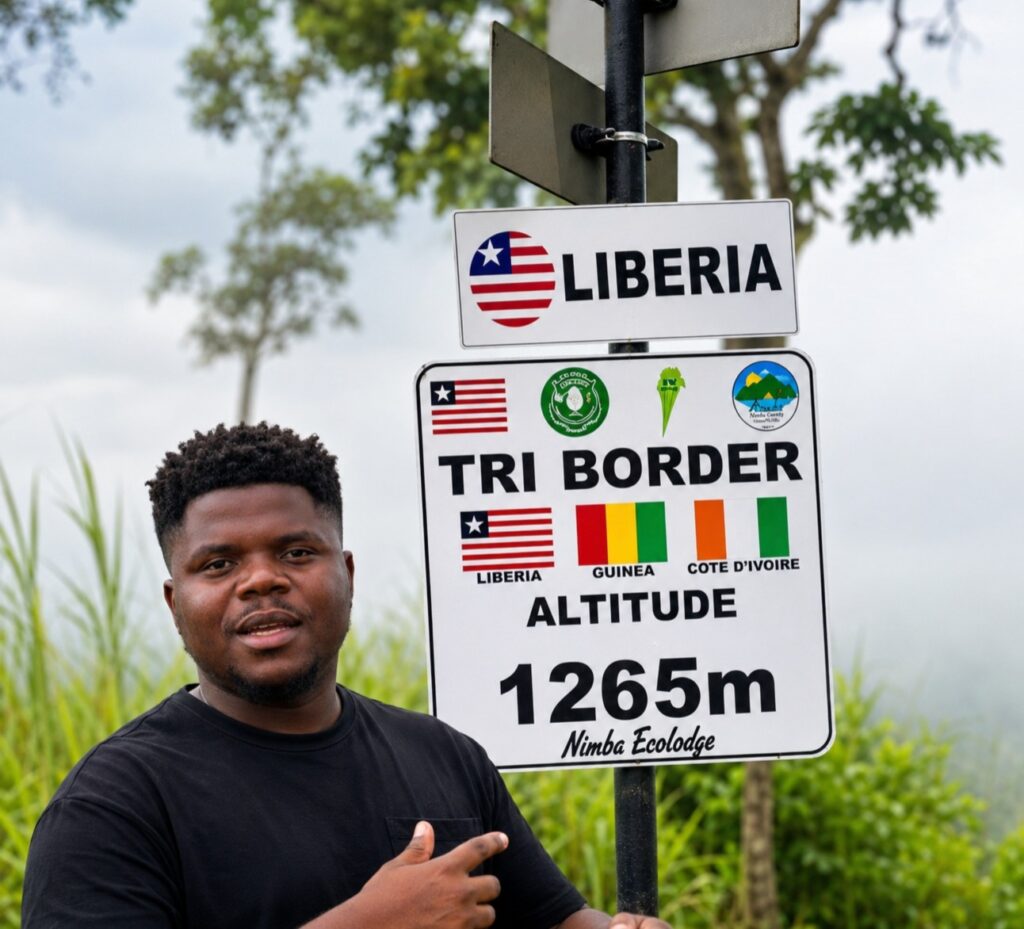
MONROVIA – A Ghanaian YouTuber with nearly 2 million subscribers has used Liberia’s 179th Independence Day week to challenge the borders that divide West Africa, standing at the stone pillar in Nimba where Liberia, Guinea, and Ivory Coast meet and asking who put it there.
“Where I’m standing is where three countries meet each other,” said Berthold Kobby Winkler Ackon, the creator known online as Wodemaya. “What do you see? You see Liberia, Guinea and La Côte d’Ivoire. But does it really make sense? And the question is, who climbed up here to come and tell us that this is for Liberia, this is for Guinea and this is for La Côte d’Ivoire?”
He then answered it himself.
“Who created these borders? These are not our creation,” he said. “And this is why I am asking fellow Africans, it’s about time for us to get rid of these borders, to ensure free movement among ourselves.”
Wodemaya arrived in Liberia on July 20 to document the country’s culture, ecotourism sites and independence celebrations in partnership with the Liberia National Tourism Authority, part of a tour meant to showcase Liberian creators and landscapes to an audience that also includes about 2.9 million followers on Facebook. He built his following on what he calls the good news about Africa, and Ghana issued him a diplomatic passport last September in recognition of that work.
The pillar he chose for the argument has a documented history. Liberia surrendered large stretches of its interior to French West Africa under the Franco-Liberian boundary treaty of 1892 and further agreements in 1907, and boundary commissions later planted markers through the hills around Mount Nimba, fixing the split between Liberia, French Guinea and Ivory Coast. Those lines cut through the homelands of the Mano and Dan peoples, known in Liberia as Gio, leaving relatives on three sides of a frontier they had never been asked about.
That shared frontier is not ungoverned space. Liberia, Guinea and Ivory Coast all belong to the Economic Community of West African States, whose 1979 protocol on free movement already gives citizens the right to enter member states without a visa and stay up to 90 days. All three are also members of the Mano River Union, a bloc founded in part to ease trade and movement across exactly the frontier where Wodemaya was standing. The rights exist on paper. Travelers who use the crossings describe a different experience on the ground, where checkpoints, informal fees and document demands make a legal journey slow and expensive.
Wodemaya tied the borders to the continent’s economic performance.
“You see, they created these borders to benefit themselves, not us,” he said. “And now that we want to be independent, it’s about time to get rid of these borders so that we can move from one place to another, trade among ourselves and develop ourselves. We can never develop when we’re still protecting something that we did not create.”
The frontier still generates friction. Imprecise descriptions of waterways and land tracts in the old boundary records continue to feed disputes over farmland, mining and border security, even though communities on all three sides share language, kinship and trade.
His closing appeal was aimed at Liberians, and it turned on the fact that gives this country its founding claim.
“Africa for Africans, and it’s about time to allow free movement of goods and services within the continent of Africa,” he said. “My final question is, if Liberia was never colonized, how did you guys allow these white people to create these borders? Dear Liberians, I want the answers from you all.”
The Liberia National Tourism Authority did not immediately respond to a request for comment on the visit.



Discussion about this post