


Published: May 11, 2026
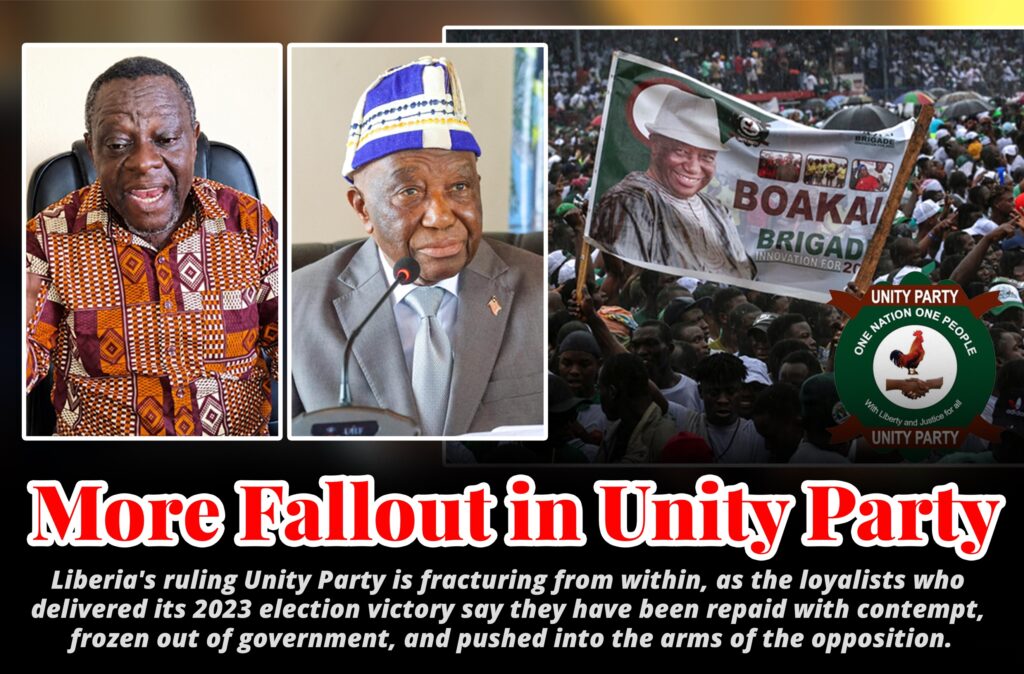
MONROVIA – Former Bomi County Sen. Sando Dazzo Johnson has said the officials President Joseph Boakai trusted with his government are the ones destroying it.
“They are the ones who do not want President Boakai to be re-elected,” Johnson said in a wide-ranging interview on FOCAL FM 105.3 in Monrovia over the weekend. “They are digging their own grave. Their conduct is making the United Party very unpopular.”
Johnson’s public break with the UP is the loudest in a chorus of grievances that also includes Gbarpolu County Senator Amara Konneh, who recently alleged deliberate marginalization, the ruling party’s own grassroots bureau threatening “radical action,” and the controversial expulsion of Representative Yekeh Kolubah in defiance of the Supreme Court.
Johnson confirmed that some current UP members are secretly collaborating with the opposition.
From War Room to the Cold
The pattern Johnson describes is one that County Sen. Konneh made public last week on the OK Conversation: you deliver the election, and then you are frozen out.
Konneh, a former Finance Minister who organized Boakai’s 2023 campaign war room at Boakai’s personal request, alleged last week that influential UP officials came to see him not as an asset but as a rival and pushed him out of decision-making. Johnson confirmed the account, saying Boakai had told Konneh directly that he wanted him to replicate for 2023 what he had done for the party in 2011. Konneh delivered. Then the government took office.
“The hand that helps you, you don’t cut it off,” Johnson said. “Mr. Konneh played a pivotal role in the success of the Unity Party. And he has been put at the back.”
Johnson said his own trajectory followed an identical arc. He helped build a coalition across Bomi County that included former CDC supporters, spent personal resources, and delivered votes in a region the UP could not afford to lose.
“We stood in the rain, in the pool, in towns and villages, Senator Tyler, myself, and our team,” he said. “You don’t see us and take us for a joke.”
The final insult, he said, came from a senior official inside the Executive Mansion who referred to him and other non-UP loyalists as “Charles Taylor’s people” who should not be encouraged to remain in the administration’s orbit.
“When you wanted us to vote for you, you didn’t know that we’re Charles Taylor’s people, right?” he said. “The last time you say that, I will expose you.”
He estimated that up to 80 percent of newer UP appointees were undermining the administration through their conduct, singling out the concurrent appointment of members of the same family within the Ministry of Labor as a specific example.
His account echoed a March 2026 warning from Fasu Kromah, chairman of the UP’s own Intellectual Bureau, who said loyalists who had defended Boakai for years were being ignored by their own appointees and warned that unless the party faithful received some acknowledgment, grassroots support would evaporate.
“They are very ungrateful and unappreciated,” he said. “There is no permanent friendship in politics. There is permanent interest. I supported you on the basis that you would support me.”
Johnson was careful throughout to distinguish between Boakai, whom he described with consistent respect, and the faction he holds responsible for the party’s deterioration. He recalled the president telling supporters during the campaign’s final days that if one Liberian had to die for him to become president, he did not want the office.
“That is the man I know,” Johnson said. “But the people around him, look at their statements. They don’t match him.”
The Kolubah Affair: A Symptom, Not the Disease
In April 2026, the House of Representatives voted to expel Rep. Yekeh Kolubah of Montserrado’s 10th district, a man who, like Johnson and Konneh, had helped deliver the 2023 election to Boakai without ever formally joining the UP.
The stated grounds were Kolubah’s remarks suggesting that the territory occupied by Guinean forces during a border incursion belonged to Guinea. Rep. Sumo Mulbah filed the complaint on April 9, the Rules Committee moved quickly, and on April 17, one day after Supreme Court Justice Yussif Kaba issued a writ of prohibition ordering the House to halt all proceedings, the House plenary voted 49 to zero to expel him anyway.
The defiance of the court order drew immediate condemnation. The CMC and CDC expelled their own members who had voted for the removal. Civil society leader Mulbah Morlu called the process “a grave abuse of power.” As of May 2026, no final Supreme Court ruling had been announced, leaving open the possibility that the expulsion could be voided entirely.
Johnson, who served as majority leader in the House during the Taylor administration before winning a Senate seat, offered a constitutional indictment of the entire proceeding.
“Does the legislature have the right or the power to try anybody for treasonable offenses in Liberia? No,” he said. “Only the court is charged for treason.”
He said he did not support Kolubah’s remarks but condemned the House with equal force, drawing on the precedent of former Sen. Roland Kahn, whom the Senate suspended for more than a year pending a murder investigation before reinstating him and restoring all back benefits after he was exonerated.
“That was the right thing to do,” Johnson said. “You suspend, pending the final decision from the court. If he is found guilty, now you can expel him. But you do not, on the basis of allegations, expel a man.”
UP Chairman Luther Tarpeh publicly defended the expulsion, arguing Kolubah’s border comments had “emboldened” foreign claims and urging him not to see the Unity Party as the force behind his removal. President Boakai has made no public statement on the matter.
Coalition Cracks and the 2029 Shadow
The Kolubah expulsion crystallized a broader anxiety within the opposition about what the ruling party intends for 2029. When Sen. Abraham Darius Dillon declared on radio that the UP was “already in 2029” and knew “how to manage power,” Johnson heard something more ominous than campaign boasting.
“The senator is thinking that they will rig the election,” Johnson said. “And if that happened in 2029, then do you really want peace here?”
The UP’s coalition with the Liberty Party is also showing strain. At a December 2025 UP homecoming rally, several senior LP figures were conspicuously absent. No LP official has addressed the absence publicly, but observers tracking whether the governing coalition holds through 2029 took note.
A New Political Home
Johnson said he formally joined the Citizens Movement for Change in February 2026, after working with the party since September 2025. He approached National Chairman James Yogi and political leader Mousa Bility on his own initiative.
“The chairman did not call me. I personally, on my own volition, went to them,” he said. “I’m not coming for material things. I’ve passed material things.”
He now serves as the CMC’s regional director for the western region, covering Bomi, Gbarpolu and Cape Mount counties — precisely the territory he helped deliver for Boakai in 2023.
“If the United Party loses not one of the region, then they are not in the mansion,” he said. “They know that.”
He confirmed that Bility was engaged in coalition discussions with opposition stakeholders and said some UP partisans were quietly among those in contact with the CMC.
“There are some United Party people, partisans, they are collaborating with us,” he said. “You call their name, they lose their jobs.”
Johnson said he will contest the 2029 senatorial race in Bomi County on the CMC ticket, and hinted his ambitions extend beyond the Senate.
“I will be on the ballot paper, by the grace of God,” he said. “I’m going above senator.”
His parting words on the UP were measured but final. He said he had informed Boakai personally of his move to the CMC and that the president had raised no objection. If that position were to change, his response would be the same.
“I will tell him thank you,” Johnson said. “I will go. I will still not insult you. I will still respect you.”





Discussion about this post