


Published: September 14, 2026
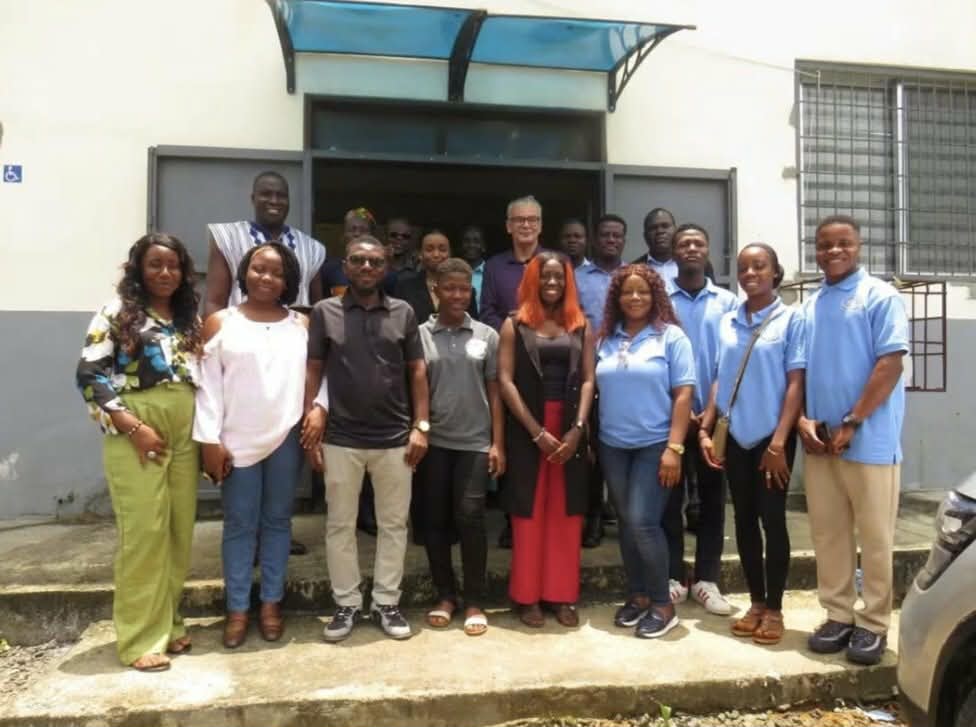
Fendall, Louisiana, Liberia – The European Union-funded Strengthening Artisanal Fish (SAFish) Value Chain project, a $30 million initiative, was presented to the University of Liberia’s Department of Fishery and Aquaculture Sciences (DoFAS) for potential collaboration.
By Winston Blyden (Contributor)
The project was presented to the university administration, faculty, and students on Tuesday, September 8, at DoFAS’ academic building in Fendall, to establish a long-term collaboration throughout the 60-month project. Through this collaboration, the project could strengthen curriculum development, support research ideas, expose interested students to knowledge, expertise, innovations, and skills for accessing promising new jobs in the blue economy, and improve the university’s academic and skills-based projects.
Project partners, which run from July 2026 through June 2031, include Liberia’s National Fishery and Aquaculture Authority (NaFAA) and others. Beneficiaries include fishers and their families, women and youth in fishing communities, micro-enterprises, the Liberia Artisanal Fishing Association (LAFA), and Village Savings and Loans Associations (VSLA), among others.
Its contracted partners are Environmental Justice Foundation (EJF) and Fishery Transparency Initiative (FiTI), which get funding from the German government. Outlined in SAFish’s problem analysis are stock overfishing and over-exploitation of five of the eight commercial key species in Liberia, lack of a solid frame survey and fish monitoring, post-harvest loses fish product quality, and fishing post-facilities.
The problem analysis also includes fishery governance, law enforcement, fighting Illegal, Unreported, and Unregulated (IUU) fishing, capacity at local levels, VSLA, and NaFAA decentralizing the needed set of skills at the community level.
University of Liberia President Dr. Layli Maparyan said the program is an exciting initiative, declaring her unwavering support for the multi-donor action project, including the university’s Department of Fisheries and Aquaculture Sciences in this major collaboration. “And I think that it is the fruit of many years of hard labor at building up this department and this program here. It’s relatively new, but it’s getting off to an amazing start,” Dr. Maparyan said.
She considered the collaboration and the invitation extended to her a sign of trust and belief and a promise of what the university is growing, and the importance of the work being done. She applauded the University of Liberia Vice President for Academic Affairs and Provost Dr. Agnes Reeves Taylor for being the mastermind behind all these academic programs.
Presenting the project to the university, Dr. Stefan Groenewold, the EU-funded SAFish Project Manager, introduced the initiative as a multi-donor action project, citing the European Union as one of the biggest donors.
Dr. Groenewold said he loves working with universities, recalling his last seven years of intensive work with universities in Bangladesh, building a program on fisheries, marine conservation, and blue economy development.
“And there, we worked very intensively together with universities because I see them as a kind of anchor, anchoring for sustainability, anchoring the knowledge and the kind of guarantee for knowledge that will be transferred to the future,” he said.
Including raising awareness at the community level on marine topics, strengthening organizations, and improving financial services, Dr. Groenewold said the project also seeks to support universities in the education sector. According to him, details on curriculum development and support for some research ideas will be shared soon, among other things. “So, we have a scholarship program, by the way, but this scholarship program, as you can see, is responsible for that, but we do that, we say, in harmony,” Dr. Groenewold said.
Dr. Groenewold said he thinks the project is a relevant initiative for DoFAS, the university, the government, technical and vocational education and training (TVET) colleges, and other institutions involved in fisheries. Better access to financial and non-financial services is another issue that he said the SAFish project seeks to address. He added that small entrepreneurs have very good ideas, but they don’t get any capital or access. “Our fishermen associations have good ideas, innovative ideas, but also lack finance. So, we would come in there and would really like to establish these services, especially at the county level,” he disclosed.
The EU project official revealed that one of SAFish’s objectives will be to reduce fishing pressure and over-exploitation of five of the eight commercial species that are over-fished in Liberia, while still using them as the main commercial species.
Dr. Groenewold expressed a wish to produce a kind of fish market guide where not only the eight over-fished commercial species can be located, but maybe 20 to 30 potentially economically important species can be found.
Citing his personal difficulty in getting fresh fish, especially where knowledge is lacking about the right markets or the landing ports, he said the project would increase the visibility of fishery governance and more Liberian products from small-scale fisheries in the supermarkets. “We would like to see really more products, more Liberian products, more products from small-scale fisheries, also in the supermarkets, whether deep frozen or not, or processed in another different way,” he said.
He noted that the project aims to strengthen organizations including the Liberia Association of Small Scale Fishermen, and the Collaborative Management Associations.
Regarding fisheries subsidies, Groenewold was clear that, going forward, the EU will not use that as the best model because of past long periods when the EU subsidized fisheries heavily under political pressure. “And that is definitely not the way to go in the future,” he said.
Notwithstanding, Groenewold said there will be a focus on how to fight and reduce illegal, unreported, unregulated fishing – an initiative he said is across all of West Africa. He said they have many similar projects in Namibia, Angola, South Africa, Madagascar, Tanzania, Kenya, and another, more focused on aquaculture, in Malawi and Uganda.
As for Liberia’s project, he said it is the newest in this line of projects co-funded by the European Union and the German government, and jointly implemented by Deutsche Gesellschaft fur Internationale Zusammenarbeit (GIZ) and Expertise France.
He said they work along the entire coast in nine counties of Liberia to develop micro-enterprises, and also work with organizations like NaFAA, collaborative management organizations (CMOs), village savings and loan associations, and others.
Convincing the EU and the BMZ to spend so much money on this project, Dr. Groenewold said they had to talk about economic inclusion and unlocking the potential in small-scale fisheries. He recalled that in his time, fishery science was all about fish, fishing gear, fishing methods, stock assessment, and modeling.
“Nowadays, he thinks, “it’s completely different because you have to deepen your knowledge in economics and bioeconomic models and so many other aspects.”
He further said it’s about strengthening the blue economy, noting that because of this big promise that the blue economy came with, there were early concepts, always promising many new jobs, lots of innovations, and partially that came true. “While you said the European Union has a blue economy program that’s worth billions around the world, including themselves, of course, there’s a blue economy development in Europe,” he said.
Dr. Agnes Reeves Taylor, University of Liberia Vice President for Academic Affairs, said she was happy that the project has come to help the university improve its academic and skills-based projects. She said these programs are more important for Liberia’s development, adding, “Thank you for choosing the university to partner with.”
Dr. Reeves-Taylor thanked the university faculty at DoFAS for their continued hard work, saying she looked forward to seeing students as the next generation that will take over and move things forward.
Dr. Alvin Jueseah, Chairman of DoFAS, pledged his department’s commitment to support the project in whatever capacity is needed. “We know that this is going to be a long collaboration throughout the lifespan of the project. And we are happy to support the Department of Fisheries in whatever capacity you need. We are there and ready to support you,” said Dr. Jueseah.
He said there’s a lot of opportunity for collaboration between DoFAS and the SAFish project, emphasizing that facilitating research and collaboration will be great because the connection and the research need to be managed in a way that is sustainable for the current and future generations.
Dr. Jueseah added that DoFAS is considering establishing a holographic program in marine, spatial planning, and coastal management, where the department wants SAFish’s work to complement what it aspires to do. “And then we can collaboratively develop that curriculum so that we can train young Liberians interested in specializing in these kinds of areas,” he added.





Discussion about this post