


Published: June 8, 2026
Liberia has spent too many years fighting to secure democratic stability to allow reckless predictions, political opportunism, and partisan hysteria to undermine it.
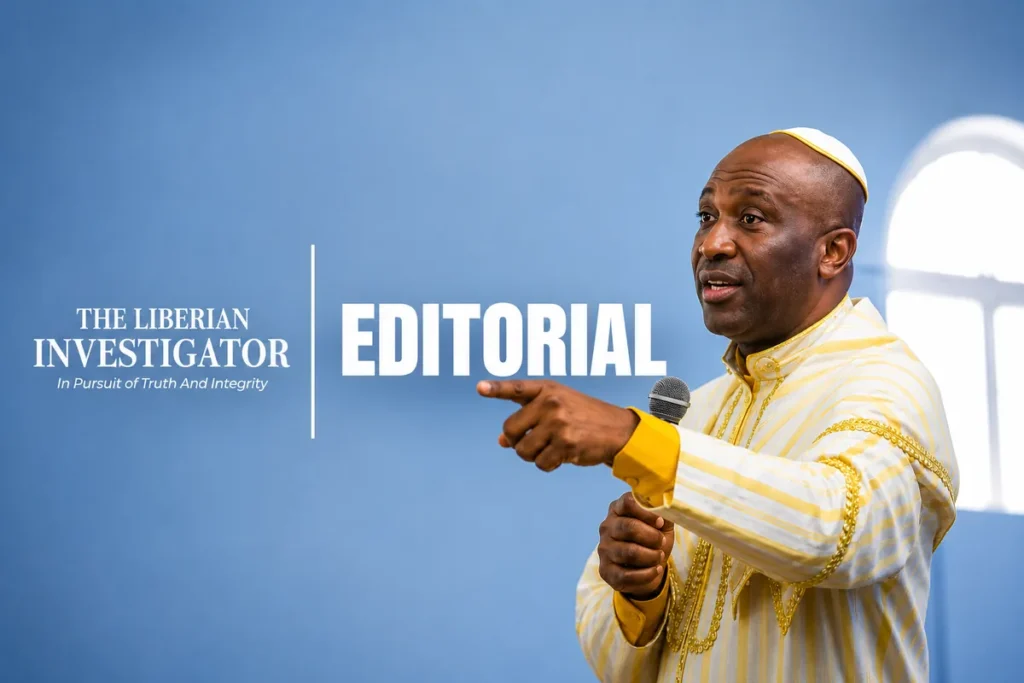
The controversy surrounding Nigerian cleric Bishop Elijah Ayodele’s prediction that President Joseph Nyuma Boakai could face a coup should concern Liberians for reasons that go far beyond religion. The debate is not about whether one believes in prophecy. Liberia is a deeply religious nation, and many citizens sincerely believe that God can reveal future events through His servants. The danger lies elsewhere: when prophetic declarations become political weapons and when politicians begin treating speculative predictions as substitutes for democratic discourse.
No responsible Liberian should casually speak about coups.
Our national history carries painful scars from April 12, 1980, when a military coup violently ended one era and opened another marked by instability, civil conflict, and decades of national trauma. Thousands died. Institutions collapsed. Generations paid the price. For many Liberians, the word “coup” is not merely political vocabulary; it is a reminder of a tragedy from which the country is still recovering.
That is why any public statement suggesting the possibility of overthrowing an elected government deserves careful scrutiny. Whether intended as a warning, a prediction, or mere commentary, such statements must be approached with responsibility. Freedom of speech does not eliminate the obligation to consider the consequences of our words.
At the same time, government officials must resist the temptation to turn every criticism or unfavorable prediction into a conspiracy against the state. Democratic governments are strengthened not by suppressing uncomfortable opinions but by demonstrating confidence in the institutions that protect constitutional order. The Boakai administration should not allow itself to appear rattled by every social media prophecy or political provocation. Governments earn legitimacy through performance, transparency, and accountability—not through arguments with foreign clerics.
Equally troubling has been the reaction from some opposition figures who have embraced the prophecy as if it were a political endorsement. Liberia’s opposition has a constitutional duty to challenge government policies, expose failures, and offer alternative solutions. It does not strengthen democracy when political actors celebrate predictions of instability simply because those predictions target their opponents. A nation cannot prosper if politicians become more invested in proving each other wrong than in protecting the democratic system that allows them to compete.
The deeper lesson here is that Liberia’s vulnerability does not come from prophecies. It comes from polarization.
When unemployment remains high, when citizens struggle with rising living costs, when public confidence in institutions weakens, and when political discourse becomes increasingly toxic, rumors and predictions find fertile ground. The answer is not censorship. The answer is governance. The answer is political maturity. The answer is building institutions strong enough that no prophecy, rumor, or social media campaign can shake public confidence.
Liberia’s future will not be determined in a church in Lagos, on a Facebook livestream, or in partisan online battles. It will be determined by the choices Liberians make at home—through elections, public policy, civic engagement, and respect for constitutional order.
The country’s democratic destiny cannot be outsourced to prophets, politicians, or foreign commentators.
Liberians should pray for their nation, but they must govern it through laws, institutions, and democratic accountability.
That remains the only prophecy worth believing in.




Discussion about this post