


Published: June 24, 2026
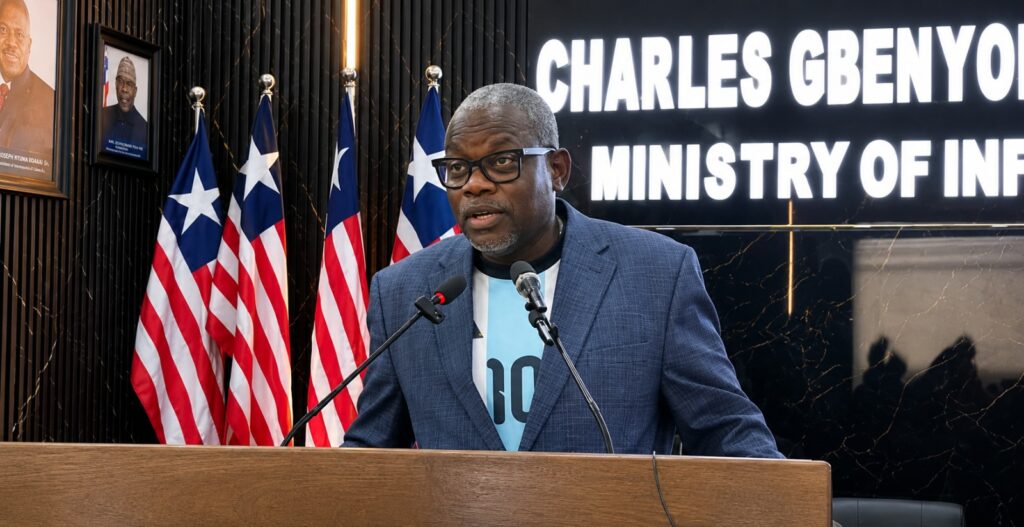
MONROVIA — Information Minister Jerolinmek Piah mounted a strong defense of the Boakai administration’s performance Tuesday, dismissing opposition claims that the government has failed and pointing to gains in infrastructure, electricity access, public services and Liberia’s international standing as evidence of progress since the Unity Party took office.
Speaking during the Ministry of Information’s regular press briefing, Piah responded to recent comments by opposition figure Eugene Nagbe, who reportedly described the administration as a failure.
The minister challenged the basis of the criticism, saying Liberians can see the changes for themselves.
“When Eugene says this government has failed, I wonder what definition of failure he is using,” Piah said. “I think you and Eugene need to sit down and define failure. Perhaps failure has a different meaning to all of you.”
Piah argued that critics who accuse the government of underperforming often overlook visible development across the country. He also took aim at those he said attack others under the guise of criticism.
“Then, when a person responds, they say something entirely different,” he said.
Drawing a comparison with the previous administration, Piah noted that Nagbe served as information minister during the first three years of former President George Weah’s government and challenged Liberians to weigh the condition of the ministry then against what exists today.
The ministry was in a deteriorated state when he took office, he said.
“There was not a single functioning generator. The entire upper section of the building was leaking. Employees struggled to come to work and return home. Ministers had no vehicles except for one old car that was nearly six years old,” he said.
Piah said the ministry has since seen significant improvements, including renovations, new vehicles and transportation support for employees and cultural programs.
“Today, look around. We have renovated the building, purchased four SUVs, acquired two buses for employees, provided a new bus for the Cultural Troupe, and secured a pickup for the tourism sector. Compare the two situations and decide for yourself which one represents failure,” he said.
The minister recalled that journalists and officials once endured press conferences in uncomfortable conditions because of failing air conditioning and deteriorating facilities.
“There was a time when all members of the press sat in this conference room sweating because there was no functioning air conditioning and the walls were covered with mold,” he said.
Beyond the ministry, Piah pointed to broader national gains under the administration, particularly in electricity expansion and road construction.
“If connecting counties and communities through road infrastructure is a failure, then we are willing to fail,” he declared. “If restoring Liberia’s international image is a failure, then we are willing to fail.”
He said the government has extended electricity to communities that had gone decades without power and is investing in renewable energy to strengthen the national grid.
“If constructing solar farms to strengthen our energy grid and extending electricity to places that have not seen power in forty or fifty years is a failure, then we are willing to fail,” Piah said.
The minister also highlighted Liberia’s growing international profile, noting that the country now holds a non-permanent seat on the United Nations Security Council.
“There was a time when Liberia was regarded as a rogue state, and even holding a Liberian diplomatic passport was associated with criminality,” he said. “Today, Liberia plays a major leadership role, including serving on the United Nations Security Council as a non-permanent member.”
Piah also cited improvements at the National Transit Authority, saying the agency inherited a handful of old and unusable buses but has since expanded its fleet.
“When this government took office, there were only six old, damaged and unusable buses. Today, the NTA fleet has expanded considerably,” he said.
While acknowledging that citizens have the right to assess the government’s performance, Piah questioned the credibility of criticism from those who previously ran the country’s affairs.
“Let us be honest in our national conversation. My advice to my friend and brother Eugene is this: the citizens we serve know what this government is doing and what it is not doing,” he said. “If an ordinary citizen evaluates the performance of different administrations and reaches a conclusion, I respect that opinion, even if I may disagree. But when the same people who managed this country for six years and, in our view, contributed to its decline are now presenting themselves as the authorities on good governance, I find that difficult to accept.”
Using a biblical analogy, Piah said Liberians can distinguish between competing narratives and judge successive governments.
“As Christians, we know the difference between God and the devil. If Satan were to come and tell you that God is not who He claims to be, would you believe him? Most Christians would not, because they know the difference between truth and falsehood,” he said.
He concluded by insisting the final verdict rests with the Liberian people.
“My point is simple: Liberians witnessed the performance of both administrations. They can judge for themselves which government has performed better,” Piah said.






Discussion about this post