


Published: May 4, 2026
PAYNESVILLE — In a country where concerns about basic reading proficiency run deep, a weekend literacy competition brought an unusually direct message: the problem starts in the earliest grades, and so must the fix.
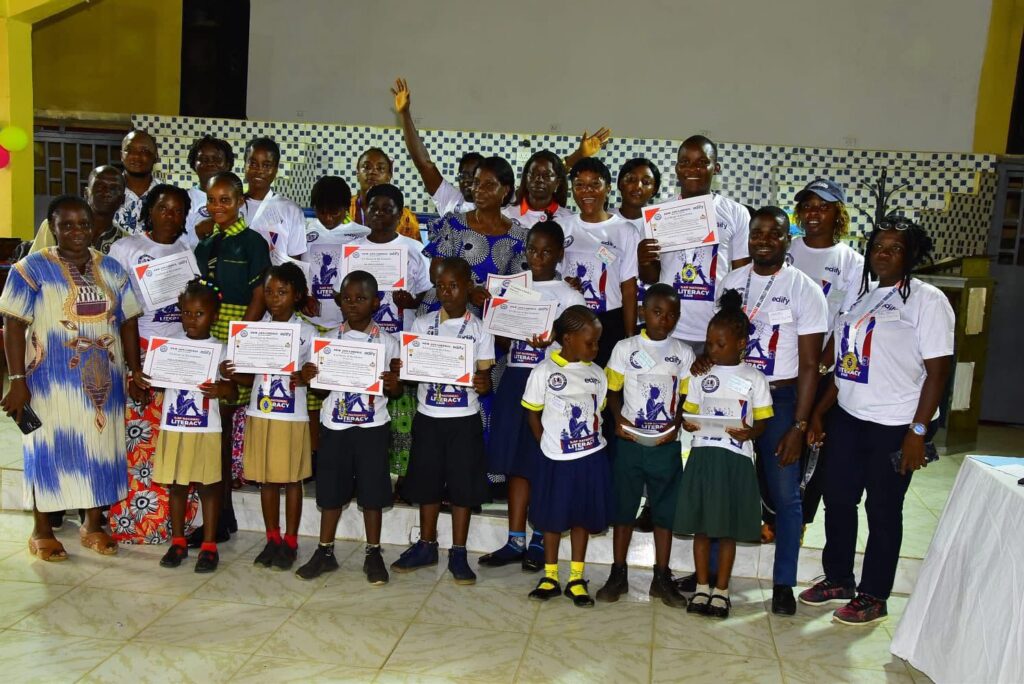
New Joy-Liberia concluded its 2026 ILAP National Literacy Fair over the weekend, assembling 72 students from Grades 1 through 3 and 14 teachers representing 25 schools across Montserrado and Nimba counties. Participants were tested in phonemic awareness, letter-sound correspondence, decoding, reading fluency and comprehension, the foundational skills that determine whether a child can read independently by the time they leave primary school.
The fair is the public face of a broader intervention already running in 94 schools, reaching more than 7,200 students and 288 teachers. Edify, the program’s funding partner, is financing teacher training, instructional materials and the coaching infrastructure that organizers say separates this effort from one-off education events.
“This is about fixing the foundation,” said Precious Joy Teeweh, founder and CEO of New Joy-Liberia. “We believe that when children develop strong phonics and comprehension skills early, they are better positioned to succeed across all subjects.”
Teeweh said the program began with baseline assessments before moving into intensive teacher training, school visits and continuous coaching. The Literacy Fair, she emphasized, is not a standalone event but a measurement and motivation tool embedded in a longer-term strategy.
“It is part of a long-term strategy to build a culture of reading and sustain literacy development across Liberia,” she said.
Edify Country Director Nyanda Biaty Duworko said the organization’s investment is aimed at building systems, not just running programs. Beyond funding materials and training, Edify covers transportation for literacy coaches who work directly with teachers in classrooms, ensuring that instruction stays aligned with the phonics-based approach the program is built around.
“We are investing in literacy because it is the bedrock of any education system,” Duworko said. “By supporting teacher training, providing materials and ensuring continuous coaching, we are helping to build a sustainable model that can improve learning outcomes across schools.”
Early results, education stakeholders say, are encouraging. Board Chair Sir Urias Brooks pointed to improvements in reading fluency and comprehension among participating students as evidence that targeted instruction is working.
“We are seeing children not just reading words, but understanding what they read,” Brooks said. “That is the real measure of progress.”
He traced Liberia’s literacy challenges to weak foundational learning at the primary level — gaps, he argued, that compound over time and are far harder to close the longer they go unaddressed. “If we address those gaps early, we can change the trajectory of learning outcomes in this country,” he said.
School principals echoed that assessment. Joyce Roberts of Haniel and Peniel Foundation School said the program was difficult to implement at the outset but that the results in her classrooms are now visible.
“Students are more confident,” Roberts said. “They can decode words, match sounds and read with better understanding.” She called for the initiative to be expanded and sustained, warning that short-term programs without follow-through rarely produce lasting change.
At the fair, Destiny and Alexander of Dr. Henry Reeves School won the Grade 1 and Grade 2 categories respectively, while Odell of Kids Life Mission School took the Grade 3 prize. In the teacher category, Morrison T. Yahba placed first, followed by Gladys L. Gowedah. Winners received literacy books, learning materials and, in the case of the top teacher, a scholarship to advance in literacy training and serve as a lead trainer within the program.
New Joy-Liberia describes the fair as a pilot, with plans to expand into additional counties. The organization is working with the Ministry of Education to ensure alignment with national education standards, an important detail for a program that ultimately wants its approach adopted at scale.
For Teeweh, the stakes are straightforward. “When a child learns to read early, that child gains the ability to learn independently,” she said. “And that is what will ultimately transform our education system and our country.”





Discussion about this post