


Published: May 4, 2026
At Red Light Market, two women lost their businesses twice in one day — first to flames, then to their neighbors.
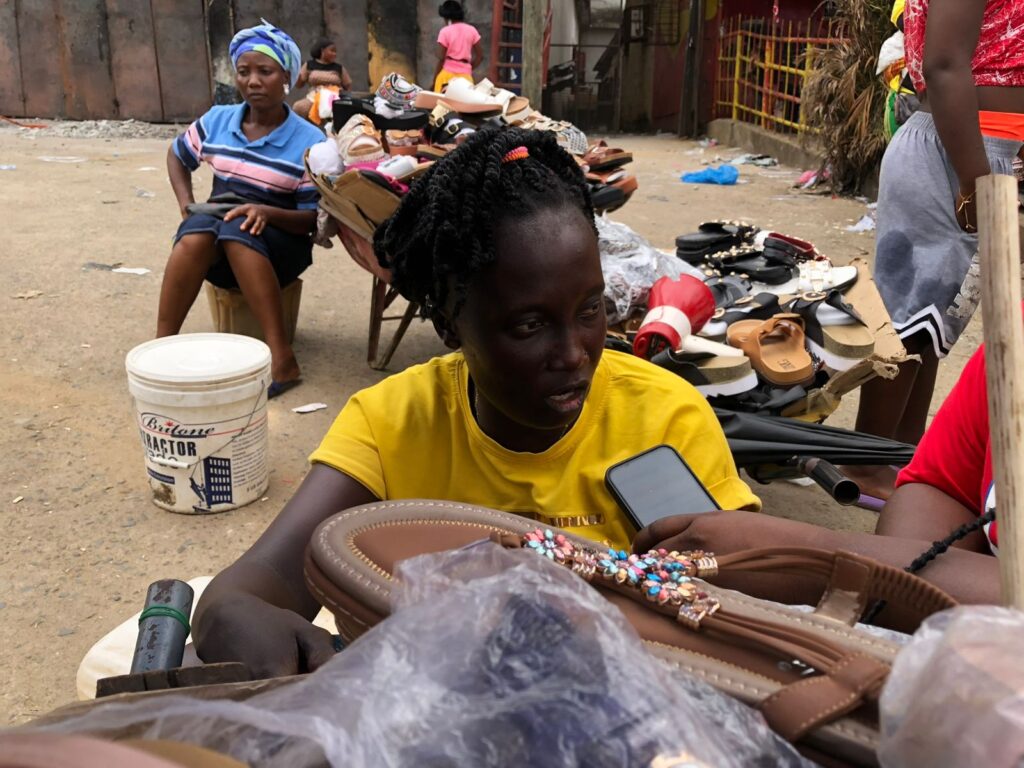
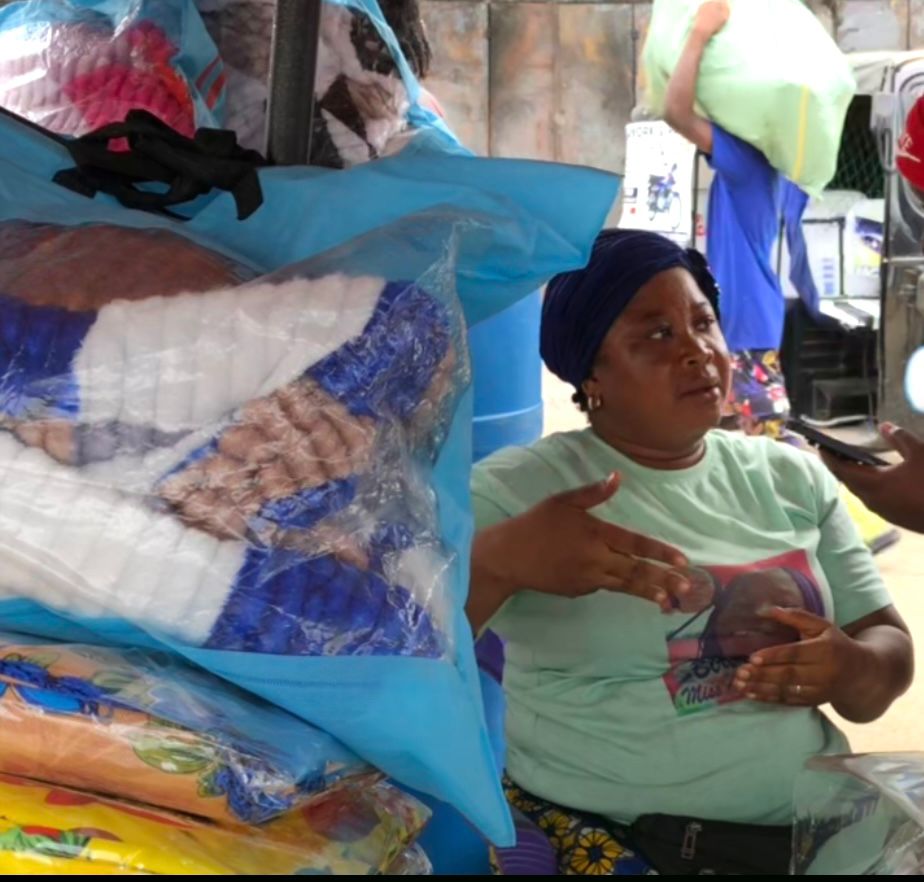
At Red Light Market, the day starts before the sun is fully up.
Women arrive early, arrange their goods on tarpaulins and fold-up tables, and wait. Slippers in rows. Clothes on hangers. Drinks in coolers. Barrels of earphones and ‘AirPods’. It is careful, deliberate work, the kind that does not draw attention but holds households together. For many of these women, what they sell by sundown is what puts food on the table that night. There is no salary, no pension, no cushion. There is only the market.
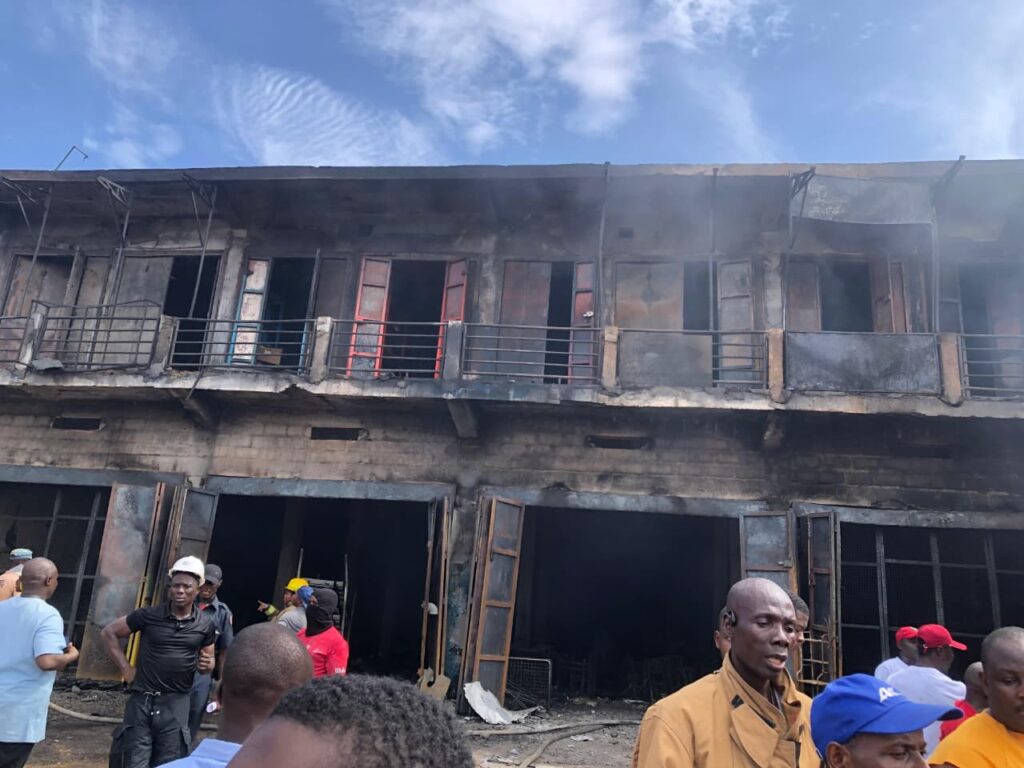
That routine was shattered on last Wednesday morning when fire broke out in a nearby commercial building, and what followed tested not just these women’s livelihoods, but their faith in the people around them.
Esther Harris was behind her slippers table when she heard the shout.
“I was just sitting at my market stand,” she says, “when we heard the store boy from the mattress shop shouting ‘fire!'”
It did not feel catastrophic at first. That is the thing about fires in their early moments, they can look manageable, containable, like something a few pairs of hands can defeat.
“We all ran there trying to help put it out by throwing sand,” Esther recalls. “At that time, the fire was not blazing.”
This is what community looks like at its best, people moving without being told, acting before authority arrives, closing ranks around a shared problem. Inside the mattress store, welding work had been underway, a detail many now believe sparked the blaze.
But fires in tightly packed commercial spaces do not wait. By the time the women realized what was happening, the flames had already found the mattresses.
“Before we knew it, the fire escalated uncontrollably,” Esther says. “It had already entered the mattresses.”
The women turned back. Not out of cowardice, but out of the sudden, sickening awareness that their own goods, their own income, their own families’ stability, were sitting unattended a few meters away. They ran.
What they found when they got back is what none of them expected.
While the fire raged and smoke darkened the sky above Red Light, a second disaster was unfolding at ground level, quieter, deliberate and far more personal.
“While we were rushing back for our market, people started looting,” Esther says, her voice flat. “We that were selling in front of the store really, really lost our businesses.”
The women describe what can only be called a double amputation. First, the fire threatened everything. Then, in the confusion of trying to save what they could, strangers moved in and took the rest.
“When we carried some of our goods and came back for the rest, they had already looted them,” Esther says. “People were just stealing.”
The details she gives are specific, and that specificity is what makes them sting.
A wheelbarrow full of slippers — gone. Her sister’s barrel of ‘AirPods’, taken while her sister ran back to retrieve her son, whom she had left behind in the chaos. A cooler of drinks, carried off.
“She ran with the ‘AirPods’,” Esther says of her sister, “but unfortunately she left her son behind. So while she went back to find her son, they stole her barrel.”
A mother chose her child over her merchandise, and paid for it twice.
A few stalls away, Mariama Sheriff had her own version of the same story.
She had been at her spot since morning, as she always is. She knows the rhythm of that market, who arrives when, what happens at what hour. When she saw the smoke, she knew immediately it was serious.
“Before I knew it, the fire started blazing,” she says.
Mariama believes the cause was electrical, a faulty current connection, not welding. She is certain of it the way only someone who has watched a place closely for years can be certain. But the cause, in the end, mattered less than what followed it.
“They stole almost all my business during the incident,” she says quietly.
She could not return to her spot for two days. There was nothing to return to. When she finally did come back, it was with a loan she had taken out to restock from scratch.
“I had to go take a loan again yesterday,” she says, “to buy my business.”
That sentence carries the full weight of informal sector life in Liberia. There is no insurance payout. No government compensation. No emergency fund. When everything is gone, the only path forward is debt, borrowing against a future that is no more certain than the morning the fire came.
What happened at Red Light that Wednesday was not only a fire story.
It was a story about what people do when the rules briefly disappear, when smoke fills the air and attention shifts and the crowd grows loud enough to hide what hands are doing. Some people threw sand. Some people grabbed barrels.
The women who lost the most were the ones who ran toward the building first.
Esther. Mariama. Others whose names did not make it into any report. They acted on instinct, the instinct to help, and paid for it when they turned around.
They are back at their spots now. Rebuilding with borrowed money and reduced stock, rearranging what little they were able to recover or afford to replace. The market looks, from a distance, the way it always does — busy, loud, alive.
But the women know what it cost to get back here.
“All of us lost our businesses,” Mariama says. “But we thank God we’re still alive.”
Gratitude and grief, in the same breath. That, too, is what surviving at Red Light looks like.






Discussion about this post