


Published: July 2, 2026
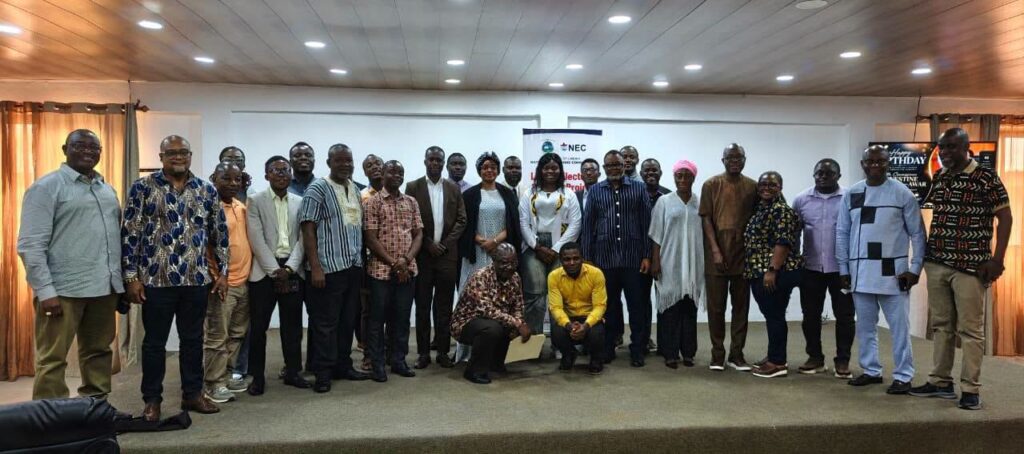
MONROVIA — The National Elections Commission (NEC) has launched a final two-day consultation to review its draft Communications Strategy, Policy and Protocol. The move the Commission says, is intended to strengthen public trust, improve access to election-related information and enhance transparency throughout Liberia’s electoral process.
The consultation, which opened Thursday at the NEC headquarters in Monrovia, brings together election officials, media representatives, development partners and other stakeholders to provide final input before the communications framework is submitted to the NEC Board of Commissioners for approval.
Making remarks on behalf of the Board of Commissioners, Commissioner Ernestine Morgan Awar described effective communication as a critical pillar of the commission’s constitutional mandate to conduct credible, inclusive and peaceful elections.
Awar said the review demonstrates the NEC’s commitment to strengthening institutional transparency, accountability and professionalism while adapting to a rapidly changing information environment shaped by digital technology and social media.
“The review of these documents reflects our commitment to transparency, accountability, professionalism and continuous institutional development,” Awar said.
She noted that timely, accurate and consistent communication is essential to sustaining public confidence in the electoral process and ensuring that citizens receive reliable information throughout every stage of the electoral cycle.
According to Awar, strengthening the commission’s communications framework will also improve its ability to counter misinformation and disinformation, which have increasingly become major challenges for election management bodies around the world.
She emphasized that providing voters, political parties, civil society organizations and the broader public with factual and accessible information is necessary to safeguard the integrity of Liberia’s democratic processes.
The draft Communications Strategy, Policy and Protocol is expected to guide how the NEC communicates internally and externally, standardize public messaging and improve coordination across the institution.
The commission believes the framework will also help ensure consistency in how election information is disseminated during voter registration, candidate nominations, civic and voter education, polling, vote counting and the announcement of election results.
Representing the United Nations Development Programme’s Liberia Electoral Support Project, Roosevelt Zayzay welcomed the initiative and reaffirmed the organization’s commitment to supporting the NEC’s institutional reforms.
Zayzay said effective communication remains a cornerstone of credible elections and commended the commission for taking proactive steps to modernize its public engagement strategy.
He said the UNDP will continue working alongside the NEC as it strengthens its operational systems and enhances transparency in the management of elections.
The consultation also received support from Liberia’s media community.
Julius Kanubah, president of the Press Union of Liberia, called for stronger collaboration between journalists and the NEC while emphasizing the importance of maintaining the independence of the press.
Kanubah said the media would continue to fulfill its responsibility of holding public institutions accountable while ensuring that citizens receive accurate and balanced information about electoral developments.
He urged journalists to maintain professional scrutiny as the NEC continues its work under new leadership, particularly regarding the commission’s engagement with political parties, enforcement of electoral laws and public communication activities.
According to Kanubah, constructive engagement between the media and election authorities is essential to promoting transparency, accountability and public confidence in Liberia’s democratic institutions.
Election observers have long emphasized that transparent communication by electoral management bodies plays a significant role in reducing uncertainty, limiting the spread of false information and strengthening confidence in election outcomes.
The NEC’s latest effort comes as Liberia continues implementing reforms aimed at improving electoral governance and reinforcing democratic institutions.
Officials said recommendations emerging from the two-day consultation will be incorporated into the draft Communications Strategy, Policy and Protocol before the documents are submitted to the Board of Commissioners for consideration and possible adoption.
Once approved, the framework is expected to serve as the commission’s guiding document for internal and external communications, helping to ensure consistent messaging and stronger engagement with citizens and stakeholders during future elections.
Also attending Thursday’s consultation were Commissioner Floyd Oxley Sayor, Executive Director Anthony K. Sengbe, Deputy Executive Director for External Relations Samuel B. Cole, Deputy Executive Director for Operations Emma K. Togba, representatives of development partners, members of the media and staff of the commission.
The consultation is expected to conclude Friday with stakeholders submitting recommendations intended to strengthen the communications framework and further enhance the NEC’s capacity to build public trust through timely, transparent and effective communication.





Discussion about this post