


Published: October 5, 2026
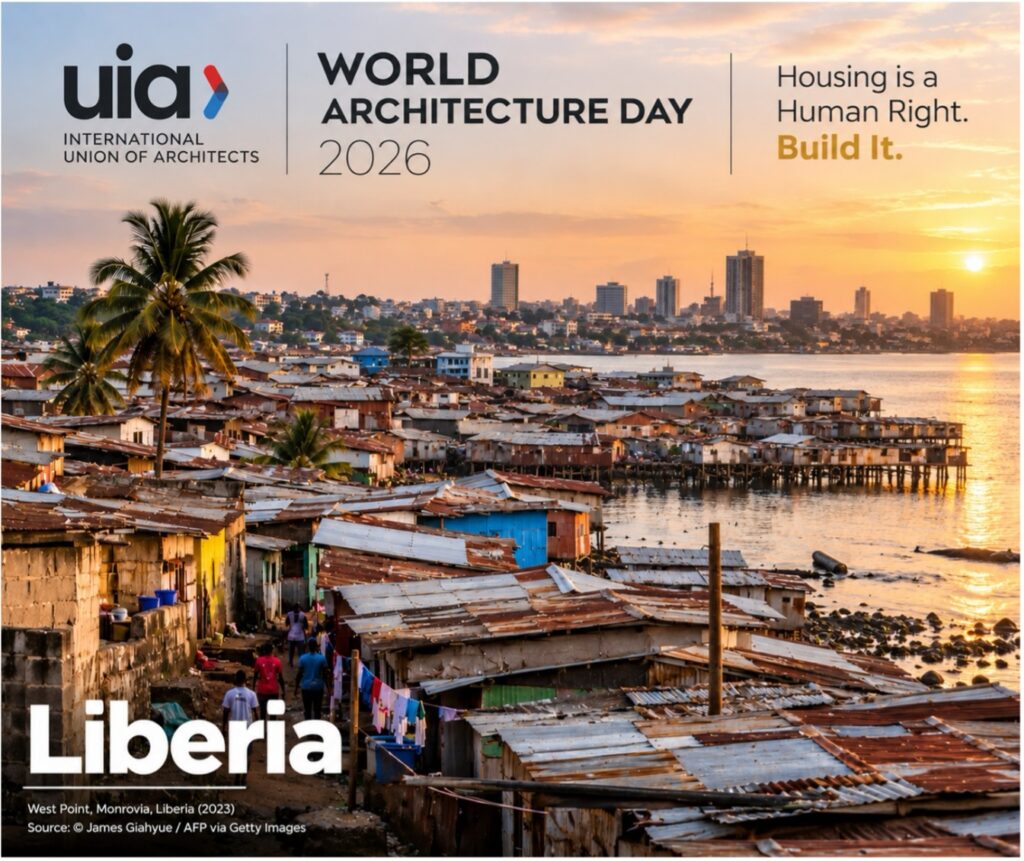
Today, architects all over the world mark World Architecture Day. The International Union of Architects has given this year one theme “Housing is a Human Right. Build It.” The trouble is that a right you cannot reach is not yet a right, it is only a promise. So, before we stand up tomorrow to agree with the United Nations, we owe our own people something harder than agreement. We owe them an honest description of what we are living in right now, in 2026, not a comfortable story from ten years ago. And the honest description begins with a word most of us do not want to hear. Slum.
By B. Garmondyu Zogar, Contributing Writer
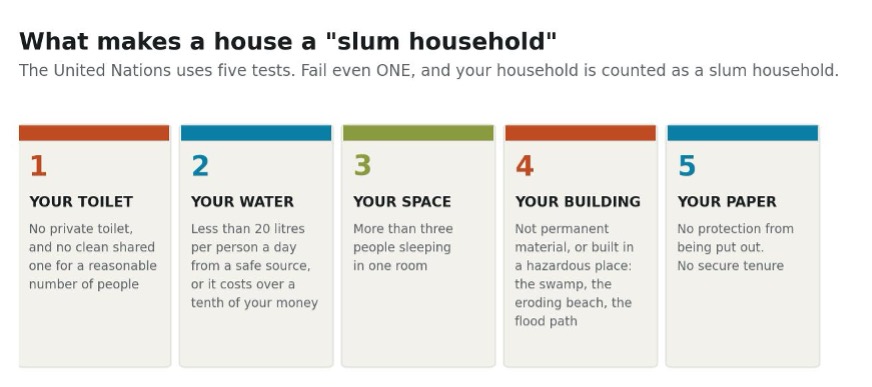
When people say it on radio it sounds like an insult, like they are talking down at us. But it is not an insult. It is a measurement, and the United Nations wrote down exactly what it means. There are five tests or criteria that make you a slum dweller. Fail even one of them, not all five, just one, and the world counts your household as a slum household. First, your toilet: do you have a private one, or at least a clean shared one used by a reasonable number of people? Second, your water: can you get 5 gallons (20 liters) of water per person per day from a safe source, without spending more than a tenth of your household income on it? Third, your space: are more than three people sleeping in one room? Fourth, your building: is it permanent material (concrete or brick house), in a place that is not hazardous, meaning not the swamp, not the beach the sea is eating, not where the water reaches your knee every rainy season? Fifth, your ownership or right to the land, the paper: can anybody put you out next month with nothing to protect you? Read those five again slowly. Then walk outside your own door and count how many of your neighbors would fail three of them.
Now the scale, from our own count and the world’s. Our 2022 National Population and Housing Census put Liberia at 5,248,621 people in 1,187,388 households, an average of 4.4 people per household, with Montserrado County alone holding 1,920,914, about 37 percent of us. Against that, the United Nations slum indicator for Liberia stands at 60.5 percent of the urban population as of 2022. Do the arithmetic on our own census and you will find that roughly 1.73 million Liberians in slumconditions. And taking a closer look at how it slowly it is moving, the same indicator was 67.5 percent in 2014, and eight years later, we had improved by less than one percentage point a year. Meanwhile, a study published this year, from fieldwork done in August 2024, counts about 75,000 people in West Point and over 70,000 in New Kru Town. So, when the radio says “the slum communities,” understand what is being said is not about describing a corner of Monrovia. They are literally describing how most urban Liberians live.
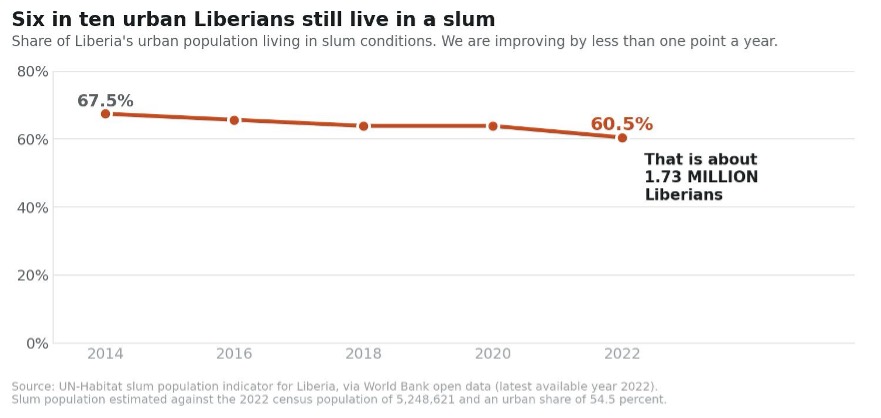
Figure 2: Share of Liberia’s urban population living in slum conditions. Source: UN-Habitat slum indicator via World Bank open data; population from the 2022 census.
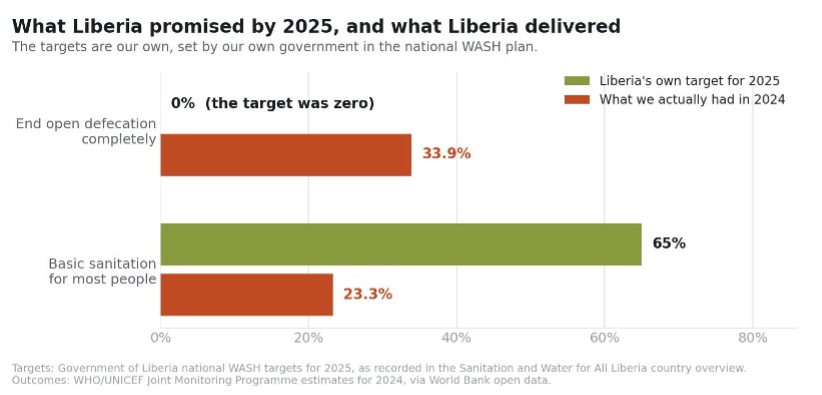
Take the toilet and the water indicators, because those two tell you everything, and here the newest numbers are worse than people assume. The WHO and UNICEF Joint Monitoring Programme estimates for 2024 shows that only 23.3 percent of Liberians had even basic sanitation, meaning an improved toilet not shared with other households. It also disclosed that 33.9 percent of us (about 1.8 million people), were still practicing open defecation, and 21.2 percent had no basic drinking water. Liberia’s national WASH targets committed this country to eliminating open defecation completely by 2025 and reaching 65 percent basic sanitation by 2025. The year 2025 has come and gone. We reached a third of the sanitation target and we did not come close on the other. The funding tells the same story: our own sector plan put the cost of meeting the water and sanitation goal by 2030 at about US$201 million a year, against actual disbursements of roughly US$37 million a year.
And here is the part that should settle the question of whose fault this is, in the government’s own words and this year. In April 2026, announcing Liberia’s first structured mortgage programme with LBDI, Bloom Bank, Ecobank and NASSCORP, the National Housing Authority stated plainly that long-term financing has remained extremely limited, that most Liberians therefore rely on “personal savings or informal means,” and that this often results in “incomplete or substandard housing.”
In July 2026 the same Housing Authority told the public it had asked the Government for US$16,813,800 to build 600 homes and received nothing, having been given US$24,000, then US$30,000, then US$300,000 across three budget periods. What we call informal settlement is not disorder. It is currently the only housing delivery system in this country that actually delivers.
So let us end with the arithmetic nobody wants to do. Take our own rate of progress since 2018 and run it forward. At this current speed of progress, Liberia ends open defecation in 2062, sees its last slum disappear in 2091, and gives every citizen a basic toilet in 2161. That is what “Housing is a Human Right. Build It.” means here if we keep going exactly as we are.
“Build it” cannot mean another ground-breaking ceremony for architects, engineers, built environment professionals, policy makers and the Government of Liberia. It has to mean the five tests, taken one at a time. Build the toilet, because three in four of us have none worth the name.
Build the drain and the water line. Build a road the ambulance can pass. Build a building code a working man can legally follow one room at a time, instead of one that pushes him outside the law the day he mixes his first mortar. And build the paper, the secure title and the honest tenancy, because a man who fears being put out will never invest in the house, he lives in. Get those five right and the slums stop being slums, by the world’s own definition, without us having to move a single family.
SOURCES
- Bah, Mohammed W., and Nicola Ulibarri. “Climate Resilience and Collective Action in Monrovia’s Coastal Communities.” Progress in Disaster Science 30 (2026): 100579.
- International Union of Architects. World Architecture Day 2026: Housing Is a Human Right. Build It. UIA, 2026.
- Liberia Institute of Statistics and Geo-Information Services. 2022 National Population and Housing Census. LISGIS, Monrovia, 2023.
- The New Dawn. “NHA, Partners to Introduce First Mortgage Program for Liberian Developers.” Monrovia, 1 April 2026.
- The New Dawn. “Liberia’s Housing Crisis Deepens as US$16.8M Project Goes Unfunded.” Monrovia, 23 July 2026.
- Sanitation and Water for All. Liberia Country Overview 2022. SWA Partnership, 2022.
- UN-Habitat. Metadata for Sustainable Development Goal Indicator 11.1.1: Proportion of Urban Population Living in Slums, Informal Settlements or Inadequate Housing. United Nations Statistics Division.
- World Bank. World Development Indicators: Liberia. Slum population, UN-Habitat estimates, 2022; water, sanitation and open defecation, WHO/UNICEF Joint Monitoring Programme estimates, 2024.
- Author’s calculations. The estimate of 1.73 million slum residents, and the projected years 2062, 2091 and 2161, are straight-line arithmetic on the sources above.




Discussion about this post