


Published: April 23, 2026
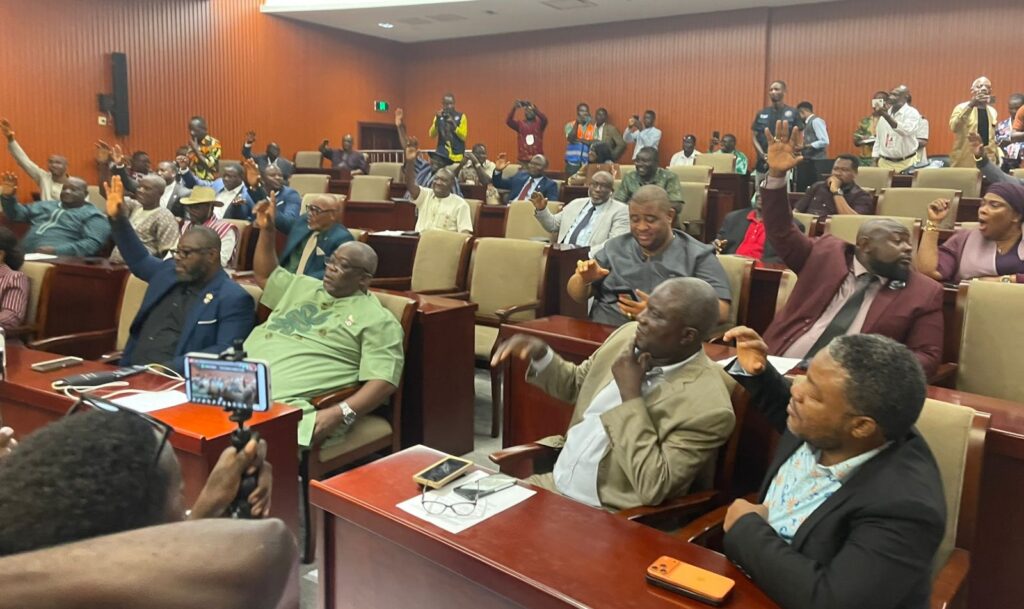
CAPITOL HILL, Monrovia — The House of Representatives passed a $53 million supplementary budget for Fiscal Year 2026 in a late-night session on Thursday.
The budget, crafted by the joint committees on Ways, Means, and Finance, and Public Accounts and Expenditure, is funded primarily by $40 million in World Bank budgetary support recorded in Fiscal Year 2025, supplemented by $5 million in excess domestic revenue and an additional $8 million from the World Bank as bonus due to the budget’s over-performance, according to lawmakers.
Lawmakers said the recast plan is designed to stabilize payroll systems, sustain public service delivery, and direct targeted funding into critical sectors without expanding the overall fiscal framework beyond what confirmed revenues and partner commitments can support.
The figure itself shifted during deliberations. The initial proposal stood at $45 million before adjustments tied to confirmed revenue figures and partner commitments pushed the final envelope to $53 million.
Public administration received the largest single allocation at $14.55 million, directed at maintaining core government operations, supporting fiscal management systems, meeting international obligations, and clearing arrears. Security and rule of law follow at $8.43 million, covering the Armed Forces of Liberia, the Liberia National Police, and other security institutions. Infrastructure and basic services were allocated $9.57 million for public transport improvements, heavy equipment deployment and infrastructure rehabilitation. Health received $8.32 million, and education received $7.25 million. Smaller appropriations cover social development at $1.7 million, local government at $1.3 million, and energy, environment, agriculture, municipal services and transparency initiatives.
Rep. P. Mike Jurry, Chairman of the House Committee on Ways, Means, Finance and Budget, said the process was as rigorous as the public had a right to expect. “At the opening of the budget, I promised the Liberian people that we were going to ask all the hard questions,” he said. “It was not an easy journey, but we had to ensure that every line in this budget was justified.”
Jurry pushed back directly against public skepticism about supplementary budgets, which critics have questioned as vehicles for discretionary or poorly justified spending. “When we say supplementary, it means there was excess from previous performance,” he said. “That excess must be incorporated into the current fiscal framework to address pressing needs.” The committee report described the budget as a reallocation driven by stronger-than-expected revenue performance rather than new borrowing or deficit expansion.
On the allocation priorities, Jurry said, “We looked at where the needs are most pressing,” he said. “Security, health, and education directly impact the daily lives of Liberians, and that is where intervention is most critical.”
He also pointed to improved revenue collection as a signal of broader fiscal progress. “With the work being done by the Ministry of Finance and the Liberia Revenue Authority, we expect continued growth,” he said. “This is just the beginning.”
The passage closes the Legislature’s special session, which was convened specifically to address the emerging fiscal adjustments.





Discussion about this post