


Published: September 23, 2026
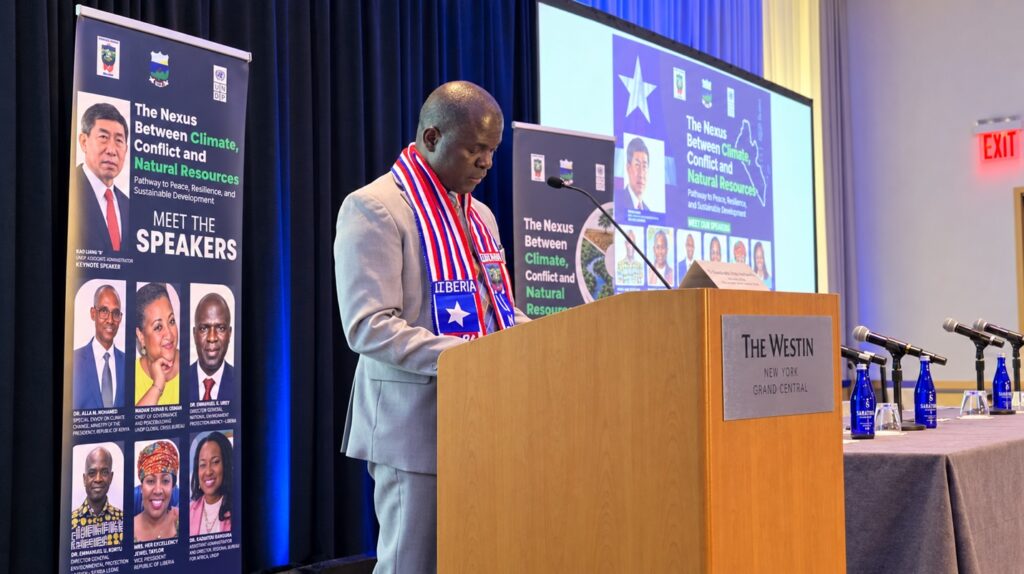
NEW YORK – Liberia’s environmental chief warned Wednesday that the country’s peace depends on confronting the climate pressures bearing down on its forests, rivers, fisheries and coast, as the government used its seat on the U.N. Security Council to push climate change onto the global security agenda.
By Lennart Dodoo
Dr. Emmanuel K. Urey Yarkpawolo, executive director of the Environmental Protection Agency of Liberia, said climate finance must reach the communities that protect those resources if Liberia is to hold on to what he called one of its greatest achievements. He spoke while opening a side event in New York during U.N. General Assembly week, organized by the EPA with the U.N. Development Program under the banner of Liberia’s 2026-2027 term on the council.
“Climate action cannot be separated from peacebuilding. Natural resource management cannot be separated from justice, transparency, community participation, sustainable livelihoods,” Dr. Yarkpawolo said.
He said climate change does not automatically cause conflict but acts as a threat multiplier, worsening poverty, food insecurity, displacement, inequality and competition over essential resources. “Where institutions are weak, or communities are excluded from decision-making, these pressures can contribute to tension and instability,” he said. He said Liberia believes climate-related risks deserve serious, balanced attention on the council, and that women, young people, and local communities must help shape solutions and share in their benefits.
The government also laid out how it intends to pay for that protection. Hon. Jeanine M. Cooper, chief executive officer of the Liberia Carbon Markets Authority and presidential envoy on climate action, said her agency has begun registering carbon projects and wants Liberia paid for the climate services its forests provide.
“The idea now is to shift the national discourse from viewing Liberia only through a conservation and protection lens, but to seeing it as a source for high integrity nature-based solutions that continue to combat climate change and to get paid for that,” Cooper said.
She said the authority presented the National Carbon Policy to the president a few weeks ago and has spent 2026 building the digital infrastructure, regulations, and valuation systems needed to determine the carbon value of a given piece of land. She said President Joseph Boakai created the authority to turn Liberia’s natural wealth into equitable revenue and that the country was among the first to integrate its forests, mangroves, 579-kilometer coastline, rivers, rainfall, and sunshine into a single natural capital framework.
“There are peace dividends that have to arrive long before a single carbon credit is sold, because the climate action itself can remove the reason for conflict between communities when it’s handled correctly,” she said. Asked for one recommendation to global leaders, she said: “We’re not interested in branding ourselves as a victim. We’re not interested in branding ourselves anymore as looking for handouts.”
The human cost came from Madam Oretha Juah-Bestman-Yates, assistant minister for human resources at the Ministry of State for Presidential Affairs, who said the coastal community where she grew up no longer exists.
“Coastal erosion gradually consumed the land, home by home,” she said. “The ocean did not simply take houses or pieces of property. It took a community, our history, our neighbors.”
She said her late daughter, after seeing erosion destroy property in West Point in 2008, told her, “Mommy, I want to change the narrative,” and went on to study environmental science and engineering before her life was cut short in an automobile accident. She said the church where she began pre-kindergarten was lost to the sea, and that its members recently built a new one further inland, “but even after moving away from the coastal land, the ocean is still coming.”
“My daughter cannot return, but we can still protect what remains,” Juah-Bestman-Yates said, calling for coastal protection, flood control, early warning systems and support for relocation. “Do not wait until the ocean takes everything.”
Opening remarks delivered on behalf of Foreign Minister Sara Beysolow Nyanti said Liberia has made climate security and peacebuilding priorities on the council. “The climate crisis is global, but its consequences are local. Our responsibility is shared, but our capacities are not equal,” the remarks said.
Haoliang Xu, U.N. under-secretary-general and associate administrator of UNDP, said in his keynote that “Liberia only constitutes 0.03% of global emissions,” yet its latest national climate plan, NDC 3.0, aims to cut economywide emissions by 64%. He said UNDP supported both that plan and Liberia’s national adaptation plan.
“Peace and security considerations feature in 41% of third-generation NDCs, rising to 70% among NDCs submitted by countries in fragile contexts,” Xu said, adding that the task now is implementation and getting finance to fragile settings. He opened by saying he was uncomfortable that his photograph had been displayed above those of African leaders.
Daniel Kandy, climate and environmental policy specialist at Australia’s Minderoo Foundation, warned that the world will likely cross the 1.5-degree warming threshold this year. He said foundations are being asked to fill gaps left by falling development aid, but “foundations will never be able to replace governments, and they really shouldn’t.”
Ambassador Dr. Ali Daud Mohamed, Kenya’s special envoy for climate change and a former chair of the African Group of Negotiators, said that about 80% of Kenya is very dry and that drought drives conflict between farmers and herders over water and land. “We should not be asked to choose and we do not need to choose,” he said about climate and growth, urging investors to treat resilient infrastructure as an investment. “It costs a little more today. It saves far more tomorrow by avoiding crises and preserving peace.”
Nana Dr. Antwi-Boasiako Amoah, chair of the African Group of Negotiators and a director at Ghana’s Environmental Protection Authority, said climate security is gaining ground in U.N. climate talks despite resistance. “There are groups who are actually shooting it down, thinking that it is not of relevance in this conversation,” he said. He described a stretch of Ghana’s coast where a community had washed away, leaving one building standing because its foreign owner could afford a sea defense. “Equity is at the center of climate change,” Dr. Amoah said.
Colorado state Rep. Naquetta Ricks, a Liberian American and president of the African Chamber of Commerce Colorado, urged Liberia to treat its resources “not simply as commodities to extract, but as productive assets,” but said weak oversight undercuts that. “Liberia does lack the infrastructure to really go there and examine what’s going on and to really monitor and take people out of the forest if they’re doing things that are illegal,” she said. She said diaspora Liberians want accountability before investing and called for “more direct, flexible financing that actually goes beyond the government, but to sub-national and community institutions.”
During questions moderated by Francine Pickup, UNDP deputy assistant administrator, a Liberian audience member noted that more than 70% of Liberia’s population is young. “I would have loved to have seen a young person on this panel as well,” the audience member said. A second questioner asked what the government and UNDP are doing to get funding to grassroots groups working on sea erosion and deforestation.



Discussion about this post