


Published: September 23, 2026
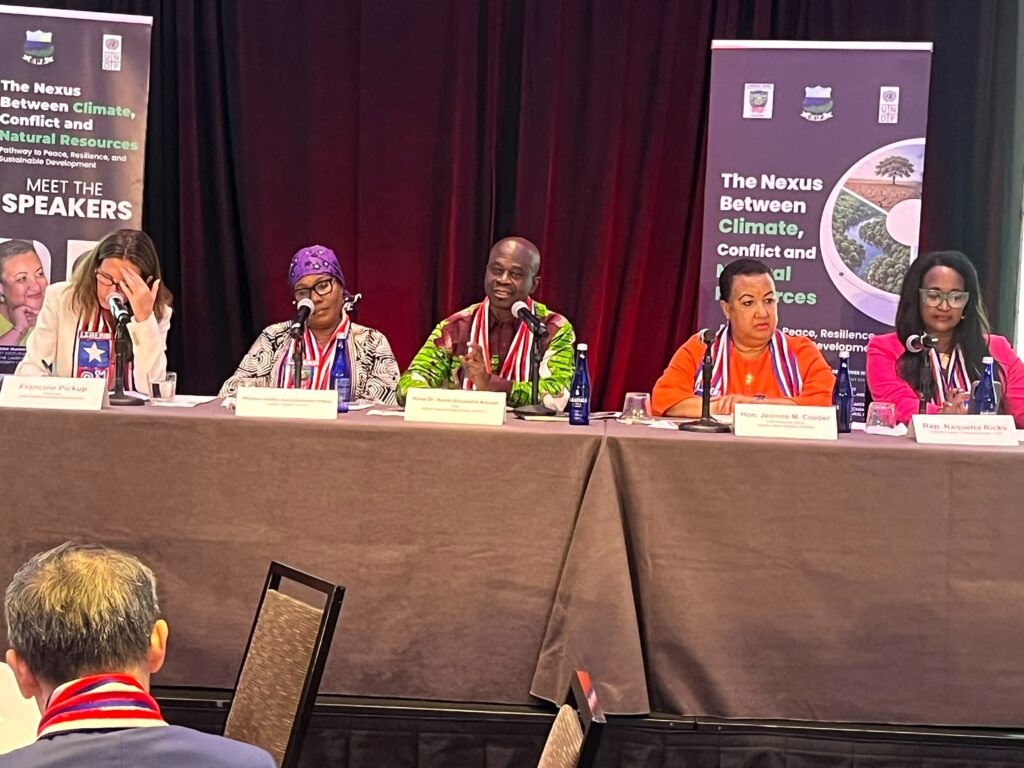
NEW YORK, United States – Liberia is moving to turn its forests, mangroves, coastline and rivers into a source of climate finance that pays communities for protecting them. The Liberia Carbon Markets Authority has begun registering carbon projects and has presented the country’s National Carbon Policy to President Joseph Boakai.
Hon. Jeanine M. Cooper, chief executive officer of the authority and presidential envoy on climate action, set out the plan Wednesday at “The Nexus Between Climate, Conflict and Natural Resources,” a high-level forum convened in New York by the Environmental Protection Agency of Liberia with the U.N. Development Programme during the U.N. General Assembly.
“The idea now is to shift the national discourse from viewing Liberia only through a conservation and protection lens, to seeing it as a source for high-integrity nature-based solutions that continue to combat climate change and to get paid for that,” Madam Cooper said.
Madam Cooper said President Boakai created the authority and mandated it to channel Liberia’s natural wealth into new and equitable revenue streams that strengthen the resilience of its people. Under that mandate, she said, Liberia became one of the earliest countries to bring its green and blue assets into a single natural capital framework: its forests, mangroves, unique biodiversity, 579-kilometer coastline, river systems, rainfall and sunshine. She described Liberia as West Africa’s most important carbon sink and biodiversity hotspot, with forests the country has preserved for centuries.
Throughout 2026, Madam Cooper said, the authority has built the digital infrastructure and regulatory frameworks for a carbon market that covers not only forests but also most of the country’s environmental assets. It has also built valuation systems to transparently determine what a given piece of land holds and the carbon value it contains. She said Liberia is preparing to attract investment that puts community benefits at the forefront and is building on its capacity for green industrialization, including biofuels and green iron ore.
Madam Cooper said the authority works with the Forestry Development Authority, the Environmental Protection Agency and the Ministry of Finance and Development Planning, under direct reporting lines to the president. She said it has begun registering projects and promoting nature-based solutions with benefit-sharing mechanisms that put people first.
She said the approach is built for peace as much as for revenue. “Liberia is treating natural capital as peace infrastructure at every level, not just the sovereign one. We recognize that peace in Liberia is often local before it is national,” Cooper said. “There are peace dividends that have to arrive long before a single carbon credit is sold, because the climate action itself can remove the reason for conflict between communities when it’s handled correctly.”
Cooper said Liberia is presenting itself to the world as a provider of solutions rather than a recipient of aid. “We’re not interested in branding ourselves as a victim. We’re not interested in branding ourselves anymore as looking for handouts,” she said. “We want to be seen as a source of high integrity, high value, nature-based solutions to the problems of global warming.”
Speakers at the forum echoed the case for investing in Africa’s natural capital. Haoliang Xu, U.N. under-secretary-general and associate administrator of UNDP, noted that Liberia accounts for 0.03% of global emissions. He said the country’s third-generation nationally determined contribution, prepared with UNDP support, targets a 64% cut in economywide emissions.
Ambassador Dr. Ali Daud Mohamed, Kenya’s special envoy for climate change, urged investors to treat climate resilience as an investment, not charity. “Africa is ready to build this way. We are asking for partners who will do it with us,” he said.
Colorado state Rep. Naquetta Ricks, a Liberian American and president and co-founder of the African Chamber of Commerce Colorado, pointed to “carefully governed carbon and biodiversity financing” as part of a broader forest economy for Liberia. She said that economy should also include agroforestry, non-timber forest products, ecotourism and restoration enterprises.
Dr. Emmanuel K. Urey Yarkpawolo, executive director of the EPA, told the forum that climate finance must reach the communities that protect forests, biodiversity and water resources.






Discussion about this post