


Published: October 9, 2026
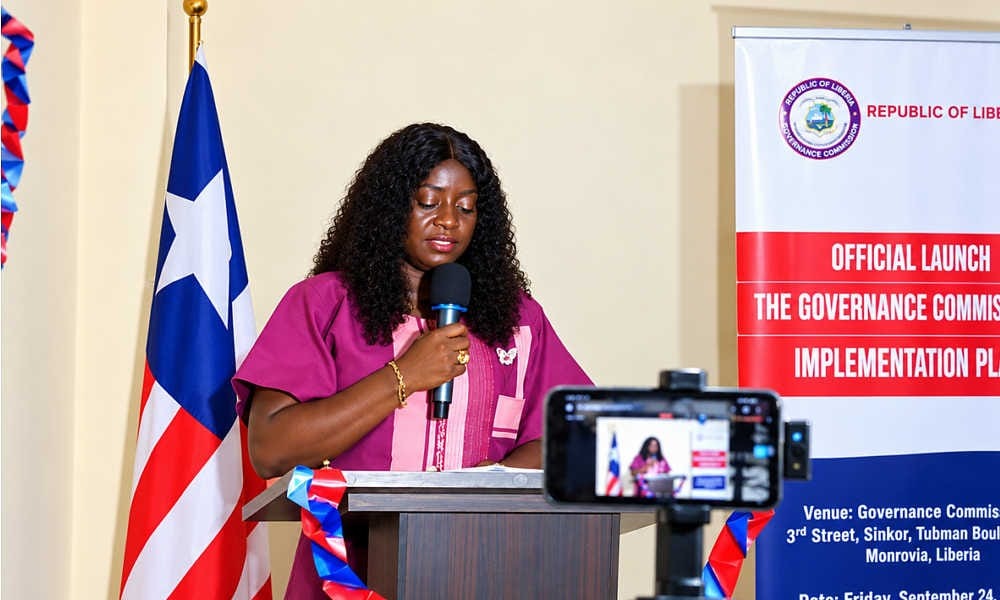
MONROVIA — Ten years after the government and civil society signed an accord to work together, a new strategy commits the government to draft legislation to protect civic space and establish a trust fund for civil society organizations.
By Blamo N. Toe
The Governance Commission launched the Government of Liberia-Civil Society Organizations Accord Partnership Policy Framework Implementation Strategy in Monrovia. Liberia Revenue Authority Commissioner General James Dorbor Jallah, who formally launched it, said the strategy assigns responsibilities and sets deadlines, financing requirements and ways to measure results.
“Let us be honest with ourselves. A signed accord is just a promise. An accord implemented is a partnership. For 10 years, we have had a promise. This strategy is the bridge to the partnership,” Jallah said.
According to Jallah, the strategy also commits the parties to produce a third volume of the national directory of civil society organizations and to hold an annual national partnership summit. It creates a Partnership Policy Technical Working Group that will meet quarterly. It also establishes an appeal board whose decisions will bind the government institutions and civil society organizations involved.
Jallah said the government, development partners and civil society will finance the strategy. He warned that declining foreign aid makes domestic revenue increasingly important.
The accord grows out of consultations that began in 2006 between civil society groups, the former Ministry of Planning and Economic Affairs and the Governance Reform Commission, Jallah said. It was signed in April 2016.
Cytrus K. Kerbay, the commission’s commissioner for civic engagement, national identity and visioning, said the commission, the National Civil Society Council, the Ministry of Internal Affairs and the Ministry of Finance and Development Planning drew up the strategy together.
“How do we operationalize the GOL-CSO Accord Partnership Policy Framework and turn our commitment into action? Today, we have an answer,” Kerbay said.
“A partnership that remains on paper cannot change a nation. A partnership that moves to action can,” he said.
Kerbay said each side has a role. “Government must create the space for meaningful participation. Civil society must bring citizens’ voices and priorities into the national development process. Development partners must help strengthen capacity and sustain partnership,” he said.
Alaric Tokpa, the commission’s acting chairman, said civil society had pushed the government toward accountability and filled gaps when state institutions failed.
“When we look back at the work that civil society has done in Liberia, civil society has played a very, very important role in this country, encouraging government to become accountable, providing social services when there was a breakdown of national government institutions,” Tokpa said.
He said relations between the two sides had at times been confrontational, but that those encounters helped promote transparency. “Having the accord, the agreement on cooperation is one thing. Activities performed jointly or separately are another thing. But of course, the implementation of the accord is also a very, very important thing,” he said.
The commission said the strategy supports Pillar Four of the government’s ARREST Agenda for Inclusive Development, which covers governance and anti-corruption.
Jallah also used the launch to warn civil society organizations that nonprofit status does not exempt them from statutory tax obligations, including withholding and remitting employees’ taxes.
“I say this not as a threat, but as a point of credibility. It is difficult to demand accountability from government when our own house is not in order,” he said.
He also warned against abuse of duty-free privileges meant for humanitarian work. “Duty-free goods meant for a clinic in Lofa must reach that clinic,” Jallah said.
Jallah said the authority will expand taxpayer education to all 15 counties with the National Civil Society Council, improve tax registration and compliance among nonprofits, and process legitimate exemptions through transparent procedures. He urged civil society groups to report misconduct by revenue officers.
“If you see integrity failures, report them. A revenue authority that the public trusts is a revenue authority that collects more fairly,” he said.
Jallah also set out four priorities for raising annual revenue beyond US$1 billion. First, replacing the Goods and Services Tax with a Value Added Tax on Jan. 1, 2027. The others are strengthening real estate tax collection, tackling undervalued and misdeclared imports, and modernizing revenue systems.
He said the authority will upgrade its customs and tax administration systems, ASYCUDA and LITAS, and connect them with commercial banks and the Central Bank of Liberia. The authority is also working with the Governance Commission on public education ahead of the VAT switch.
“Every container declared below its true value is a classroom not built,” Jallah said.







Discussion about this post