


Published: July 24, 2026
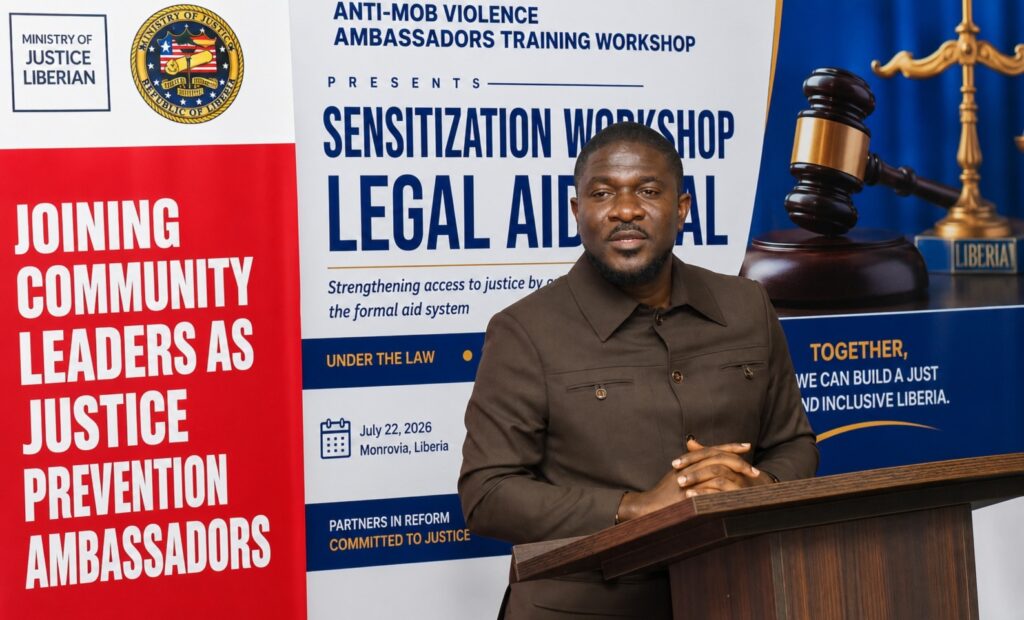
MONROVIA – Special Assistant to the Minister of Justice and Attorney-General, Cllr. Oswald N. Tweh, Atty. Siafa Bahn Kemokai II has issued a strong warning against mob violence, declaring that no accusation, public anger or crowd has the legal authority to replace the courts, while cautioning that mob justice can kill innocent people, destroy evidence and leave communities with more victims than answers.
Speaking Wednesday, July 22, during the Federation of Liberian Youth’s Anti-Mob Ambassadors training, organized in collaboration with the Ministry of Justice in Monrovia, Kemokai delivered a legal and constitutional presentation emphasizing that due process—not public outrage—must guide the administration of justice in Liberia.
Kemokai reminded participants that suspicion alone is never proof of guilt.
“An accusation is not evidence, suspicion is not conviction, anger is not authority, and a crowd is not a court,” he declared.
He stressed that the 1986 Constitution guarantees equal protection under the law to every individual, including those accused of committing crimes.
Quoting Articles 20 and 21 of the Constitution, Kemokai noted that no person can be deprived of life, liberty, security or property except through due process of law.
“These rights are not technical favours granted to criminals. They are safeguards against mistakes, revenge, false accusations and abuse of power,” he said.
The public administration expert further explained that the constitutional presumption of innocence remains one of the country’s most important legal safeguards.
“Until guilt is proven beyond a reasonable doubt before a competent court, the person remains legally innocent. The community may have questions, the police may have reasonable grounds to investigate, the prosecution may have evidence to present, but only the court may pronounce guilt and impose punishment. That distinction is the foundation of justice.”
Kemokai cautioned against interpreting every act of fleeing as evidence of guilt, recalling the Supreme Court’s decision in Saah James v. Republic of Liberia.
According to him, the Court recognized that a person may flee not because he committed a crime but because he fears being killed by an angry mob.
“This is an important lesson. Behaviour that looks suspicious in the heat of the moment may have an innocent or reasonable explanation. That is precisely why evidence must be examined calmly and lawfully,” he explained.
He also warned that individuals who encourage or participate in mob attacks cannot escape legal responsibility simply because they acted as part of a crowd.
“When someone shouts, ‘Kill him,’ hands a stick to another person, closes a gate to prevent escape, or helps drag the victim back into the crowd, the law may not treat that person as an innocent observer,” he said, adding that “a crowd does not erase individual responsibility.”
Beyond criminal prosecution, Kemokai warned that those involved in mob attacks may also face civil liability.
He explained that victims or their families may seek compensation for medical expenses, loss of income, permanent disability, pain and suffering, damaged property and wrongful death.
“The same conduct may therefore lead to both a criminal case and a civil action. A person may be prosecuted by the Republic for assault or homicide and may separately be sued by the victim or the victim’s family for monetary compensation,” he said.
Addressing what he described as one of Liberia’s most misunderstood legal concepts, Kemokai clarified that a citizen’s arrest does not authorize private citizens to assault or humiliate suspects.
“It is not permission to punish a suspect. It is not a right to beat someone until he confesses. It is not a right to parade a person naked. It is not a right to interrogate, torture or imprison someone in a private building. It is not a right to seize a person merely because someone shouted ‘rogue,'” he said.
He noted that Liberia’s Criminal Procedure Law primarily grants arrest powers to peace officers and other officials authorized by law and requires that no unnecessary or unreasonable force be used during an arrest. He added that while the Penal Law permits the use of force in limited circumstances during a lawful arrest, deadly force is subject to strict legal restrictions and is never a general power available to a private crowd.
Kemokai challenged the newly trained Anti-Mob Ambassadors to become defenders of lawful justice rather than participants in mob violence.
“You should encourage people to raise an alarm without inciting violence. You should contact the police. You should help protect the complainant, the suspect and the scene. You should discourage people from touching weapons, stolen property or other possible evidence. You should obtain the names and contact details of witnesses,” he advised.
He also urged participants to discourage the irresponsible circulation of photographs and videos that humiliate victims or accused persons.
“Above all, you should remind the crowd that handing a suspect to the police is not weakness. It is obedience to the law,” he said.
Kemokai emphasized that while the law may authorize authorities to restrain suspects, only the courts have the constitutional authority to impose punishment.
“Mob justice is sometimes presented as community protection. In reality, it leaves the community with more victims, more crimes and fewer answers. It can kill an innocent person. It can destroy evidence against a guilty person. It can turn witnesses into defendants. It can leave children without parents and families without providers. And it teaches young people that the loudest crowd, rather than the law, decides who deserves to live,” he warned.
Maintaining that mob violence can never substitute for justice, Kemokai added: “Justice is deliberate. Justice listens. Justice examines evidence. Justice gives the accused an opportunity to answer. Justice protects the victim without abandoning the Constitution. Justice punishes only after guilt has been lawfully established.”
He concluded by urging the anti-mob ambassadors to remain courageous in defending the rule of law, even in the face of public pressure.
“When you stop a mob, you do not know only whose life you may be saving. You may also be saving members of that same crowd from imprisonment, civil claims and a lifetime of regret,” he said.






Discussion about this post