


Published: June 24, 2026
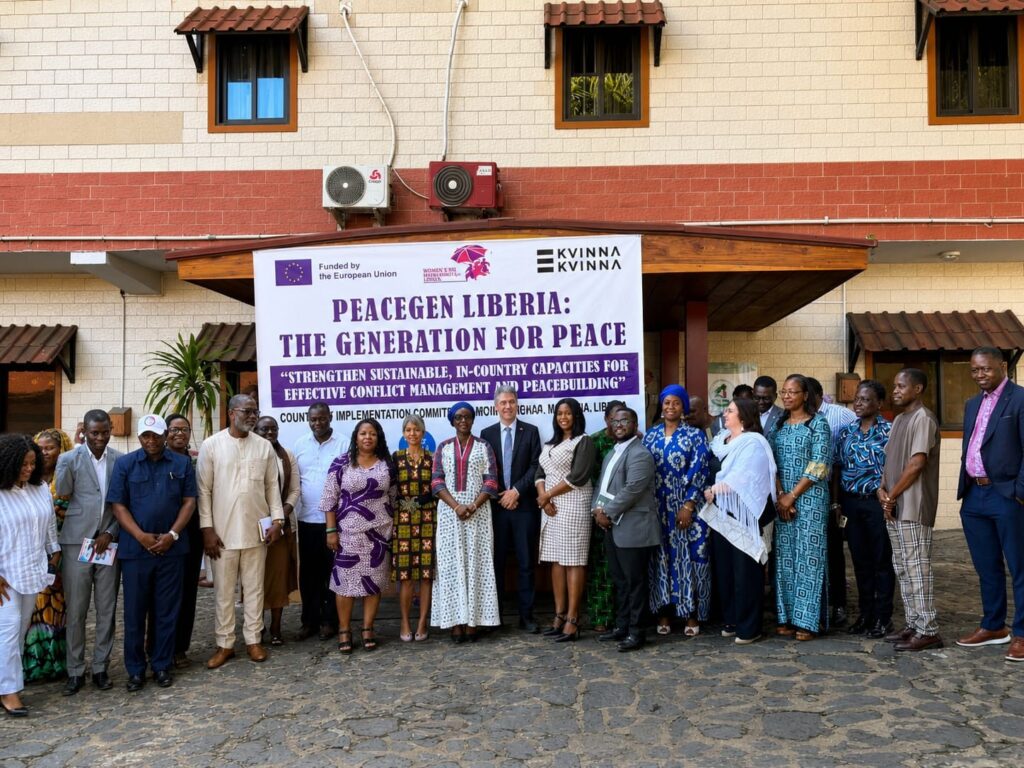
MONROVIA – A European Union and Embassy of Ireland-funded project that seeks to put women and young people at the center of Liberia’s peacebuilding and transitional justice work launched in Monrovia on Tuesday, with its chief launcher challenging the organizers to take young Liberians face-to-face with President Joseph Nyuma Boakai.
Dr. Cllr. Jallah A. Barbu, Executive Director of the Office for the Establishment of the War and Economic Crimes Court in Liberia, made the demand the centerpiece of his keynote at the launch of the PeaceGen Project, telling implementers that the initiative would prove its worth only if it opened a direct line between the country’s youth and its presidency.
“I expect to see or at least to hear that the PeaceGen project brought together young people and the president of the republic face to face,” Barbu said, “so they tell the president what they are going through. They tell the president what they expect of his government. They tell the president what could make Liberia better.”
Barbu, who said he had accepted no other role at the ceremony than that of chief launcher, argued that executive attention is the surest route to results in Liberia. “Liberia is a presidential country,” he said, repeating the phrase for emphasis. “When the president speaks, the nation moves.” He recounted episodes from his student days, when presidential visits to campus produced swift government action on student complaints, to illustrate the point.
If the president committed to placing young people in the national budget or to meeting them monthly, Barbu said, those commitments would hold. He urged the organizers to act as the conduit. “You and your team must ensure that you break the doors open so that we let the president hear from the young people,” he said, insisting the message reach the president “not from the media, but from them directly.”
The PeaceGen Project is funded by the European Union with co-funding from the Embassy of Ireland in Liberia, and is implemented by the Kvinna till Kvinna Foundation in partnership with the Women NGO Secretariat of Liberia and four national organizations: the Female Journalist Association of Liberia, the Association of Female Lawyers of Liberia, the Alliance for Peace, Justice and Human Rights, and the National Young Women Political Council of Liberia.
Launched at The Cape Hotel in Mamba Point, the event drew representatives of the Government of Liberia, the EU Delegation, civil society organizations, youth-led groups and community leaders. The three-year project runs from January 2026 to January 2029 and is being implemented across Bomi, Bong, Montserrado, Nimba and Sinoe counties.
Organizers said the project links the Youth, Peace and Security agenda with transitional justice and memorialization, creating spaces for dialogue, advocacy and collective action. It is expected to engage more than 2,500 young people in those activities and to reach 5,000 persons directly. The initiative aligns with Liberia’s National Action Plan on Youth, Peace and Security and with United Nations Security Council Resolution 2250.
Anna Brzozowska, Governance Team Leader at the EU Delegation in Liberia, said the bloc’s backing was meant to position women and young people as leaders rather than bystanders. “Lasting peace in Liberia depends on the full participation of women and young people,” she said. “Through its support to PeaceGen, the EU is helping to ensure that they are not only part of the conversation, but are recognised as leaders in peacebuilding, reconciliation and democratic life. By creating space for dialogue, accountability and remembrance, this project helps connect transitional justice with the leadership of a new generation committed to peace.”
Sheikh S. S. Kamara, Executive Director of the Liberia Peacebuilding Office, said youth-led dialogue was essential to sustaining the country’s hard-won stability. “Supporting youth-led engagement and dialogue remain central to sustaining peace in Liberia,” he said. “The Liberia PeaceGen Project offers an important platform for nurturing these efforts and fostering a culture of mutual understanding.”
Barbu tied the youth agenda to the broader fight against impunity that defines his own office, which President Boakai created by executive order to lead Liberia toward a War and Economic Crimes Court and a national anti-corruption court. He cast peace and accountability as inseparable. “Investing in peace is not charity,” he said. “It is a national security imperative and a moral obligation.”
He closed by inviting co-launchers to join him, among them the Ambassador of Ireland and representatives of the ministries of Justice, Youth and Sports, Gender, Children and Social Protection, and Local Government, alongside the project’s partner organizations. As part of the rollout, organizers also convened a national radio discussion to open public dialogue on youth participation, women’s leadership and reconciliation.






Discussion about this post