


Published: July 9, 2026
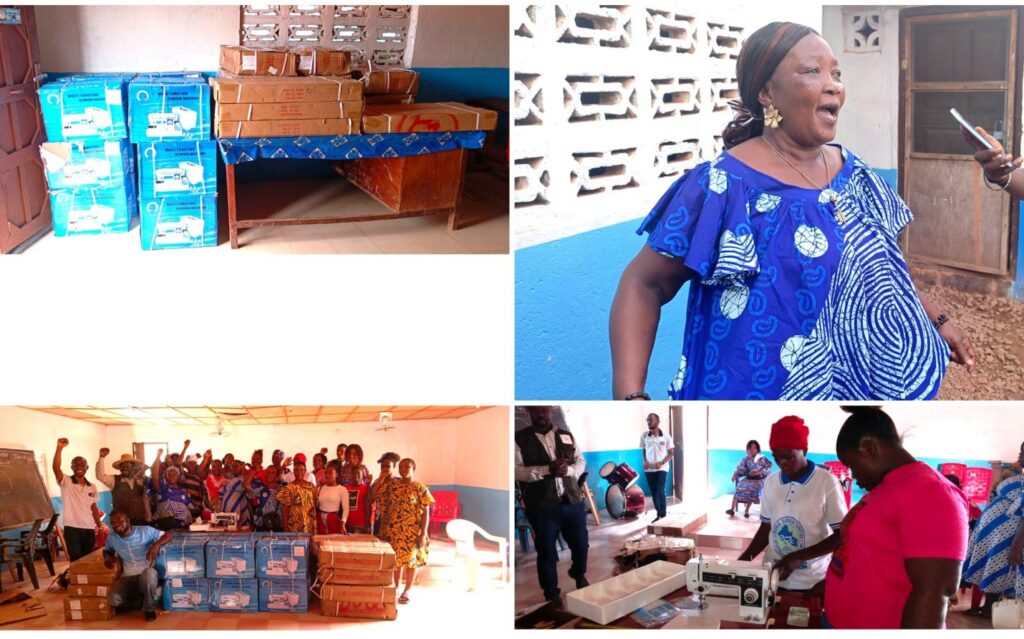
GBARNGA, Bong County—Eco Energy Liberia has begun distributing high-quality solar-powered sewing machines to beneficiaries of its tailoring empowerment program being implemented through the Liberia Opportunity Industrialization Center (LOIC) Gbarnga Satellite, marking a significant step toward economic empowerment for rural women across Bong County.
By Nukanah Kollie / [email protected]
The distribution follows months of intensive tailoring and entrepreneurship training provided under a partnership between Eco Energy Liberia and LOIC. The initiative aims to equip women with practical skills, modern technology, and business knowledge needed to establish sustainable livelihoods and support their families.
Speaking during the distribution ceremony, Eco Energy Liberia Founder and Executive Director, Nelson Papi Kolliesuah, described the initiative as a family-centered empowerment program designed to create economic opportunities for women while strengthening households and communities.
“From the beginning, Eco Energy has been a technical institution focused on solar photovoltaic installations, model development, and implementation. We never had anything to do with tailoring before. Today, we are proud to say that at least 24 women are leaving with solar-powered sewing machines that will help them establish themselves and empower their families,” Kolliesuah said.
He emphasized that empowering women ultimately means empowering entire families, noting that women often bear much of the responsibility for household welfare and rural economic activities.
According to Kolliesuah, the machines being distributed are advanced multi-system sewing machines powered by both electricity and solar energy. Each machine is equipped with multiple features, including solar charging capability and lighting accessories that allow beneficiaries to continue working even during nighttime hours or in areas with limited electricity access.
Rather than providing the machines entirely free of charge, Eco Energy has introduced an affordable ownership model aimed at promoting responsibility and business sustainability among beneficiaries.
“The machines are valued at approximately US$525. Beneficiaries will be given a 60-day grace period, after which they will make an initial payment of US$50 and continue with monthly payments of US$25 for the next 19 months,” Kolliesuah explained.
He described the arrangement as a pilot initiative intended to test the sustainability of the program and potentially expand it to reach more women in future training cycles.
“If this model succeeds, our next intake could support up to 100 women with these machines,” he added.
At the local level, the program is being coordinated by Rachel J. Paye, Program Manager of the Liberia Opportunity Industrialization Center (LOIC) Gbarnga Satellite. Under her leadership, LOIC has continued to create opportunities for women and youth through vocational and technical training programs that promote self-reliance and entrepreneurship.
Paye praised the partnership with Eco Energy and expressed optimism that the initiative would continue to expand opportunities for women throughout Bong County.
“We look forward to empowering more women and ensuring that they have the tools and support needed to improve their lives and contribute to their communities,” she said.
The beneficiaries themselves expressed excitement and gratitude as they received the machines, many describing the opportunity as life-changing.
One beneficiary, Krubo T.Mulbah of the Frog Island community in Gbarnga explained that before the training she could only perform basic sewing using traditional hand-operated machines. Through the program, she learned advanced tailoring techniques and was able to produce the outfit she wore during the ceremony.
“I made this dress myself through the training. Before now, I could only do simple sewing. Today I can make suits, coats, and different designs. Receiving this machine is a big achievement for me,” Mulbah said.
She encouraged her fellow graduates to make productive use of the machines and honor their monthly payment commitments.
“We should not take these machines home and lock them away. We must use them to generate income and support our families. If we work hard and make the payments, more women will have opportunities like this in the future,” she added.
Another beneficiary, Nowai Gbanyan, said the machine would help her provide for her three children while also teaching the skill to others.
“They brought something good to us. I will use this machine to make money, support my children, and teach them the skill as well,” she said.
For Patient Brown, the program has opened the door to a larger dream.
“My goal is to own a fashion and garment production factory one day. I want to design clothing, produce uniforms, and train other people. This program has given me the confidence to pursue that dream,” she said.
Brown noted that the business management training provided by Eco Energy was equally important as the tailoring instruction.
“It taught us that business is not only about money but also about ideas, planning, and determination. The lessons we received will help us build successful businesses,” she said.
Another young beneficiary, Princess Akoi, described the initiative as a powerful example of women’s empowerment and urged other young people to take advantage of similar opportunities whenever they arise.
The tailoring program forms part of Eco Energy Liberia’s broader strategy of combining renewable energy solutions with livelihood development initiatives. While the organization remains known for its work in solar energy and technical training, the tailoring project demonstrates how clean energy technologies can be leveraged to create economic opportunities for women in rural communities.
As the beneficiaries return to their communities with their new solar-powered machines, organizers hope the initiative will not only improve household incomes but also inspire other women to pursue entrepreneurship and vocational skills development.
For many of the women, the sewing machines represent far more than equipment. They symbolize a pathway to independence, dignity, and a brighter future powered by skills, innovation, and opportunity.




Discussion about this post