

Published: July 10, 2026
By Gibson Gee
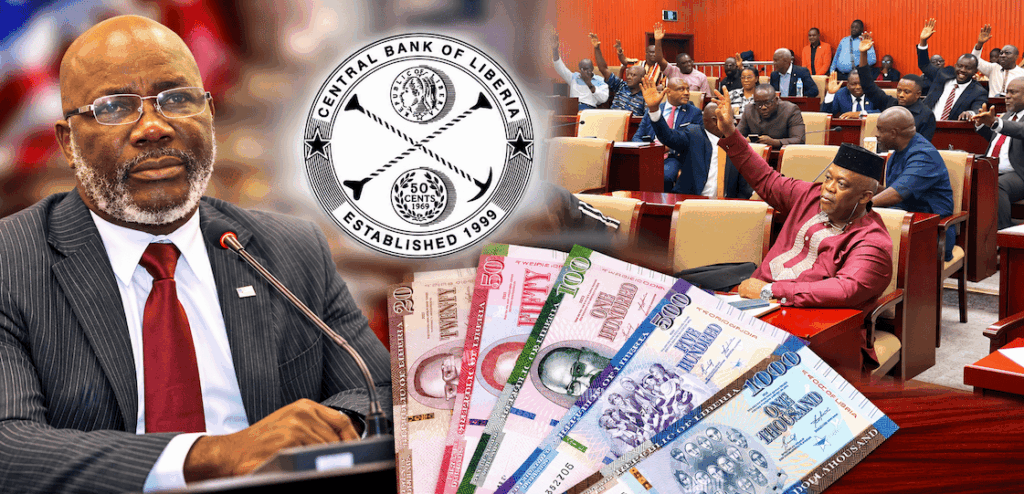
CAPITOL HILL, Monrovia – The House of Representatives has approved a resolution authorizing the Central Bank of Liberia (CBL) to procure and print up to L$79 billion in Liberian dollar banknotes, forwarding the measure to the Liberian Senate for concurrence after lawmakers endorsed the proposal following debate over legislative procedure and the scope of the authorization.
The approval came after the House Committee on Banking, Currency and Insurance presented its report on the Central Bank’s revised currency printing proposal, concluding that the request was necessary to ensure the continued availability of clean, secure and sustainable Liberian dollar banknotes needed to support the country’s economy.
Presenting the committee’s findings, lawmakers were informed that the revised printing program was intended to strengthen confidence in Liberia’s national currency while ensuring that commercial banks and the public continue to have access to adequate supplies of legal tender.
According to the committee, the authorization is also expected to improve the efficiency of future currency management by allowing the Central Bank to plan procurement over several years rather than returning to the Legislature for repeated approvals.
“The proposed printing program is necessary to ensure the continued availability of clean, secure and sustainable Liberian dollar banknotes to support the efficient functioning of the national economy and to strengthen public confidence in the country’s currency,” the committee stated in its report.
The committee further clarified that legislative approval to print the banknotes should not be interpreted as permission to immediately inject all of the currency into the economy.
“The legislative authorization to procure and print banknotes does not constitute authorization for the immediate release of all such banknotes into circulation,” the report emphasized.
Instead, lawmakers were told that “the timing, quantity, storage, distribution and circulation of printed currency remain matters within the statutory responsibility of the Central Bank of Liberia to be exercised in accordance with sound monetary policy and applicable laws.”
The committee also argued that granting approval for the entire revised printing program would make Liberia’s currency management process more efficient and financially prudent.
“The granting of authorization for the entire revised printing program will enhance operational efficiency, reduce procurement costs, eliminate the need for repeated legislative approvals and provide the Central Bank of Liberia with the flexibility necessary to manage the nation’s currency in a prudent, transparent and accountable manner,” the report added.
Proceedings briefly stalled when the Deputy Chief Clerk began reading the measure as a “joint resolution” of the House of Representatives and the Senate.
Several lawmakers immediately questioned the description, arguing that because the Senate had not yet considered the proposal, it could not properly be referred to as a joint resolution.
The disagreement prompted Speaker Richard Nagbe Koon to intervene before directing that the reading continue.
Following the presentation of the committee’s report, Bong County Electoral District #7 Representative Foday E. Fahnbulleh moved that Plenary endorse the report and adopt the accompanying resolution authorizing the Central Bank to proceed with the procurement and printing program before forwarding the measure to the Senate for concurrence.
The motion received the required support and was subsequently adopted.
According to the official tally announced on the House floor, 27 lawmakers voted in favor of the resolution, three voted against it and one lawmaker abstained.
Among those voting against the measure were Nimba County Electoral District #7 Representative Musa Hassan Bility, Nimba County District 9 Representative Taa Z. Wongbe and Margibi County Electoral District #3 Representative Ellen Attoh-Wreh, both of whom expressed concerns about whether the House had fully complied with the legal requirements governing legislative authorization.
Immediately after the vote, Representative Attoh-Wreh sought recognition from the Chair and attempted to move for reconsideration.
The motion was denied.
She subsequently requested that the official legislative record reflect her opposition, maintaining that the Central Bank Act requires a formal legislative resolution before any currency printing exercise can proceed.
“The Central Bank Act was supposed to have resolution before printing. There’s no resolution. So the record should carry that,” Attoh-Wreh said.
She further insisted that the legislative record should indicate that she voted against the proposal because she believed the procedural requirements had not been fully satisfied.
Speaker Koon immediately rejected the assertion.
“There’s a resolution,” the Speaker responded before directing that the vote be recorded and ordering that the approved measure be transmitted to the Senate for concurrence.
The revised proposal forms part of the Central Bank’s currency management strategy for the 2026–2030 period.
The Bank has argued that additional banknotes are needed to replace worn and damaged currency, maintain sufficient cash within the banking system and ensure the uninterrupted availability of Liberian dollar notes across the country.
The proposal authorizes the procurement and printing of up to L$79 billion in banknotes over the life of the program.
Central Bank officials have repeatedly maintained that printing additional currency should not be confused with increasing the money supply.
Instead, they have argued that many of the newly printed banknotes will replace unfit notes already in circulation or remain in reserve until economic conditions require their release.
The committee echoed that position, stressing that approval of the printing program does not authorize the immediate circulation of the full amount and that all decisions regarding the release of newly printed banknotes remain within the statutory authority of the Central Bank under existing monetary policy.
The request follows Liberia’s recent currency replacement exercise, during which the Central Bank introduced newly designed Liberian dollar banknotes with enhanced security features to replace aging and deteriorating notes that had remained in circulation for years.
If the Senate concurs with the House’s action, the Central Bank will be authorized to proceed with implementing the revised printing program, which officials say is intended to safeguard the integrity of Liberia’s currency system while ensuring that adequate quantities of Liberian dollar banknotes remain available to support commerce and economic activity throughout the country.






Discussion about this post