

Published: July 9, 2026
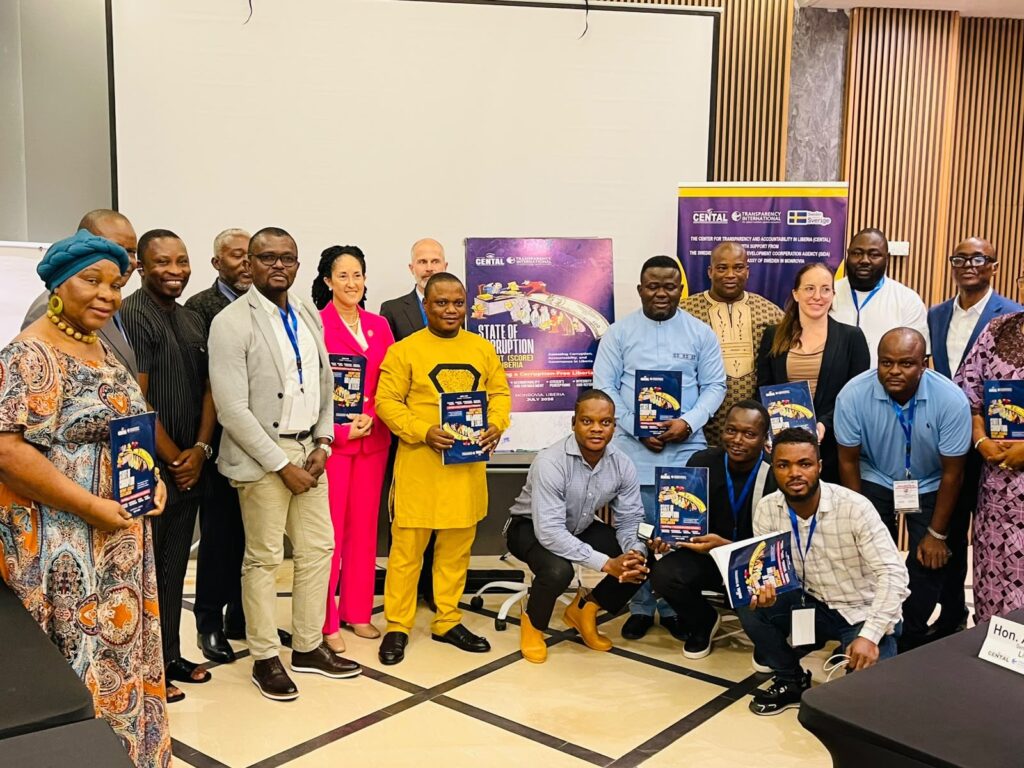
MONROVIA – Liberia has made measurable progress in strengthening its anti-corruption institutions, but corruption remains deeply entrenched across the country, with 94% of Liberians still viewing it as a serious national problem, according to the Center for Transparency and Accountability in Liberia’s (CENTAL) 2025 State of Corruption Report (SCORE).
The report, launched on Wednesday in Monrovia, paints a mixed picture of Liberia’s anti-corruption landscape. While it credits the Boakai administration with demonstrating stronger political commitment through institutional reforms and enforcement measures, it warns that those efforts have yet to translate into consistent accountability and meaningful improvements in public governance.
CENTAL said President Joseph Nyuma Boakai’s administration has strengthened anti-corruption efforts by enforcing asset declaration requirements, reconstituting the Assets Recovery and Property Retrieval Task Force (AREPT), and operationalizing the Witness Protection Agency. However, the organization stressed that corruption remains widespread across public institutions.
Although the percentage of Liberians who rated corruption as “high” dropped from 83% in 2024 to 59% in 2025, the report notes that when respondents who rated it “moderate” are included, 94% still consider it a serious national challenge.
The report found that bribery increased in 2025 after declining for two consecutive years.
According to the survey, 37% of respondents admitted paying bribes, up from 26% in 2024, and more than half said they paid to speed up access to public services.
Public perception of corruption also remains highest within frontline government institutions.
The Liberia National Police was identified as the institution most vulnerable to corruption, followed by the health sector and the judiciary. Concerns also increased within the education and transportation sectors.
While public confidence in the government’s commitment to fighting corruption improved slightly, trust in key institutions—including the Executive, Legislature, Judiciary, integrity institutions, and religious organizations—declined. The media, however, remained Liberia’s most trusted institution.
Despite the grim public perception, the report acknowledged notable progress by Liberia’s accountability institutions.
The General Auditing Commission (GAC) issued several audit reports exposing financial irregularities involving the National Port Authority, Liberia Electricity Corporation, Forestry Development Authority, and the Government of Liberia Consolidated Fund Account.
However, implementation of audit recommendations remains a significant weakness. CENTAL reported that only 37% of more than 7,000 audit recommendations were implemented across 62 audited institutions.
The Liberia Anti-Corruption Commission (LACC) also recorded its highest investigative workload since its establishment.
According to the report, the Commission received 44 corruption complaints, completed investigations into 27 cases, secured 12 indictments, and obtained three convictions during the reporting period.
CENTAL further reported significant improvement in compliance with the country’s asset declaration regime, with approximately 91% of targeted public officials across the three branches of government submitting declarations.
The report also credited the Executive Branch for suspending and blocking the salaries of hundreds of public officials who failed to comply with the Code of Conduct.
Civil society organizations were likewise recognized for sustaining advocacy campaigns to promote transparency, strengthen accountability, and push for key reforms, including the establishment of a specialized anti-corruption court.
Despite the institutional gains, CENTAL warned that Liberia’s anti-corruption framework continues to face major obstacles.
These include inadequate funding for integrity institutions, delayed budget disbursements, weak implementation of audit recommendations, judicial delays, low public reporting of corruption, and limited access to anti-corruption services in rural communities.
The report also expressed concern over the underrepresentation of women in leadership positions across key integrity institutions.
CENTAL concluded that although Liberia has largely established the institutional framework needed to combat corruption, the country’s greatest challenge remains translating policy commitments into consistent, impartial enforcement.
Among its recommendations are sustained political commitment from the Executive, Legislature, and Judiciary; increased funding for integrity institutions; impartial investigation and prosecution of corruption regardless of political affiliation; greater transparency in decisions to discontinue corruption cases; establishment of a specialized anti-corruption court; and stronger collaboration among government, civil society, the media, development partners, and citizens.
Launching the report, the Executive Chairperson of the Liberia Anti-Corruption Commission described the publication as an important contribution to Liberia’s anti-corruption agenda and called on policymakers, public institutions, civil society organizations, and citizens to use its findings as a roadmap to strengthen governance and restore public confidence.
“The publication of this report is a valuable contribution to Liberia’s anti-corruption efforts, providing reliable data and independent analysis to inform public discourse, evaluate progress, identify challenges, and guide policy reforms,” the LACC Chairperson said.
The Chairperson welcomed the report’s balanced assessment, noting that it recognizes both the progress achieved and the challenges that remain.
“Although meaningful gains have been achieved through stronger legal frameworks, public education, institutional collaboration, and the dedication of public servants, the fight against corruption remains an ongoing national responsibility that demands sustained commitment from all stakeholders,” the Chairperson emphasized.
Reaffirming the Commission’s commitment to its statutory mandate, the Chairperson said the LACC will continue conducting impartial investigations, prosecuting corruption cases, promoting public education, preventing corruption, and enforcing the national asset declaration regime.
The Chairperson also acknowledged the collaboration among the LACC, CENTAL, the Ministry of Justice, the General Auditing Commission, the Financial Intelligence Agency, development partners, and other integrity institutions to strengthen Liberia’s accountability framework.
Calling for greater national ownership of the anti-corruption agenda, the Chairperson urged Liberians to embrace the report’s recommendations.
“It is only through collective action, unwavering political will, and active citizen participation that we can build a Liberia where corruption has no place and public resources are managed solely for the benefit of the people,” the Chairperson said before officially launching the 2025 State of Corruption Report.





Discussion about this post