


Published: October 30, 2026
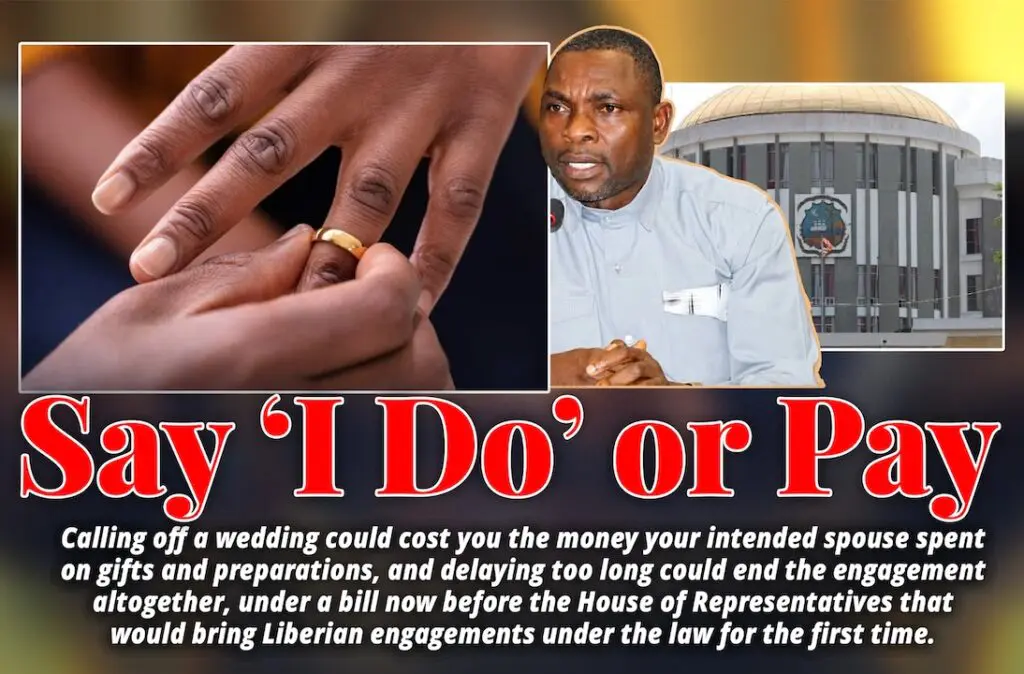
CAPITOL HILL, Monrovia — A Liberian who walks away from an engagement could be required to repay money the other side spent preparing for the wedding, and an engagement that drags on without a wedding would legally end, under a bill now before the House of Representatives.
By Gibson Gee
The proposed “Act to Regulate Marriage Engagement and Protect the Rights of Intended Spouses,” introduced by Maryland County District No. 2 Rep. Anthony F. Williams, would, for the first time, place the period between a proposal and a wedding under a defined legal framework. It provides for the recovery of certain expenditures and financial losses associated with an engagement while protecting either party’s right to give or withdraw consent to marriage.
“The proposed Act affirms the fundamental principle that marriage must be based on the free and voluntary consent of the parties,” the bill says.
That tension sits at the center of the measure. Nobody could be forced to marry, but walking away might no longer be free.
The bill was read in plenary and referred to three committees: Judiciary, which will lead the review; Gender, Child Protection and Social Development; and Internal Affairs and Local Government.
Its most unusual provision puts engagements on a clock. Engaged couples could jointly apply to a designated authority to extend or renew their ordinary engagement period for up to two years, but only twice. Once the second and final renewal expires, the relationship created by the engagement would end, although contractual obligations arising from it could continue.
The bill also proposes the voluntary registration of engagements and encourages couples to hold their weddings in a timely manner.
Its framers argue that broken engagements are not merely private heartbreak. The bill says disputes over money spent, fraudulent representations, and other forms of exploitation can have significant personal, social, and economic consequences. It seeks remedies for those losses while requiring that the recovery of gifts and expenditures be governed by fairness, accountability, and applicable legal principles, and that protections against fraud, coercion, and exploitation do not undermine personal liberty, human dignity, gender equity, or the voluntary nature of marriage.
The gap the bill targets is real. Liberia’s Domestic Relations Law governs marriage, including consent and formal recognition, but families often spend heavily on preparations, exchange gifts, and enter financial arrangements before the wedding, in anticipation of a union that may never happen.
During debate, Rep. Michael Thomas urged colleagues to weigh the bill against the Domestic Relations Law, saying its provisions bear directly on domestic relations. Rep. Jacob Debee backed further consideration and said the measure’s protections must apply to men and women alike.
Committees will decide whether its financial remedies, engagement time limits, and other protections fit within Liberia’s existing legal framework, and whether the measure strikes a workable balance between protecting people who spend in good faith and preserving the freedom to decide not to marry.
The question before lawmakers is simple, but it has consequences for many Liberian families: when an engagement collapses, should the losses fall where they land, or should the law step in?





Discussion about this post