


Published: June 12, 2026
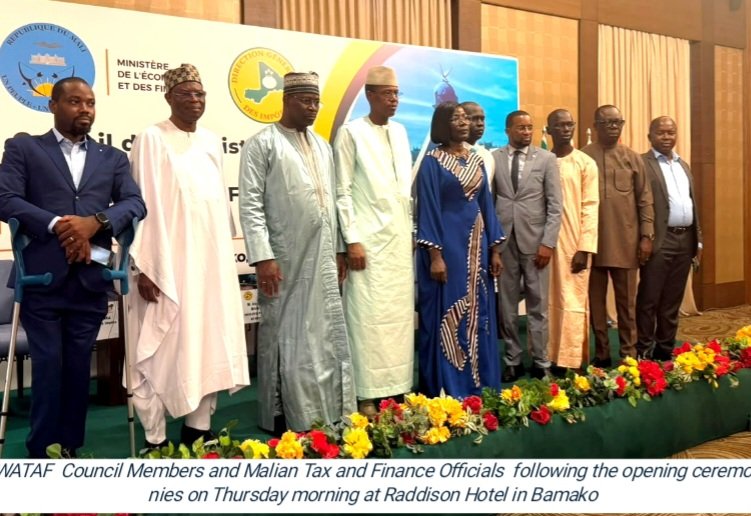
BAMAKO, Mali — Tax administration leaders from across West Africa gathered in Bamako on Thursday for the 22nd Council Meeting of the West African Tax Administration Forum (WATAF), where officials emphasized the urgent need for stronger regional cooperation to improve domestic revenue mobilization and support sustainable development across the region.
Held under the theme “Strengthening Regional Tax Cooperation for Sustainable Development,” the meeting brought together senior tax officials and policymakers to discuss strategies aimed at modernizing tax administration systems, improving governance and addressing emerging challenges in an increasingly digital global economy. The meeting, hosted by Mali’s Directorate General of Taxes in collaboration with the WATAF Secretariat, served as a platform for reviewing the organization’s governance, financial performance and strategic direction ahead of key milestones later this year.
Opening the meeting, Mali’s Minister of Economy and Finance, Alousseni Sanou, described domestic resource mobilization as a critical pillar for Africa’s development agenda, arguing that governments can no longer rely solely on external financing to meet growing development needs. “The effective and sustainable mobilization of domestic resources is no longer simply a budgetary necessity; it is a strategic imperative for the development of our nations,” Sanou said.
WATAF’s press statement, in the possession of The Liberian Investigator, quoted Sanou as saying that financing public services and development priorities, including infrastructure, education, healthcare, security, and economic transformation, increasingly depends on governments’ ability to generate domestic revenue. According to Sanou, tax administrations now play a central role in building resilient, sovereign states capable of delivering on citizens’ expectations.
The minister also highlighted challenges posed by digital transformation, e-commerce, taxation of the digital economy, and the growing complexity of cross-border financial flows. “Faced with these challenges, no tax administration can act alone. Regional cooperation has become an absolute necessity,” he said. Sanou praised WATAF as an important mechanism for dialogue, technical collaboration and the exchange of best practices among tax administrations throughout West Africa.
WATAF Executive Secretary Jules Tapsoba echoed those concerns, stressing that tax authorities must continuously adapt to rapidly evolving economic realities. “Today, more than ever, the effective mobilization of domestic resources remains a strategic priority for our States,” Tapsoba said, adding, “Faced with increasing demands for development financing, the digital transformation of economies, the internationalization of economic activities and tax compliance challenges, tax administrations must continuously adapt, innovate and strengthen their performance.” Tapsoba thanked the Government of Mali for hosting the gathering and highlighted WATAF’s growing regional influence.
He noted that the organization currently comprises 15 member countries and is preparing to welcome Mauritania as its 16th member at the upcoming General Assembly. He also outlined ongoing initiatives focused on strengthening institutional governance, enhancing technical capacity, promoting organizational sustainability and expanding strategic partnerships.
WATAF Council Chairperson Talato Eliane Djiguemdé-Ouédraogo emphasized the increasingly important role tax administrations play in supporting economic resilience and national development. “Our meeting today takes place in a context where tax administrations are being called upon to play an increasingly decisive role in financing the development of our States,” she said. She further noted that member countries share a common goal of building stronger, more efficient tax systems capable of supporting economic sovereignty throughout the region.
“Beyond our borders and differences in national contexts, we are united by a common conviction: strong, modern and efficient tax administrations constitute one of the foundations of our States’ economic sovereignty,” Djiguemdé-Ouédraogo said. The council chairperson said delegates would review governance matters, assess progress on previous recommendations and examine measures aimed at strengthening WATAF’s institutional and financial framework.
Discussions also focused on preparations for the organization’s General Assembly and its 15th-anniversary celebrations, scheduled for September in Accra, Ghana.
Before the formal proceedings began, the statement contains, participants observed a minute of silence in memory of victims of the tragic events that occurred in Mali on April 25, 2026. WATAF leaders expressed solidarity with the government and people of Mali.
During the daylong session, council members reviewed implementation reports from previous meetings, examined the organization’s 2025 External Audit Report and first-quarter 2026 activity and budget reports, and considered revisions to WATAF’s governing agreement and procedures manual. The council also received updates on member-state financial contributions and discussed strategic initiatives designed to strengthen cooperation and improve the effectiveness of tax administrations across the subregion.
Sanou commended the leadership of Djiguemdé-Ouédraogo and Tapsoba for raising WATAF’s profile and advancing its development agenda. Reaffirming Mali’s commitment to regional integration, he called on member countries to embrace innovation, solidarity, and collective action. “Together, we can build tax systems that are more efficient, more equitable, and better adapted to the realities of our economies,” he said.
Officials said the outcomes of the meeting are expected to contribute to stronger regional tax cooperation, enhanced institutional effectiveness, and improved domestic revenue mobilization, helping West African countries finance development priorities and strengthen economic resilience in the years ahead.
WATAF is a regional organization that brings together tax administrations across West Africa to promote cooperation, capacity development, and knowledge sharing. The organization plays a leading role in supporting tax modernization efforts and fostering greater harmonization of tax systems in line with regional and international standards.




Discussion about this post