


Published: August 14, 2026
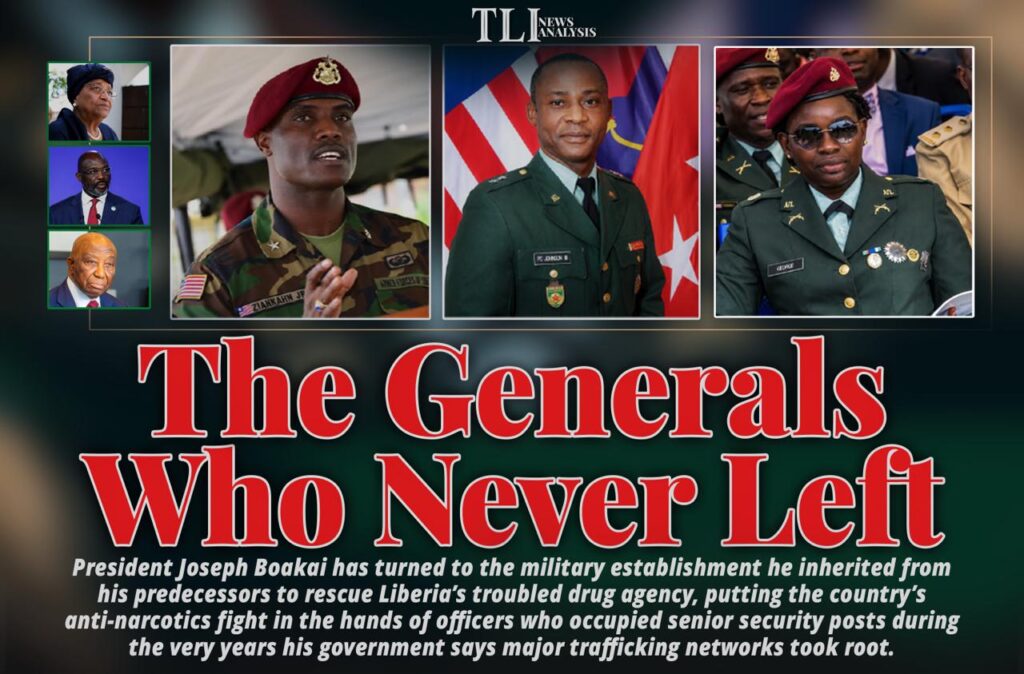
MONROVIA – Liberia’s war on drugs has been handed to the general who ran George Weah’s army, completing a transfer from the defense ministry, the armed forces, the intelligence service, and now to the anti-narcotics agency of a government elected to replace Weah, in the hands of officers Weah promoted.
President Joseph Boakai announced late on Aug. 10 that retired Maj. Gen. Daniel Dee Ziankahn Jr., his military adviser and Weah’s defense minister for six years, would take over the Liberia Drug Enforcement Agency. He named Precious Rue deputy director general for operations and Prince Mulbah deputy director general for administration. All three assume duty in an acting capacity until the Senate reconvenes. Ernest Tarpeh, an outgoing deputy, returns to the National Security Agency, where the director is retired Maj. Gen. Prince C. Johnson III, Weah’s chief of staff of the Armed Forces of Liberia.
In the same announcement, Boakai suspended Fitzgerald T. M. Biago indefinitely from the Liberia National Police over what the Executive Mansion called ethical concerns, after a Ministry of Justice investigation that did not establish that Biago was involved in trafficking. Biago had run the LDEA as officer in charge since August 2025.
Ziankahn will report directly to the president in close consultation with the justice minister. That reporting line removes the Justice Ministry as a buffer, which means the next scandal at the drug agency, if there is one, arrives at the Executive Mansion by design.
“Our fight against drugs is a fight for the future of Liberia,” the Executive Mansion quoted Boakai as saying after what it described as a marathon National Security Council meeting.
A bench built by Sirleaf
The officers Boakai keeps reaching for were not made by Weah. They were made by Ellen Johnson Sirleaf.
At a single commissioning ceremony, Sirleaf promoted Ziankahn to major general as chief of staff of the Armed Forces of Liberia, made Prince C. Johnson III deputy chief of staff with the rank of brigadier general, and made Davidson Fayiah Forleh commander of the 23rd Infantry Brigade with the rank of colonel. Those three men are, today, the director general of the drug agency, the director of the National Security Agency and the chief of staff of the army.
Weah’s contribution was to move each of them up one rung. He retired Ziankahn from the army in January 2018 and made him minister of national defense. He elevated Johnson to chief of staff, confirmed by the Senate on Feb. 6, 2018. In March 2018 he nominated Geraldine Janet George as deputy chief of staff, the first woman to hold the post, and commissioned her as a brigadier general that June. For the next six years, the top three uniformed and civilian defense positions in Liberia were held by Ziankahn, Johnson and George.
All three now serve Boakai. George is minister of national defense, confirmed by the Senate on April 30, 2024, the first woman to hold the office. Forleh, the colonel Sirleaf pinned at the 23rd Infantry Brigade, is chief of staff of the army. Johnson has the intelligence service. Ziankahn has the drugs.
This continuity runs through the institution the United States spent two decades rebuilding after the war. Ziankahn and Johnson were inducted into the U.S. Army Command and General Staff College International Hall of Fame at Fort Leavenworth on April 12, 2022, as classes of 2011 and 2012. George was inducted at the same institution on April 9, 2026. The Armed Forces of Liberia has been paired with the Michigan National Guard under the State Partnership Program for 15 years. Ziankahn, accepting his induction, said American mentorship had “rebranded the Liberian Military.”
That is the answer to why Boakai keeps returning to the same names. The post-2005 army is the only Liberian security institution with a professional pipeline, a promotion ladder that mostly works, and a foreign patron that funded both. The drug agency has none of those things. Neither, for most of its history, has the police. When a civilian agency fails, there is no bench to draw on except the one Leavenworth built.
Thirty-one months, five leadership arrangements
What that failure looks like is a matter of record, and the drug agency has the worst of it. Ziankahn’s appointment is the fifth leadership arrangement at the LDEA since Boakai took office in January 2024. Biago is the fourth head of the agency to leave under this president, and the third to leave badly.
Boakai’s first choice was Abraham S. Kromah, a former deputy inspector general of police for operations, appointed in early 2024. Kromah and his deputy for operations, Hassan Fadiga, fell out publicly. On June 3, 2024, the dispute produced a near-violent confrontation at LDEA headquarters. Boakai suspended Kromah and both deputies the following day and relieved them formally on Nov. 1, calling the events at the agency unacceptable.
Christopher S. Peters Sr. held the agency as officer in charge for four months, oversaw seizures the Executive Mansion valued at 4 million United States dollars, and resigned in October 2024 citing the conditions he had inherited. Anthony K. Souh, appointed acting director general on Oct. 10, 2024 and nominated to the substantive post that November, lasted until Aug. 28, 2025, when Boakai dismissed him along with deputies Sebastian Farr and Gwee K. Porkpah for what the Executive Mansion called administrative reasons. No fuller explanation was given. Biago, a deputy commissioner of the Liberia National Police, took over that same day.
Four appointees, none of them lasting a year, all of them Boakai’s own choices, at the agency standing between Liberia and a trafficking industry that has grown faster than the state’s capacity to police it. On July 21, investigators recovered roughly 3,971 kilograms of suspected cocaine from properties at Duazon, on the highway to Roberts International Airport, with an estimated street value of 317.7 million United States dollars. The attorney general and justice minister said in a joint statement that the operation “revealed an organized, sophisticated, complex and well-funded narcotics trafficking network.” Weeks earlier, six containers at Roberts International Airport, declared as textiles and food seasoning, were found to hold nearly 200 compressed blocks of cocaine.
The years in question
The problem with reading this as a rescue is that the rescuers were in the room.
Inspector General Gregory Coleman said the Duazon operation targeted trafficking networks active between 2018 and 2023. Those are precisely the years in which Ziankahn ran the Defense Ministry, Johnson ran the army, and George was second in the army’s command structure. If a sophisticated, well-funded network established itself in Liberia across those six years, it did so while the men now assigned to dismantle it held the country’s senior security posts. Nothing in the public record ties any of them to it.
IGP Coleman was Sirleaf’s inspector general from September 2016 until Weah replaced him with Patrick Sudue in early 2018. Boakai brought him back. The police leadership is a Sirleaf restoration. The military leadership is a Weah inheritance. What both have in common is that Boakai’s own appointees, the ones with no prior tenure, are the ones who have collapsed.
Nor has the officer class delivered clean government where it has been given power. Suspects arrested over the Dec. 18, 2024 fire at the Capitol Building, among them Thomas Isaac Etheridge, alleged that agents of the National Security Agency beat and threatened them to extract statements implicating then-Speaker J. Fonati Koffa. Justice Minister Oswald Tweh called the allegations false and said independent investigators had been invited to examine them. The agency in question is run by Johnson.
Johnson’s own record includes the fastest exit in the administration’s history. Boakai nominated him defense minister on Feb. 9, 2024. Wives of soldiers blockaded roads over pay, pensions and barracks conditions, and demanded he go. He resigned within days, writing that he acted to “preserve the peace and security of the State.” Twelve weeks later he had the intelligence service.
What the Senate has to decide
Gbarpolu County Sen. Amara Konneh, who ran a political operation for Boakai in 2023, welcomed Ziankahn’s nomination and then said the thing that matters: a leadership change is not a fix, and the investigations into senior security and law enforcement officials must run independently of who now sits at the top of the drug agency.
The Senate cannot act until it reconvenes later this year, which means Ziankahn will have run the LDEA for months before anyone votes on whether he should. In Kakata, Resident Circuit Judge Roosevelt Z. Willie has ordered a 15-member sequestered jury for the Duazon case, citing tampering in an earlier proceeding.
Liberia is not the first West African state to answer a narcotics crisis by putting a general in charge of it. The reason it feels different here is that the generals never actually left. Three presidents, two parties and one change of government have produced one continuous security establishment, and the country is now asking it to investigate the years it was in charge.






Discussion about this post