

Published: July 10, 2026
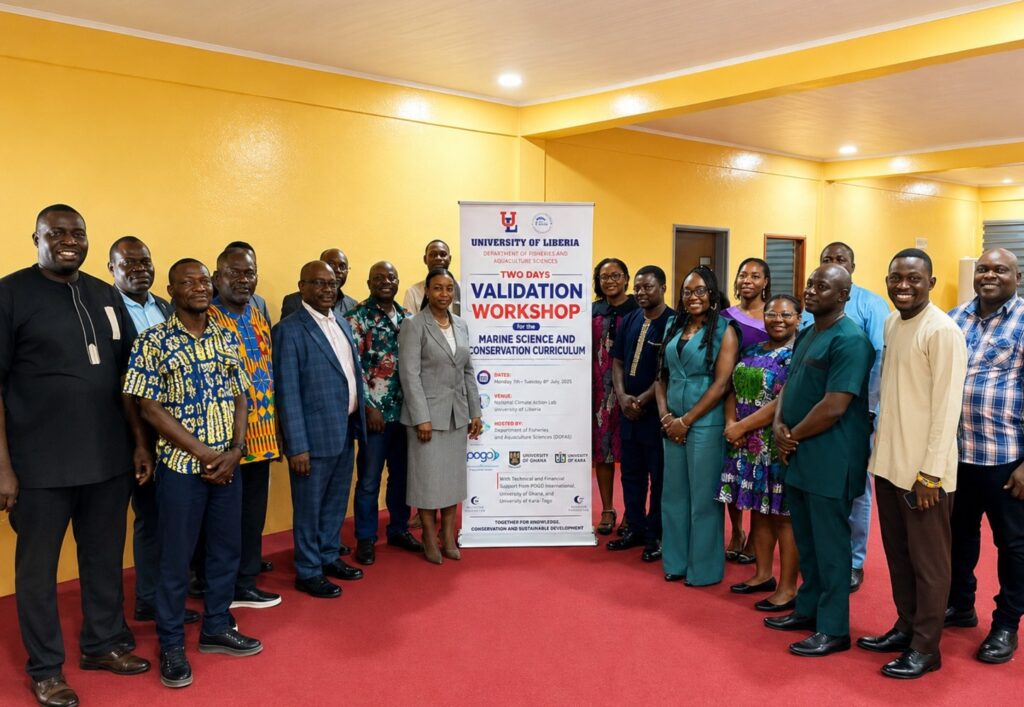
MONROVIA – The University of Liberia (UL) has completed the final validation of a proposed Bachelor of Science in Marine Ecosystem and Conservation, marking a significant step toward establishing the country’s first specialized undergraduate program dedicated to training marine scientists, conservationists and fisheries professionals to support Liberia’s growing blue economy.
The two-day curriculum validation workshop, held July 7-8 at the University’s National Climate Action Laboratory, brought together more than two dozen scientists, government officials, academics and conservation experts to review the proposed curriculum before it is submitted to the University’s Academic and Faculty Councils for final approval.
The initiative was spearheaded by the University’s College of Science through the Department of Fisheries and Aquaculture Sciences (DOFAS), with technical support from the Partnership for Observation of the Global Ocean (POGO) International, the University of Ghana and the University of Kara in Togo.
Opening the workshop, University of Liberia President Dr. Layli Maparyan described the exercise as another milestone in the institution’s efforts to strengthen higher education while promoting the sustainable management of Liberia’s marine and aquatic resources.
“The proposed curriculum reflects our determination to equip students with the scientific knowledge, technical competencies, and practical skills needed to address emerging challenges in marine conservation, fisheries management, climate change, and the sustainable use of our coastal and marine ecosystems,” Dr. Maparyan said.
She noted that the proposed program aligns with Pillar Five of the ARREST Agenda for Inclusive Development (AAID), which emphasizes biodiversity conservation, responsible natural resource management and climate resilience.
According to the UL President, curriculum validation is essential to ensuring academic programs meet national and international standards while responding to the needs of government, industry, research institutions and local communities.
“I therefore encourage all participants to engage openly and constructively, drawing upon your diverse expertise to enrich this curriculum and ensure its quality and relevance, so that it covers every fragment of the sector under consideration,” she said.
Dr. Maparyan also commended development partners, consultants, faculty members and stakeholders for helping bring the program to its final validation stage.
“Special thanks to Dr. Alvin Jueseah and your team for the oversight in this entire process. Your collaboration demonstrates our shared commitment to producing graduates who will become leaders in marine science, conservation, and sustainable fisheries development,” she added.
Speaking during the workshop, DOFAS Chairman, Assistant Professor Alvin S. Jueseah, announced that the proposed bachelor’s degree will be housed within the Department of Fisheries and Aquaculture Sciences.
He said the department is already producing professionals in fish farming, fisheries administration and aquaculture, while the new program will significantly expand Liberia’s capacity in marine science and conservation.
“This is a huge milestone that cannot be overstated. However, the success of this program depends on our collective support with all available resources,” Jueseah said.
Dr. Agnes Reeves Taylor told participants that the validation team was mandated to ensure the curriculum satisfies both quality assurance and international academic standards.
Meanwhile, DOFAS instructor Fred Ahaiti outlined the workshop’s objectives, including reviewing the curriculum’s structure and learning outcomes, assessing its alignment with government policies and industry needs, and building consensus before formal endorsement.
Representing National Fisheries and Aquaculture Authority (NaFAA) Director-General J. Cyrus Saygbe, Director of Marine Environmental Protection S. Ahmed Sheriff described the program as a direct response to Liberia’s longstanding shortage of trained professionals in marine resource management.
Representatives from the Food and Agriculture Organization (FAO), Conservation International, the Environmental Justice Foundation, the Liberia Artisanal Fishers Association, the Liberia Maritime Authority and the University of Liberia’s Departments of Public Health and Environmental Science also welcomed the initiative.
Environmental Protection Agency Executive Director Dr. Emmanuel Urey Yarkpawolo described the proposed degree as a historic milestone for conservation education in Liberia and pledged the EPA’s support by opening its advanced laboratory facilities for student practicals and exploring internship opportunities with DOFAS.
“When data is weak, outdated, or unavailable, our ability to make strong, science-based decisions is undermined. This is why the development of national capacity in marine science is not just an academic exercise. It is a national development priority, a regulatory priority, a climate priority, an economic priority, and a sovereignty issue,” Yarkpawolo said.
He stressed that Liberia must build the capacity to study and monitor its own marine environment while producing professionals capable of managing the country’s coastal and ocean resources.
According to Yarkpawolo, the proposed Bachelor of Science in Marine Ecosystem and Conservation will prepare a new generation of Liberian marine scientists, conservation professionals, coastal managers, environmental regulators, fisheries experts, climate practitioners and researchers.
“It can create the human capacity needed to support government institutions, private sector actors, civil society organizations, local communities, and international partners working in the marine and coastal space,” he said.
Yarkpawolo noted that the program comes at a critical time as Liberia confronts growing environmental threats, including coastal erosion, flooding, wetland degradation, plastic pollution, illegal sand mining, poor waste management and the impacts of climate change.
“At the same time, the world is moving toward greater attention to the blue economy, marine conservation, ocean governance, and climate-resilient coastal development. Liberia cannot afford to remain behind,” he added.
He praised the University of Liberia for taking what he described as a bold and forward-looking step.
“By developing this curriculum, the University is helping to build the scientific foundation Liberia needs to protect its marine ecosystems, improve environmental governance, and benefit responsibly from the opportunities offered by our coastal and ocean resources,” he said.
Closing the opening session, Dr. Maparyan reaffirmed that the proposed program is vital to Liberia’s national development agenda and thanked DOFAS Chairman Dr. Alvin S. Jueseah for leading the initiative.
Following the successful validation, the proposed curriculum will now be submitted to the University’s Academic and Faculty Councils for final approval—the final step before the University of Liberia launches its Bachelor of Science in Marine Ecosystem and Conservation, a program expected to strengthen the country’s capacity to sustainably manage its fisheries, coastline and marine ecosystems for generations to come.




Discussion about this post