


Published: June 26, 2026
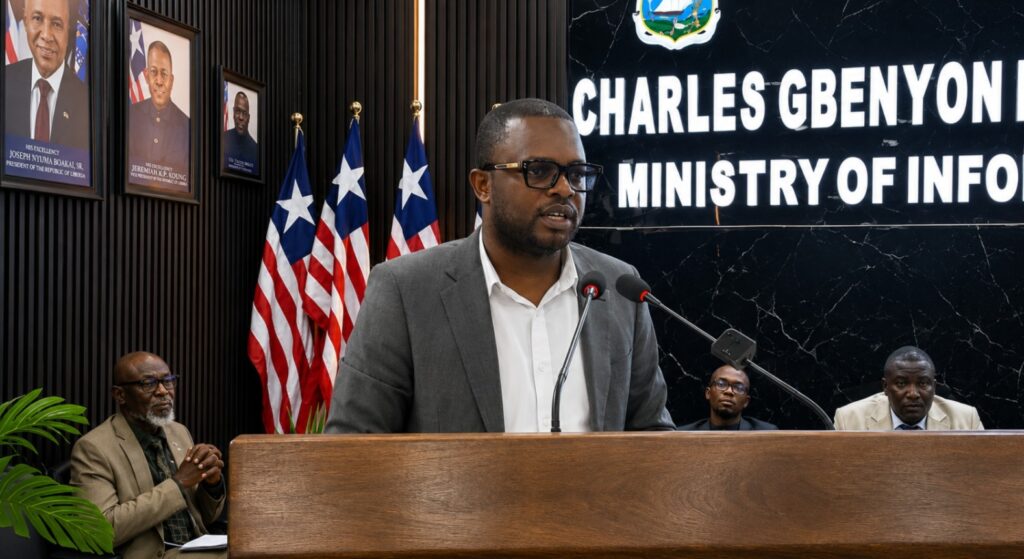
MONROVIA – Liberia’s National Water, Sanitation and Hygiene Commission (NWASHC) says it is making significant strides toward transforming the country’s water and sanitation sector, announcing major reforms that include the rollout of digital platforms, the inspection of more than 300 business facilities nationwide, and renewed efforts to eliminate open defecation by 2030.
Speaking Thursday during the Ministry of Information’s regular press briefing, NWASHC Executive Director Morris G. Gono outlined the Commission’s latest achievements while emphasizing that stronger coordination, institutional reform, and sustained investment remain essential to achieving universal access to safe water, sanitation and hygiene services.
Gono said the Commission, which is mandated to regulate and provide leadership and oversight for Liberia’s WASH sector, has continued to advance reforms despite persistent institutional challenges.
A cornerstone of those reforms, he noted, is the Presidential WASH Compact and Institutional Reform Agenda, a high-level governance framework intended to unify the country’s fragmented water, sanitation and hygiene sector under a single national vision.
“Specifically, we have been working on the Presidential WASH Compact and Institutional Reform Agenda. The WASH Compact is a high-level governance and reform instrument designed to provide national leadership around a single, coherent vision for water, sanitation, and hygiene across Liberia,” Gono said.
According to him, the Compact brings together government ministries, commissions, development partners and private-sector actors to commit to measurable actions aimed at improving sector financing, strengthening service delivery, enhancing regulatory oversight and eliminating open defecation nationwide.
Gono disclosed that the initiative is a Head of State program expected to be signed by President Joseph Nyuma Boakai.
He explained that responsibilities for Liberia’s WASH sector are currently spread across multiple institutions, including the Ministries of Public Works, Health, Education, and Mines and Energy, the Liberia Water and Sewer Corporation (LWSC), and local governments.
According to him, this fragmented structure has created overlapping mandates, inconsistent regulatory standards and weakened accountability.
If approved, he said, the Compact will streamline oversight, reduce duplication, improve institutional efficiency and strengthen climate resilience, groundwater protection, catchment management and emergency response planning.
“As of today, the Compact has been submitted to the President’s Office. The President has instructed a committee to review the document and provide recommendations before further action is taken,” Gono added.
The Executive Director also disclosed that President Boakai has directed the Ministry of Health to coordinate all government agencies responsible for inspecting businesses and WASH-related facilities.
As part of that effort, the Inter-Agency Joint Task Force on Food Safety and Sanitary Inspection was officially launched on April 22 by Presidential Political Advisor Madeira Cooper at the Ministry of Health.
The task force comprises several government ministries and agencies and is currently inspecting hotels, restaurants, eateries, catering centers and water production facilities across the country.
According to Gono, the nationwide inspection exercise began on June 11 and is expected to continue for 23 working days.
He explained that while the Ministry of Health coordinates the initiative and the Liberia Food Authority serves as Secretariat, NWASHC leads the inspection component.
“To date, the team has inspected more than 300 facilities across the identified categories,” he disclosed.
Gono also highlighted the Commission’s success in ensuring the continuation of several community water projects following the withdrawal of USAID funding, which had threatened to stall implementation.
“One of our major achievements has been the successful transition and continuation of Phase One water system projects following the departure of USAID funding. As many are aware, the withdrawal of the USAID created significant funding challenges. However, the Commission worked closely with partners and stakeholders to ensure that these projects continued and that communities would still gain access to safe drinking water,” he explained.
The projects include Dolo’s Town and Riverview in Montserrado County, Yarnwuellie in Margibi County, Baypolu Town in Bong County and Sarah Johnson Quarter at Gate 15.
Together, the projects are expected to provide safe drinking water to approximately 32,500 residents through solar-powered boreholes, elevated water towers, water kiosks and chlorination systems.
Gono said NWASHC continues to provide technical supervision, regulatory oversight and community engagement for the projects.
The Executive Director also announced major advances in the Commission’s digital transformation agenda.
He revealed that NWASHC has transitioned from a paper-based certification system to a digital platform that now allows service providers and sector stakeholders to apply remotely for permits and regulatory clearances.
The Commission has also secured initial funding from Catholic Relief Services (CRS) to establish a National WASH Digital Information Platform, which will centralize water, sanitation and hygiene data from across Liberia.
“Additionally, we secured initial funding from Catholic Relief Services (CRS) to develop a national WASH Digital Information Platform. This system will serve as a centralized information management platform for the entire WASH sector,” he said.
According to Gono, WASH-related data are currently scattered among different ministries and agencies, limiting coordination and planning.
The new digital platform will consolidate those records into a single national database accessible to sector stakeholders and policymakers.
He added that field teams have also begun using the KoboCollect digital data collection system, replacing traditional paper-based methods and significantly improving the speed, accuracy and reliability of field assessments.
Despite the progress, Gono acknowledged that institutional fragmentation remains one of the sector’s greatest challenges.
He noted that responsibilities continue to be divided among the Ministries of Public Works, Health, Education, Internal Affairs and Mines and Energy, as well as the Liberia Water and Sewer Corporation.
Nevertheless, he reaffirmed NWASHC’s commitment to driving coordinated, inclusive and climate-resilient reforms.
“The National Water, Sanitation and Hygiene Commission reaffirms its commitment to leading a coordinated, inclusive, and climate-resilient WASH sector in Liberia. Through sustained partnerships, strengthened governance, digital innovation, and strategic investments, NWASHC will continue to work toward achieving universal access to safe water, improved sanitation, and hygiene services by 2030,” Gono said.
He called on the Government of Liberia, development partners, the private sector, civil society organizations, and communities to continue supporting national WASH reforms and infrastructure development to improve the health, dignity, and well-being of all Liberians.






Discussion about this post