


Published: June 3, 2026
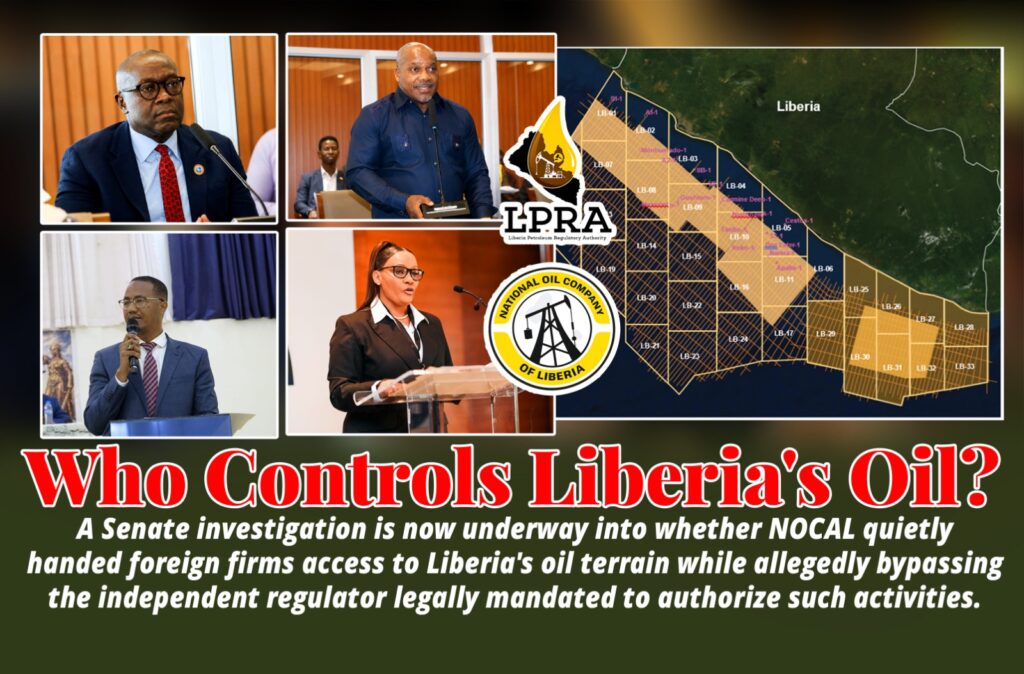
MONROVIA – Liberia’s petroleum sector is headed for a Senate reckoning after two lawmakers alleged the National Oil Company of Liberia (NOCAL) quietly authorized foreign firms to survey the country’s oil terrain, sidelining the independent regulator, the Liberia Petroleum Regulatory Authority (LPRA), and the law specifically created to control that process.
News Analysis by Blamo N. Toe & Lennart Dodoo
The Senate hearing demand triggered by Senators Amara M. Konneh of Gbarpolu County and Jonathan Boye Charles Sogbie on Tuesday is, on its face, a dispute over whether two foreign firms, GeoPartners and Searcher, needed a license from the LPRA to conduct petroleum reconnaissance activities in Liberia. But at a deeper level, it is about a structural fault line running through the country’s oil governance architecture, one that predates the current controversy and that lawmakers, regulators and legal experts have been warning about for years.
The fault line is this: the 2014 Petroleum (Exploration and Production) Act was designed to separate Liberia’s commercial petroleum interests from its regulatory function. NOCAL would be the state’s business arm in the oil sector. LPRA would be the independent watchdog. Both would operate with clear, non-overlapping mandates. In practice, that separation has never been as clean as the law intended, and the 2019 amendment to the Petroleum Act widened the gap between legal theory and operational reality in ways that now appear to have emboldened NOCAL to act in areas squarely outside its statutory lane.
A Design Intended to Prevent What Is Now Alleged
The architects of Liberia’s petroleum reform framework recognized the danger of allowing a state-owned commercial enterprise to control both the regulatory process and the enterprise itself. It is a conflict of interest that has corrupted oil sectors across Africa and beyond, where national oil companies that simultaneously operate fields and issue licenses have been known to favor their own interests over national ones, freeze out foreign competition, and suppress data about reserves and revenues.
To guard against that, the 2014 law vested exclusive licensing authority in the LPRA. Under Section 8.1 of the Petroleum Act, LPRA is empowered to conduct technical evaluations, manage bidding rounds and licensing, negotiate petroleum agreements, and administer petroleum rights. All of it. NOCAL’s role, by contrast, is commercial: it holds and manages the state’s equity interest in oil projects, undertakes exploration and production on the government’s behalf, markets Liberia’s share of crude production, and deposits revenue into the Consolidated Fund.
There is one narrow carve-out that runs to the heart of the current dispute: reconnaissance licenses. Under the NOCAL Act, the oil company was given a limited administrative role in reconnaissance licensing, but in consultation with LPRA. The 2014 Petroleum Law reinforced this by requiring, under Section 11.1, that any company seeking to conduct reconnaissance activities, including the geological, geophysical, geochemical and geotechnical surveys that GeoPartners and Searcher are alleged to have undertaken, must apply to LPRA for a license before commencing any operations.
That provision, Konneh and Sogbie argue, is unambiguous. NOCAL had no authority to authorize those activities on its own. If the agreements with GeoPartners and Searcher did what the senators allege, NOCAL did not bend the rules. It broke them.
The 2019 Amendment: Reform That Introduced New Risks
The problem did not begin with the GeoPartners and Searcher contracts. It was at least in part seeded by a 2019 amendment to the Petroleum Law that introduced a new mechanism called “executive allocation,” under which the president could announce the direct allocation of a petroleum block to NOCAL at 100%, without a competitive bidding process. The amendment was controversial from the start. Critics warned it would blur the institutional separation between NOCAL’s commercial role and LPRA’s regulatory gatekeeping function.
LPRA itself pushed back publicly, insisting that even under executive allocation, any resulting petroleum agreement still required LPRA’s involvement, the formal grant of rights by its Director-General and the countersignature of the Finance Minister. The authority cited Sections 4.1, 7.2 and 8.1 of the law as retaining final licensing and contract authority in LPRA’s hands regardless of how a block was initially allocated.
But the very fact that LPRA felt compelled to issue public statements defending its own jurisdiction tells a story. When a regulator has to remind a state-owned enterprise that it cannot issue petroleum rights unilaterally, something has gone wrong with the institutional design. The 2019 amendment did not explicitly prohibit overlapping action. It added complexity without resolving the ambiguities it created, and NOCAL appears to have operated within or beyond those ambiguities.
What the Senate Needs to Establish
The Committee of the Whole hearing now demanded by Senate Plenary will need to answer a set of questions that are as legal as they are practical. Did NOCAL’s agreements with GeoPartners and Searcher authorize reconnaissance activities within the meaning of the Petroleum Law? If so, were LPRA licenses applied for and obtained before those activities began? If they were not, who authorized the work and under what claimed legal basis?
NOCAL has maintained that its actions are lawful. That position will require explanation, because the statutory language the senators cited offers little room for creative interpretation. Either a reconnaissance license was issued by LPRA, or it was not. The company will need to point to the specific provision that authorized it to bypass the statutory process, if one exists.
The hearing will also need to address the structural question, which is in some ways the more important one. What are the enforceable boundaries between NOCAL’s commercial mandate and LPRA’s regulatory authority? The two agencies share a board composition that blurs those lines at the top: NOCAL’s board includes the ministers of Finance and Mines and Energy as ex officio members, the same ministries whose counterparts at the policy level are supposed to provide oversight. LPRA’s Director-General is also a presidential appointee, raising questions about political independence that are relevant whenever the executive branch develops a direct commercial interest in how a block is allocated or operated.
Why This Matters Beyond One Hearing
Liberia’s petroleum sector remains largely undeveloped. The country has offshore blocks with explored potential, but years of governance instability, legal uncertainty, and the collapse of global oil prices have kept major investment away. Whatever oil wealth Liberia might one day extract will be worth very little if the legal framework governing it cannot be trusted by investors, audited by legislators, or explained to the communities that will bear the environmental costs of extraction.
The NOCAL-LPRA jurisdictional dispute isn’t just a legal dispute between two agencies over authority. It tests whether Liberia’s petroleum governance institutions work as intended or if NOCAL can self-regulate by signing agreements with foreign operators without LPRA’s independent oversight. The reconnaissance activities in question are exactly the kind of early-stage data gathering that decides whether and where oil development will happen. If those activities go ahead without LPRA licensing, the authority loses sight of what data is being collected, by whom, under what conditions, and how it will be used. That data is a national asset. Managing it properly is crucial.
There is also a revenue aspect. Analyzing the legal framework shows that NOCAL is legally obligated to deposit dividends, royalties, and other oil-related proceeds into the Consolidated Fund. Reconnaissance deals that bypass the official LPRA licensing process can also bypass the revenue tracking systems that ensure money reaches the treasury. This is not hypothetical; it is the typical outcome when extractive sector governance fails.
The Pattern and the Precedent
In May 2026, just weeks before the Senate hearing demand, LPRA issued a public statement reaffirming its legal primacy over petroleum rights, specifically in response to growing confusion about the scope of executive allocations. Legislative committees had already signaled they were examining whether the mandates of LPRA and NOCAL needed sharper statutory definition to prevent exactly the kind of conflict now before the Senate.
That background suggests the GeoPartners and Searcher controversy did not emerge from nowhere. It is the visible surface of a deeper institutional problem: a governance architecture that was well designed in principle but that has been eroded by amendments, executive discretion and the operational ambitions of NOCAL, which may have come to view the LPRA as an obstacle rather than a partner.
If the Senate succeeds in compelling clear answers from the Minister of Justice, the Minister of Mines and Energy, the LPRA director and NOCAL’s president and CEO, it will not only resolve the immediate dispute. It will have the opportunity to demand the legislative and regulatory clarifications that analysts, civil society and the LPRA itself have been calling for: amendments that restore unambiguous licensing authority to the regulator, a formal memorandum of understanding between NOCAL and LPRA defining their coordination protocols, and transparent publication of all petroleum agreements and the financial terms attached to them.






Discussion about this post