


Published: June 3, 2026
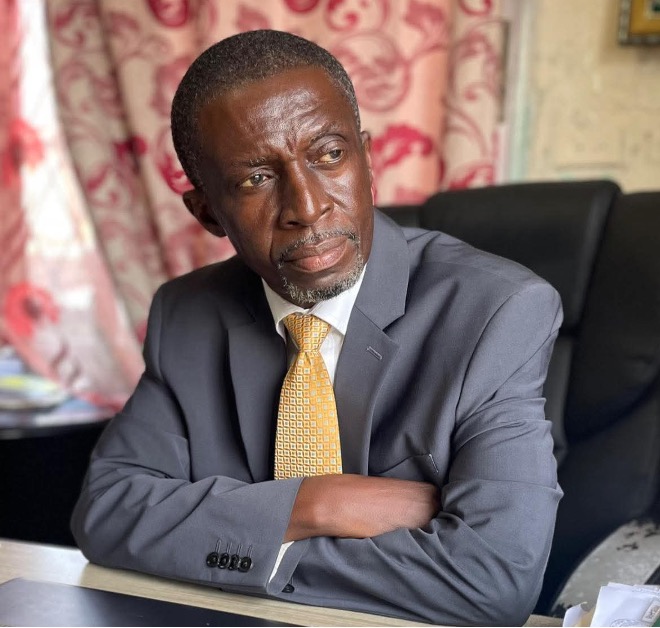
MONROVIA — Liberia is not a poor country. It is a country that has been poorly led. That is the blunt assessment of veteran human rights lawyer and statesman Cllr. Tiawan Saye Gongloe, who says the real curse haunting Africa’s oldest republic is not a shortage of natural wealth but a governing class that has consistently chosen self-enrichment over national development.
Gongloe’s remarks responded to former Mines and Energy Minister Wilmot Paye, who recently raised concerns about the influence of foreign mining cartels on Liberia’s extractive sector and the government’s failure to regulate or punish what he called embedded criminality within the industry. Paye estimates the country’s untapped mineral wealth at over one trillion dollars.
For Gongloe, those figures make the condition of ordinary Liberians not only tragic but also inexcusable.
“Liberia is not inherently a poor nation,” he said. “The true obstacle we face is the significant deficiency in effective and responsible leadership.”
The significance of the assessment is heightened given Liberia’s position in African history. When the country declared independence from the American Colonization Society on July 26, 1847, it entered the global stage with advantages that few other African nations would enjoy for the next century. It was politically sovereign while most of the continent remained under colonial rule. It controlled vast deposits of iron ore, diamonds, and gold. It possessed millions of acres of fertile agricultural land, some of the richest forests in West Africa, what would become one of the world’s largest natural rubber operations, and one of the largest maritime registries globally.
That head start, however, has not translated into development. Countries that gained independence more than a hundred years after Liberia have since surpassed it in infrastructure, education, healthcare and economic diversification. In communities sitting directly atop mineral deposits, residents still lack clean water, functional schools, paved roads and basic medical care.
“Our abundant natural resources generate wealth that flows into economies across the globe,” Gongloe said. “So why are they not being utilized to create world-class schools, hospitals, quality roads, thriving factories and ample opportunities for the people of Liberia?”
The question is no longer rhetorical. It has become the defining political frustration of a generation.
The Cartel Problem
Paye’s warning about mining cartels has sharpened that frustration. Critics of Liberia’s extractive industries have long argued that concession agreements are structured to benefit foreign investors and politically connected elites while returning little to the communities and the national treasury. The pattern is consistent: ships leave Liberia’s shores loaded with iron ore, timber and other raw commodities, and the country earns a fraction of their ultimate value because the wealth-generating processing happens elsewhere.
Rather than building domestic industries that refine minerals and create jobs, Liberia largely exports raw materials. Many economists have described the dynamic plainly: the country exports resources and imports poverty.
Gongloe stopped short of naming specific actors but his argument implies that the problem is not simply technical or regulatory. Entrenched networks of political and economic interests, he suggested, exercise disproportionate influence over how national resources are managed, making reform difficult even when the political will nominally exists.
Previous legislative investigations have reinforced that picture. A 2024 Senate probe into port concessions found procurement irregularities, potential misrepresentation during bidding processes and revenue arrangements that appeared to benefit concessionaires far more than the Liberian state. Senators are now pursuing a fresh round of investigations into port-related agreements amid allegations that revenues collected in Liberia are being transferred abroad.
The Botswana Lesson
To make the case that resource wealth need not produce poverty, Gongloe points to Botswana. At independence in 1966, Botswana was among the poorest countries in the world, with limited infrastructure and no established institutions. The discovery of diamonds could have replicated the extractive trap that has ensnared so many resource-rich nations.
Instead, Botswana made different choices. Its government channeled mineral revenues into public education, healthcare, road construction and long-term economic diversification. It enforced transparency and accountability in its resource agreements. Today Botswana is widely recognized as one of Africa’s most successful development stories.
Gongloe’s invocation of Botswana is pointed. It removes the excuse that geography, history or the behavior of foreign companies explains Liberia’s condition. The variable that distinguishes the two countries is not the resources themselves but what leaders chose to do with them.
“If the citizens of Botswana can reap the rewards of their natural wealth, there is no reason why Liberians cannot do the same,” he said.
A Call to Account
At the core of Gongloe’s argument is a proposition that is simple and damning in equal measure: Liberia’s crisis is political, not geological. The country has the resources. What it has lacked across successive governments, he argues, is a governing culture committed to stewardship rather than extraction of a different kind, the extraction of public wealth by those entrusted to protect it.
Liberia has experienced military rule, civil war, internationally supervised elections and multiple administrations since the return to civilian government. Concerns about corruption, impunity and the concentration of economic benefits among political elites have persisted across all of them. The perception that public office is primarily an avenue for personal enrichment rather than public service has become a fixture of national cynicism.
Gongloe distills the alternative into a phrase: “Serve Not Steal.”
He also frames the 2029 elections as the next decisive test of whether Liberians will demand something different. In his view, the vote will not simply be a contest between candidates but a referendum on whether the country continues along its current trajectory or elects leadership capable of redirecting national wealth toward national development.
“The upcoming election in 2029 is not merely another political contest,” he said. “It represents a profound decision regarding who will truly benefit from Liberia’s vast wealth.”
A Republic Still Searching
As Liberia approaches its 178th year of independence, the distance between what the country was supposed to become and what it has remained is the central question of its national life. The oldest republic in Africa, born as a symbol of Black freedom and self-determination, continues to ask why generations of resource wealth have not produced widespread prosperity.
Gongloe’s answer is unsparing. The resources are there. The opportunity is there. What has been missing, and what the country must find before the next election and every one after it, is leadership willing to treat the nation’s wealth as a public trust rather than a private opportunity.
Until that changes, Africa’s oldest republic may keep living out the same bitter contradiction: a nation so rich, and yet home to so many who remain poor.






Discussion about this post