


Published: June 8, 2026
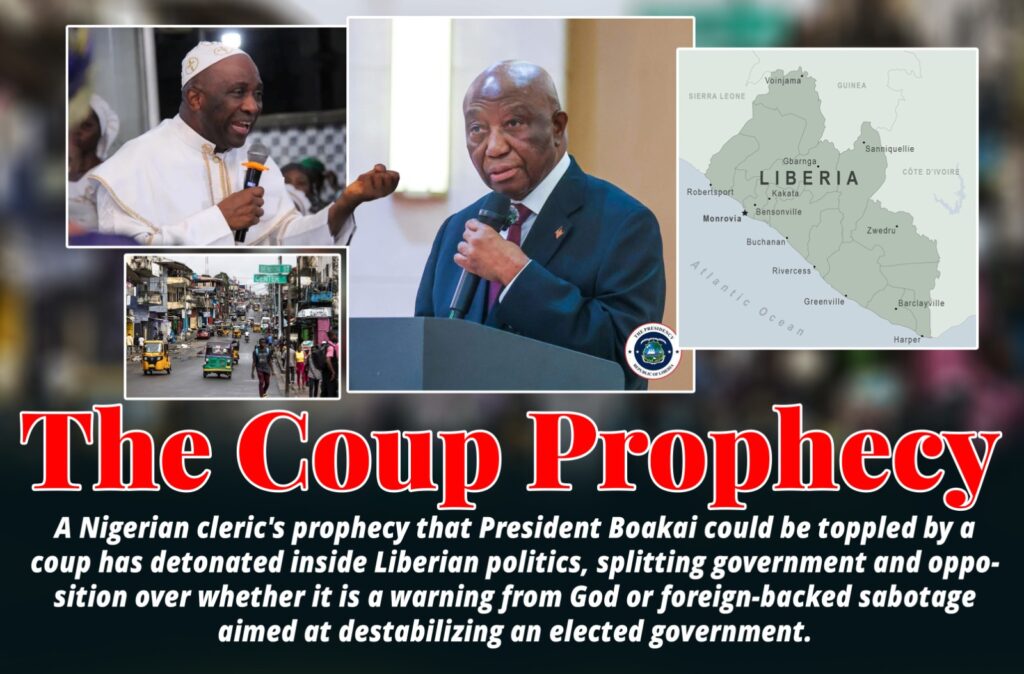
MONROVIA — A Nigerian preacher’s public suggestion that President Joseph Nyuma Boakai could face a coup has touched off a political confrontation in Liberia, with senior government officials branding the remarks incitement and members of the opposition Congress for Democratic Change rushing to the cleric’s defense.
Bishop Elijah Ayodele, founder of the Inri Evangelical Spiritual Church in Lagos, predicted in widely circulated social media videos that Liberia faces a prolonged crisis stretching to 2029, warned of a “disgraceful” rupture between Boakai and Vice President Jeremiah Kpan Koung, and questioned whether the president should resign. It was his reference to a coup, however, that drew the fiercest reaction.
“Liberia is going to be hot next year. If they don’t even plan coup against you, sincerely, your government will be very tough,” Ayodele declared in one video.
He went further, casting the presidency itself as the source of the country’s troubles. “Liberia, your president is confused, so the economy of the country is confused,” he said. “So confusion from now till 2029 in Liberia, you are going to face crisis.” Of Boakai, he added: “The man is tired, tired. Why can’t he resign?”
The cleric also forecast an open break between the nation’s two top officials. “Liberia, your President and the Vice President will fight. They get to fight disgraceful fight,” he said, predicting worsening economic hardship.
Government officials moved quickly to cast the predictions as a foreign attempt to destabilize an elected government. Liberia Water and Sewer Corporation Managing Director Mohammed Ali delivered the sharpest rebuke, accusing Ayodele of calling for the overthrow of a sitting president. “A rogue and criminal parading as pastor in Nigeria incites violence in Liberia,” Ali wrote, questioning why self-described activists had stayed silent.
National Bureau of Concessions Director-General Hanson S. Kiazolu described the prophecy as deceptive and politically motivated. “While we believe prophecy is biblical, we must remember that in the last days deception and false teaching will arise,” he said, warning that Liberia “must not return to a scandalous reign where men act as lords in a banana republic-like situation.”
Lawmakers joined the condemnation. Gbarpolu County Sen. Amara M. Konneh urged Liberians to reject the predictions outright and told the cleric to turn his attention to Nigeria’s own problems. Montserrado County Sen. Abraham Darius Dillon questioned Ayodele’s motives, citing what he called the preacher’s open political sympathies. “It is clear he loves former Pres. Weah. They are good friends and political partners,” Dillon said. “And clearly, the ‘Man of God’ does not love Pres. Boakai, so all his ‘prophecies’ are seen and delivered as such.”
Those suspected ties have been fueled by a separate video showing Ayodele symbolically handing Liberia to former President George Manneh Weah through a wrapped Bible, later passed to former Executive Chief of Protocol Nora Finda Bundoo. Weah has not commented publicly on the cleric’s latest remarks.
Several CDC figures, however, defended Ayodele and accused the governing Unity Party of attacking a truth-teller. Montserrado County CDC Youth League official Abdul D. Kanneh urged the cleric to “keep telling those confused guys from the regime of lies and deceptions.” Aloysius Howe, a former special assistant to ex-Finance Minister Samuel D. Tweah, dismissed government critics as “U.P. puppies.”
Esiaka Sheriff, now chairman of the CDC Policy Response Committee, argued that Ayodele’s earlier predictions before the 2023 elections were being deliberately ignored and disputed claims that the cleric had forecast a Weah victory. Talk-show host Abu M. Sheriff defended the prophecy by pointing to the government’s award of a vehicle license-plate contract to a foreign firm, asking, “So why are you insulting the Prophet when he’s simply telling the truth about what our dear country has turned into?”
Into the dispute stepped renowned Liberian cleric Bishop Peter Manasseh Conto, who posted guidance titled “How to Identify a False Prophet” without naming Ayodele. Citing scripture, Conto wrote that false prophets teach false doctrine, make failed predictions, pursue personal gain, reject accountability and “produce confusion and division.”
The standoff has hardened along familiar political lines. Opposition supporters insist Ayodele voiced concerns many Liberians already hold, while government officials and their allies argue the predictions amount to political advocacy disguised as prophecy, capable of inflaming an already polarized nation.



Discussion about this post