


Published: May 11, 2026
MaryJane Uzoeto-Sumo built Jane’s Healthline from scratch, with no equipment, no funding, and no guarantee anyone would buy what she was making. Four years later, she is redefining what agribusiness, wellness, and female ambition look like in Liberia.
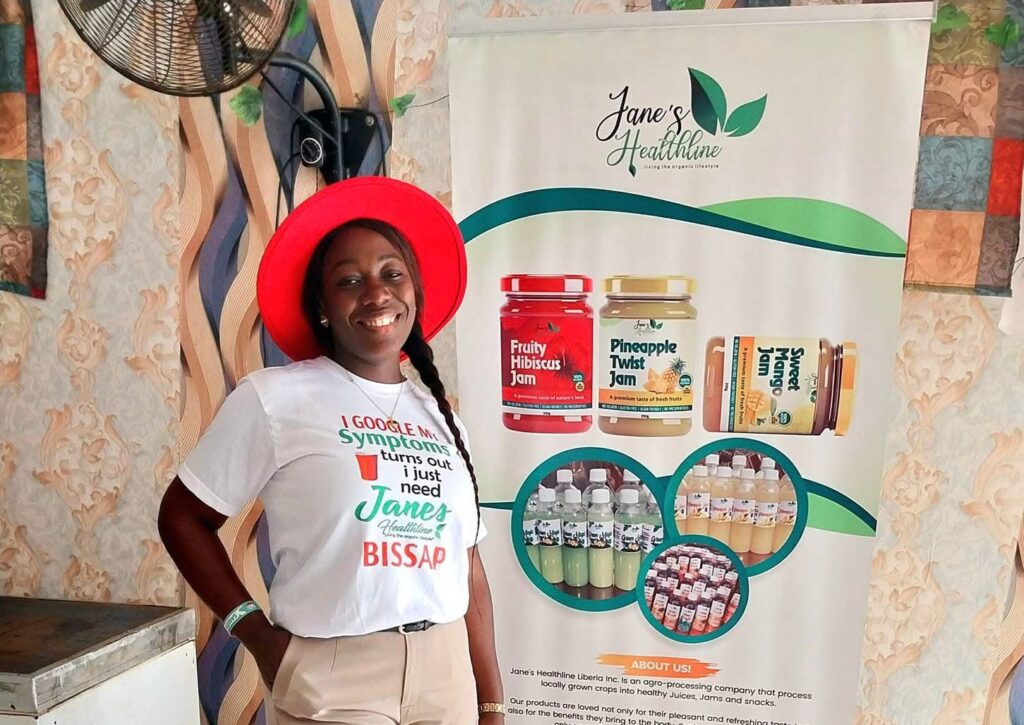
Today, Jane’s Healthline is a growing wellness and agribusiness brand producing healthy snacks, juices, parfaits, granola, and nutritional products for families across Liberia.
There is a particular kind of courage required to build something in a place that has not yet decided it wants what you are offering.
MaryJane Uzoeto-Sumo knew this when she started Jane’s Healthline Liberia Inc. She knew it when she stayed up through the night preparing products and rose before dawn to market them herself. She knew it when customers looked at her wellness snacks and juices with skepticism, when funding dried up before it ever really flowed, and when the people around her could not yet see what she was building toward.
She built it anyway.
Today, Jane’s Healthline is a growing wellness and agribusiness brand producing healthy snacks, juices, parfaits, granola, and nutritional products for families across Liberia. Its founder is an internationally certified nutritionist and mental health counselor who has spoken at graduation ceremonies, employed single mothers and young people, and built a business that, by her own telling, was never supposed to be just a business.
“Everything I do through Jane’s Healthline Liberia Inc. is rooted in my desire to help people heal, grow, live healthier lives, and become the best version of themselves,” she said.
But before any of that, there was a girl being raised by a single mother, watching carefully, and learning things that no classroom teaches.
Shaped by What She Watched
MaryJane grew up observing her mother find ways to provide when there were few ways available. That early education in resilience and resourcefulness did not leave her.
“Growing up with my single mom shaped me deeply,” she said. “I was determined, observant, compassionate, and sensitive to people’s struggles. Life exposed me to challenges early, and those experiences taught me resilience, responsibility, sacrifice, and the importance of staying grounded in purpose.”
She describes the girl she was as naturally drawn to helping, to encouraging, to finding solutions to problems in her immediate environment. But she was also being quietly formed by difficulty — by the kind of early maturity that comes not from privilege but from necessity.
Those formative years would later give shape to her business. When she began seeing loved ones struggle with obesity, unhealthy eating habits, and lifestyle-related illnesses in a market flooded with imported food of questionable nutritional value, the desire to do something about it became impossible to ignore.
“I wanted to create something that would not only provide healthy products but also inspire people to intentionally care for their bodies and overall wellbeing,” she said.
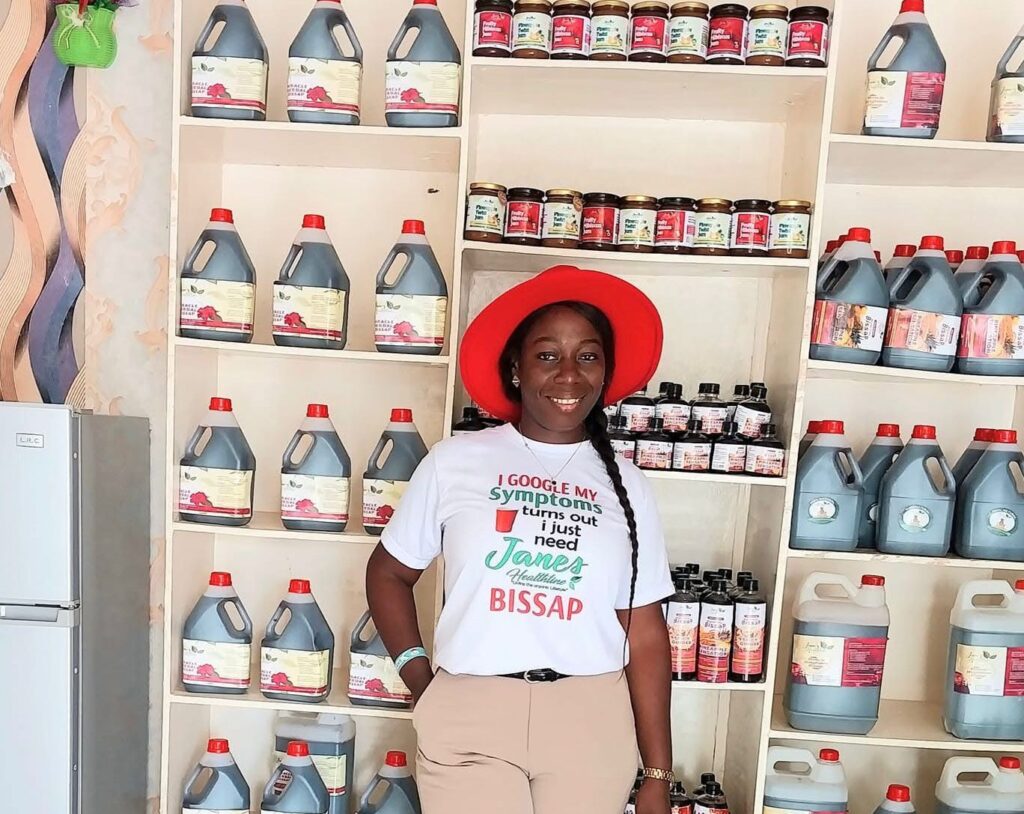
She started, by her own description, messy. Used bottles. No major equipment. No outside funding. A vision that the market had not yet been prepared to receive.
The Struggles Nobody Saw
Liberia imports a significant portion of its food despite possessing some of the most fertile land in West Africa. The country’s agricultural sector remains largely subsistence-driven, with limited investment in processing, packaging, storage, and distribution infrastructure. For a young woman trying to build a wellness brand rooted in locally sourced produce, that landscape presented obstacles that went well beyond the personal.
“One of the biggest struggles people never saw was trying to be taken seriously as a young woman in agribusiness,” MaryJane said. “Many people see the finished products, the branding, and the growth today, but they never saw the days of uncertainty, rejection, exhaustion, and starting with very limited resources.”
In the early months, she wore every hat the business required. Production, packaging, marketing, delivery, customer service, and overall management all fell to her. She was simultaneously trying to introduce a product category, local wellness food, that Liberia’s consumer market had not yet embraced.
“Convincing people that wellness products could be both healthy and enjoyable was a challenge on its own,” she said. “Our products were pure innovation and strange to the Liberian market.”
Financial constraints compounded everything. Access to equipment, quality packaging, and consistent raw materials was unreliable. And beneath the logistical pressure ran something harder to name: the emotional weight of building something meaningful while carrying everything else life demands of a young woman.
“There were nights I stayed up preparing products and still woke up early to market them myself,” she recalled. “People rarely saw the emotional side of entrepreneurship, the fear of failure, burnout, disappointments, and the pressure of trying to build something meaningful while balancing other responsibilities.”
The Moments She Almost Quit
She does not dress it up. There were moments of real doubt, seasons when she questioned whether the vision was worth the cost it was extracting from her.
“There were times I felt exhausted from trying so hard and not seeing immediate results,” she said. “Times when sales were slow, resources were limited, and I was carrying personal family struggles while still trying to show up strong for everyone else. I have cried, felt overwhelmed, and even asked myself, ‘Is this really worth it?'”
What pulled her back, she says, was a combination of faith, purpose, and the faces of the people depending on her.
“My faith in God kept me grounded during difficult seasons because this was God’s idea and I am the steward,” she said. “There were moments when all I had left was prayer, hope, and determination.”
But there was something else too — something immediate and human. Most of her team members are single mothers and young people. Knowing she is the reason they have food on their tables gives her a particular kind of accountability that abstractions about legacy cannot match.
“I watched my mom work hard for us as a single mother,” she said. “Just knowing that I am the reason they have food on their table makes me wake up and get myself together.”
Customer responses also sustained her. Messages from people managing blood pressure, blood sugar, and cholesterol through her products. Customers who had learned, slowly, to value their health. Each message reminded her that the work was reaching beyond the transaction.
“I learned that strength does not always look like having everything together,” she said. “Sometimes strength is simply choosing not to quit even when you are tired.”
Changing What Agriculture Looks Like
One of MaryJane’s most deliberate missions is to dismantle the perception of agriculture in Liberia as, in her words, “hard village work” — the image of cutlass and rain boots, subsistence and struggle, rather than innovation, branding, processing, and wealth creation.
“Agriculture is not just planting cassava or pepper,” she said. “It is food processing, manufacturing, nutrition, wellness, distribution, marketing, and job creation.”
Through Jane’s Healthline, she makes that argument not with words alone but with the product itself, with packaging, branding, and customer experience designed to make locally produced food look and feel as premium as anything imported.
She is also candid about Liberia’s structural failures in the sector. The country loses significant produce to waste during peak seasons because of limited irrigation, preservation systems, and storage infrastructure. Local processors face chronic barriers, inadequate funding, unreliable electricity, limited market access, while imported alternatives arrive ready to fill the gap.
“We still treat agriculture mostly as growing and eating instead of a full value chain that includes processing, packaging, storage, branding, and distribution,” she said. “If we invest more in training farmers, climate-smart agriculture, food preservation, and processing, we can reduce waste and maintain supply year-round.”
Her frustration with Liberia’s import dependence is real, but it has not curdled into resignation. If anything, it has clarified her sense of purpose.
“I truly believe agriculture can transform Liberia,” she said. “But we need to stop seeing it only as farming and start treating it as an industry capable of creating jobs, wealth, healthier communities, and national growth.”
The Misconceptions Women Carry
MaryJane speaks with particular clarity about what it costs women to be visible and ambitious in Liberia, not just the practical costs but the social ones.
“One major misconception people have about women who lead businesses or pursue ambitious goals is that we are ‘too strong’ to feel pressure, exhaustion, or emotional struggles,” she said. “Many people see the confidence, leadership, and achievements, but they forget that behind it all is a human being carrying responsibilities, fears, sacrifices, and personal battles.”
She also identifies a specific Liberian dynamic she has experienced firsthand: the assumption that a successful woman must have someone behind her, a benefactor, a sponsor, an explanation that does not credit her own work.
“People sometimes assume a woman’s success must be connected to luck, outside help, or someone ‘sponsoring’ her, instead of recognizing the hard work, sleepless nights, discipline, and resilience behind the journey,” she said. “Many people do not see the sacrifices women make quietly to keep their businesses alive.”
She is also aware of the impossible standard women leaders are held to — expected to succeed professionally while remaining humble, emotionally regulated, presentable, and perpetually available to others.
“We are expected to succeed, stay humble, look presentable, manage emotions perfectly, care for others, and still perform at a high level,” she said. “It can be overwhelming sometimes.”
The Legacy She Is Building
MaryJane was recently a guest speaker at the Stitches by Vee Bead Academy graduation, where more than 50 young women completed a beading skills program. She spoke about struggle, ambition, and patience, themes she does not address as theory but as lived experience.
“Struggle is not a sign of failure,” she told them. “It is often the beginning of formation.”
That is the message she returns to when she thinks about what she wants Jane’s Healthline to mean beyond its products. Not a brand, exactly, or not only a brand, but a proof of concept. Evidence that something meaningful can be built in Liberia, from Liberia, without leaving.
“I want people to remember a story of courage, consistency, purpose, and the power of a woman who dared to dream,” she said. “I want the legacy to be about people, the young woman who decided to start her own business after seeing mine succeed, the employee who found dignity through work, the single mother who found hope for her children’s future, the customer who managed their lifestyle disease and learned to value their health again, the farmer who found a consistent buyer because we chose to use local produce.”
And for the young women watching her, still deciding whether their dreams are worth the risk of pursuing them, she is direct.
“You are not late. You are not behind. Everyone has different harvest seasons. What looks like delay is often preparation,” she said. “If they can hold on to their vision, stay disciplined, remember their why, and remain teachable, their time will come.”
She paused, then added: “I just want them to believe that their dreams are valid, even in Liberia, even with limited resources, even in uncertain seasons. Because I am living proof that something meaningful can grow from starting small, staying consistent, and refusing to give up.”





Discussion about this post