


Published: May 4, 2026
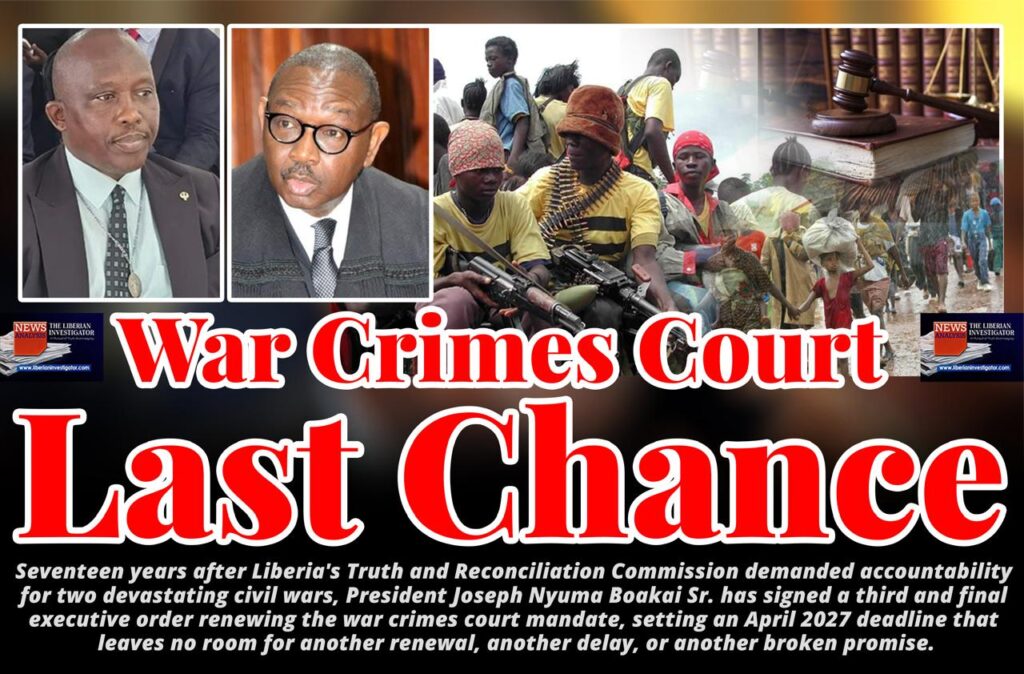
MONROVIA – Seventeen years after the Truth and Reconciliation Commission demanded accountability for Liberia’s two civil wars, President Joseph Nyuma Boakai Sr. has signed Executive Order No. 164, renewing for the third consecutive time the mandate of the Office of the War and Economic Crimes Court for Liberia (OWECC-L). The order expires April 30, 2027. There will be no fourth renewal. Either the court is established by then, or the process dies with the mandate.
The new Executive Order mandates quarterly disbursements of $500,000 directly into OWECC-L’s bank accounts, a direct response to years of financial strangulation. It sets 60-, 90-, and 120-day deadlines for resource mobilization plans, legislative engagement, and comprehensive implementation frameworks. It orders a dissolution plan by March 1, 2027, and a final transition report by April 15, 2027.
17 Years, Three Orders, One Unbuilt Court
The TRC’s 2009 final report called for an extraordinary hybrid tribunal to prosecute war crimes and crimes against humanity committed between 1979 and 2003. Three presidential administrations let the recommendation gather dust. It was not until April 2024, under sustained domestic and international pressure, that the Legislature adopted Joint Resolution JR-001/2024 endorsing a Special War Crimes Court. Boakai signed EO No. 131 on May 2, 2024. He renewed it on April 30, 2025. He has now renewed it again.
Each renewal has brought fresh pledges and fresh appropriations on paper. What the renewals have not consistently delivered is money in the Office’s accounts, legislation on the Legislature’s floor, or a court nearer to reality. That pattern is the central crisis of this process.
Accomplishments That Have Gone Underfunded
Under Executive Director Cllr. Jallah Barbu, appointed in late 2024, OWECC-L has produced real results: a nationwide consultative road map launched in July 2025, draft bills for both a War and Economic Crimes Court and a National Anti-Corruption Court submitted to the Presidency in December 2025, and a landmark media memorandum of understanding with the Association of Journalists for the United Right of Liberia. In his January 2026 State of the Nation address, Boakai publicly confirmed that the draft laws were complete and urged lawmakers to act.
But those accomplishments have been produced on a financial shoestring that borders on bad faith. EO No. 131 pledged two million dollars annually. In the first year, the Office received $500,000, of which $368,000 was money transferred from the Ministry of Justice rather than a fresh government allocation. By early 2026, Barbu publicly disclosed the Office had received only $800,000 of the funds promised for the entire 2025 fiscal year. For reference: the TRC itself received approximately $1.4 million annually from the government during its own operations. The body charged with delivering the court the TRC called for has been funded at half that rate, irregularly, through channels Barbu has described as deliberately obstructive.
The problem has never been the executive orders. The problem has been everything else.
A Government at War With Itself
Nothing has damaged this process more visibly than the public rupture between Barbu and Justice Minister Oswald Tweh. In radio appearances earlier in April, Cllr. Barbu accused senior officials of deliberately burying draft legislation and blocking fund disbursements. Cllr. Tweh rejected the accusations, attributed delays to legitimate procedural and constitutional requirements, and invited OWECC-L to direct engagement. The exchange was conducted largely through the press. International partners watched. Donor confidence took a measurable hit.
Compounding the damage: Boakai’s appointment of Lewis G. Brown II, whose name appears on the TRC’s list of persons recommended for further investigation, as Liberia’s Ambassador to the United Nations, sent a signal to the international community that the presidency has struggled to walk back. The EU, the UN, and Human Rights Watch all noticed.
The Legislative Maze
As of this writing, at least four competing legislative proposals are in circulation: OWECC-L’s official draft bills, a rival civil-society-backed statute submitted independently to the Senate in December 2025, Sen. J.K. Jallah’s placeholder bill, and additional proposals from other quarters. The fragmentation reflects not just poor coordination but a deeper political contestation over what the court should be, who should control it, and, for some, whether it should exist at all.
EO No. 164 gives OWECC-L 90 days to commence technical engagement with the Legislature and submit a legislative support framework. The Judiciary and Human Rights committees are reportedly consolidating the competing texts. But calling a floor vote, in the face of opposition from powerful former leaders and their legislative allies, remains untested political terrain.
The Opposition That Will Not Go Away
Former President Ellen Johnson Sirleaf has called the court counterproductive to stability. Former President George Weah has questioned its timing. Sen. Thomas Y. Nimley, a former faction leader, has opposed it outright. These voices represent networks of influence that extend deep into the current Legislature and the business community. Any bill that reaches the floor will face organized opposition from people with direct personal stakes in its failure.
The TRC named approximately 100 individuals as bearing the greatest responsibility for civil war atrocities. Many remain politically active. The court’s credibility depends on its independence from precisely those actors. Its passage through the Legislature depends on some of those same actors allowing it to move.
International Money Is Not Enough
The EU and OHCHR launched a $724,000 joint project in February 2026 to support the court’s establishment, a meaningful political signal, but a fraction of what operational reality requires. Experts estimate annual operating costs for a functioning hybrid tribunal at $10 to $15 million. Sweden, a major rule-of-law donor, is scaling back regional engagement. US foreign aid freezes have introduced uncertainty across West Africa’s governance programs. The donors who remain are watching Liberia’s Legislature and Ministry of Finance for evidence that domestic commitment is real.
The Special Court for Sierra Leone, which prosecuted Charles Taylor, demonstrated what is possible when political will, adequate funding, and international backing align. It also demonstrated that such tribunals cost real money over many years and require the government being held to account to actually support the process. Liberia has produced three executive orders and draft legislation. It has not yet produced the financial commitment or legislative consensus the Sierra Leone model required.
What the Next 12 Months Must Deliver
The Ministry of Finance must release $500,000 into OWECC-L’s accounts each quarter, on schedule, without the bureaucratic delays that have characterized every prior disbursement cycle. The Legislature must harmonize the competing bills and bring a credible statute to a floor vote. The Ministry of Justice and OWECC-L must resolve their institutional conflict and produce a unified legislative submission. And the presidency must demonstrate — in action, not address — that it will not allow powerful political opponents to quietly suffocate the court before the Legislature ever votes.
None of that is impossible. All of it is harder than signing an executive order.
Either the court is established by April 2027, or the process dies with the mandate.
The Only Question Left
Behind every institutional debate and budget figure are approximately 250,000 Liberians killed between 1989 and 2003, and tens of thousands more who survived atrocities that have gone unprosecuted for a generation. Those survivors are aging. Witnesses die. Evidence deteriorates. The international infrastructure of accountability that would underpin a Liberian tribunal is under pressure from shifting global priorities.





Discussion about this post