


Published: October 28, 2026
MONROVIA — Liberia will take the U.N. Security Council presidency in December for the first time in 65 years. President Joseph Nyuma Boakai is scheduled to chair a high-level debate on maritime security on Dec. 3, the government said Monday as it set out a calendar of national events leading up to the presidency.
“The international order is being shaped now, and Liberia is at the table,” Boakai said at the Ministry of Foreign Affairs, where the government marked U.N. Day under the theme “Liberia on the United Nations Security Council: From Sustaining Peace at Home to Advancing Peace and Security Globally.”
Boakai, who formally launched the government’s “Road to the United Nations Security Council Presidency,” said Liberia will approach the presidency with humility, responsibility and a stronger voice. He said the country will draw on its experience of ending civil conflict, advancing reconciliation and rebuilding after war to contribute to international peace and security.
He called Liberia’s 2025 election to the council for the 2026-2027 term a historic achievement that reflects the country’s renewed engagement in international affairs. He said global problems require collective action and stronger partnerships among nations, citing climate change, irregular migration, poverty, widening inequality and emerging technologies such as artificial intelligence. He said developing countries must have a meaningful voice in decisions that affect the international community.
The council presidency rotates monthly among its 15 members.
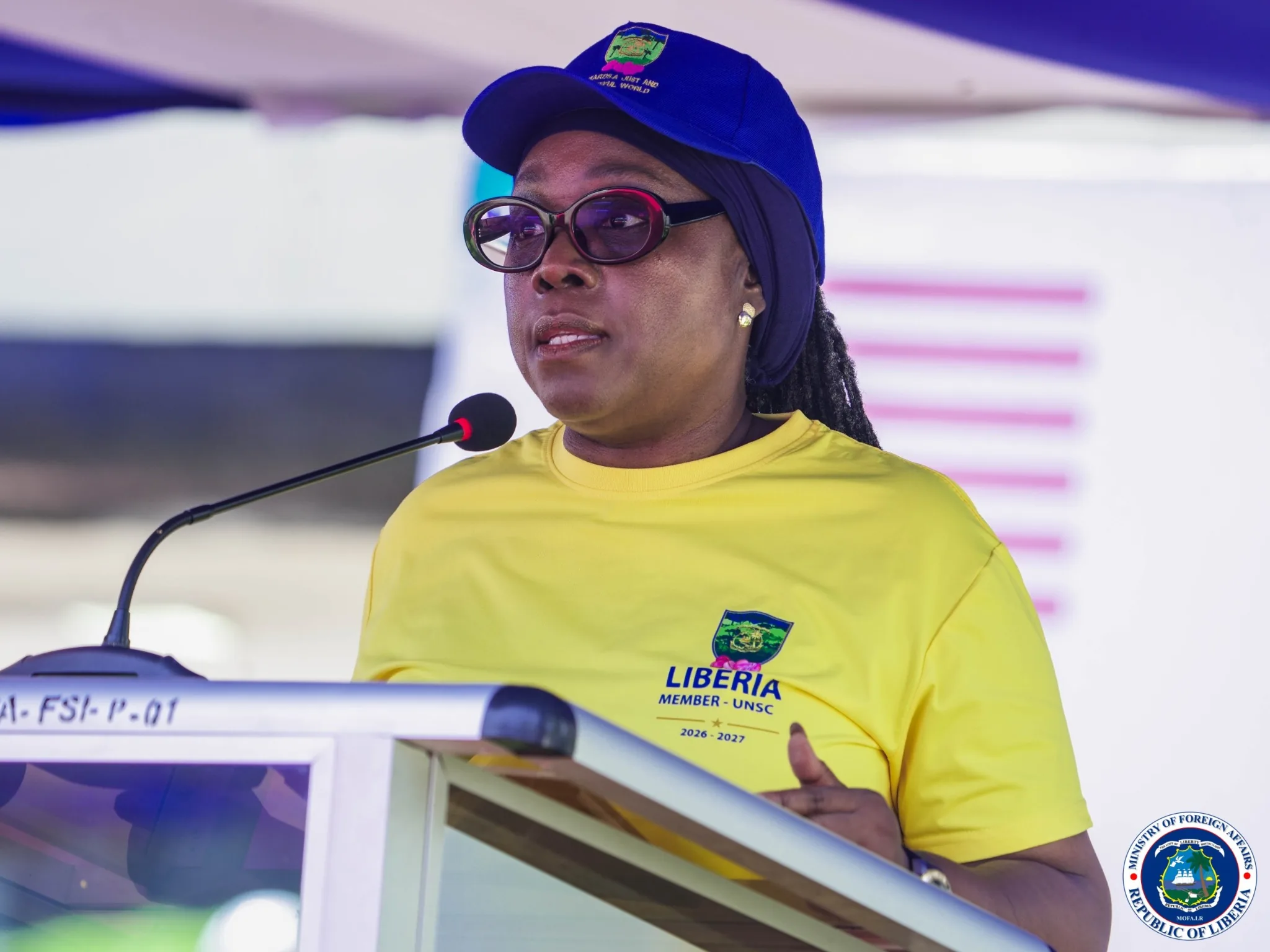
Foreign Minister Sara Beysolow Nyanti told the gathering that Liberia’s place at the head of the council belongs to the country, not to any single government. “This is not about an event; it is about a process through history,” she said. She said the presidency results from decades of diplomatic work, national resilience, and the contributions of successive administrations.
Minister Nyanti traced Liberia’s path from the years when the Security Council sanctioned it to its coming turn in the chair. During the civil wars, she said, the council adopted several resolutions imposing sanctions on Liberia, including restrictions on arms, diamonds, timber and travel. She contrasted that period with the country’s recovery through reconciliation, democratic governance and international partnership.
She paid tribute to the Women of Liberia Mass Action for Peace, whose campaign helped end the war, and to the U.N. Mission in Liberia for its role in the country’s post-conflict recovery. She cited Liberia’s peaceful democratic transfers of power and the 2011 Nobel Peace Prize shared by former President Ellen Johnson Sirleaf and peace activist Leymah Gbowee. She also cited the lifting of the last U.N. sanctions on Liberia in 2016 as milestones.
Minister Nyanti recalled that Liberia first sat on the Security Council in 1961. She said Liberians have served in senior U.N. posts, naming Sirleaf, Ambassador Winston Tubman and herself.
She honored 11 former foreign ministers and senior diplomats for their part in building Liberia’s international standing: H. Boima Fahnbulleh, Monie R. Captan, Lewis G. Brown, Thomas Nimely, George Wallace, Olubanke King-Akerele, Augustine Kpehe Ngafuan, Toga McIntosh, Marjon Kamara, Gbehzohngar Findley and Dee-Maxwell Saah Kemayah.
Minister Nyanti said Liberia’s diplomatic record should be treated as a shared national legacy. She called for greater investment in preparing qualified Liberians for leadership positions in international institutions.
She also unveiled the ministry’s calendar of events ahead of the presidency. It begins with a diplomatic briefing and reception on Oct. 30 and includes the unveiling of a model for a proposed National War Memorial. Liberia’s feminist foreign policy is due to launch Nov. 17, which the ministry tied to the government’s commitment to women’s leadership and the women, peace and security agenda.
The ministry also plans to release a compendium of Liberia’s peace agreements and to hold a presidential dinner at the ministry. Other events include a national event recognizing seafarers and a model Security Council debate meant to draw young people into international affairs. The events lead up to the December presidency and the Dec. 3 debate on maritime security.
The ministry also unveiled a commemorative billboard naming Boakai “Liberia’s Foreign Policy Legacy President.” The ministry said it highlights the administration’s work to strengthen Liberia’s international standing, advance economic diplomacy and expand global partnerships.
Christine Umutoni, the U.N. resident coordinator, said countries must keep putting dialogue ahead of conflict and peace ahead of disputes. She urged member states to recommit to the values and obligations that underpin the United Nations. She said upholding the U.N. Charter and international law has become more critical than ever, and called for strengthening the organization so it can serve people effectively and meet complex global challenges.
The day marked 81 years since the United Nations was founded in 1945, after World War II.



Discussion about this post