


Published: May 20, 2026
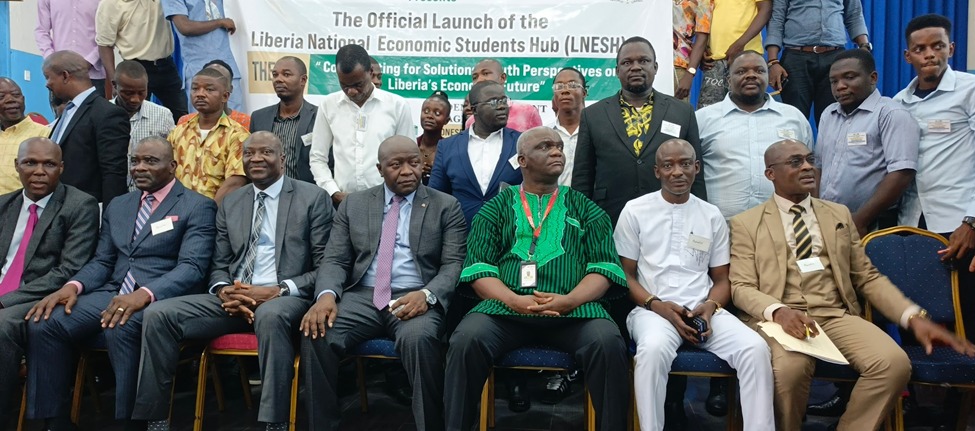
MONROVIA – The Ministry of Finance and Development Planning has officially launched the Liberia National Economic Student Hub (LNESH), a new government-backed initiative aimed at training more than 500 students in economic research, policy writing, and macroeconomic analysis as authorities seek to redirect young people from what Finance Minister Augustine Kpehe Ngafuan described as “toxic discourse” and political “battle cries” toward professional and intellectual development.
The initiative was formally launched Tuesday at the auditorium of the University of Liberia under the theme: “Collaborating for Solutions: Youth Perspectives on Liberia’s Economic Future.”
The event brought together senior government officials, economists, students, development partners, and members of the academic community, including Henry F. Saamoi, former Central Bank Executive Governor Mills Jones, Deputy Commerce Minister Woodward Reeves, and officials from the Finance Ministry.
Ngafuan Pushes Youth Toward Research, Policy Development
Launching the initiative, Ngafuan said the government has a responsibility to “light the candle” by creating opportunities that help young Liberians transform raw talent into professional capacity.
He stressed the importance of moving beyond political rhetoric and encouraging young people to engage in evidence-based research, fiscal policy discussions, and national development planning.
“It is my pleasing duty as Minister of Finance, empowered by our visionary leader, President Joseph Nyuma Boakai, to launch this very transformative Liberia National Economic Student Hub,” Ngafuan declared. “By this, we wish all of us well, and we wish our country well.”
According to the minister, the Hub will train students to produce policy briefs, fact sheets, and macroeconomic policy recommendations grounded in valid national data.
“In this process, the hub is targeting to train over 500 students to produce policy briefs, fact sheets, and macroeconomic policies grounded in valid national data,” he said. “This effort will build a pipeline of future economists, researchers, and policy professionals who can contribute meaningfully to Liberia’s development agenda.”
Ngafuan warned that Liberia risks weakening its future leadership if young people focus only on political slogans instead of intellectual and professional development.
“We, the Liberians of today, need to do better than what we are doing,” Ngafuan stated. “Many are practicing how to shout better battle cries. But if it’s only battle cries, then we have a problem.”
“Our duty is to prepare men and women that are well-rounded,” he continued. “When the time comes to produce a paper or a policy brief, we don’t want them to be running away.”
Reflecting on Student Activism, Search for Knowledge
In a reflective moment during his address, Ngafuan recounted his own years as a student leader at the University of Liberia during the country’s civil conflict, describing his generation as “greedy” for knowledge and enlightenment despite difficult conditions.
“We were greedy, very greedy, but greedy in another way,” he told students. “We were greedy for knowledge, for enlightenment. We never had Facebook, we never had internet.”
Ngafuan said students of his generation actively sought mentorship and intellectual engagement from accomplished Liberians, describing the university as “the crucible” that shaped many future leaders.
“We were in the classroom, but we were in many other rooms,” he said. “If people say today that we are strong in any way, that is our story. That’s how we made it.”
Government Expands Youth Development Programs
The Finance Minister also announced that approximately 1,100 young Liberians will begin a six-month national cadet program on June 1, 2026, to be deployed across government institutions, private entities, and international organizations, including the United Nations.
“Six months to learn, to bridge the gap between theory and practice,” he explained. “Most of them will justify their inclusion and most of them will be employed.”
Ngafuan described the government’s investment in youth capacity development as equally important as physical infrastructure projects.
“What I want to stress is that as a government, we are engaging in a lot of investment addressing the issue of our infrastructure,” he said. “But we also have to deal with the soft infrastructure for development. We have to prepare the capacity of men and women.”
He compared the initiative to a form of national recruitment aimed at building intellectual capacity.
“The government is recruiting people who will hold guns,” Ngafuan said. “The government is recruiting people who will hold pens. We will do all together.”
He pledged that the initiative would eventually expand beyond Monrovia to universities in counties including Lofa, Bong, and Margibi.
Saamoi: Youth Must Shape Liberia’s Economic Future
Delivering special remarks, Central Bank Executive Governor Saamoi described LNESH as “a timely, forward-looking, and highly strategic initiative” that places young people at the center of Liberia’s economic transformation.
“This initiative is important because it brings young Liberians directly into the heart of the economic conversation at a time when such inclusion is no longer optional, but a national necessity,” Saamoi said.
He emphasized that Liberia’s youthful population should be viewed as a national advantage rather than a burden.
“In Liberia, more than 60 percent of the population is under the age of 35, making our youth not only a demographic reality but a decisive economic force,” he noted.
Saamoi encouraged students to see themselves as contributors to national policy development and innovation.
“Your ideas matter, your voices matter, and your engagement today can help shape policies that will define Liberia’s economic trajectory for years to come,” he told participants.
The Central Bank Governor also highlighted ongoing reforms aimed at strengthening digital financial services, payment systems, and financial inclusion.
Experts Describe Initiative as ‘Intellectual Movement’
Meanwhile, Executive Director of the Liberia Macroeconomic Policy Analysis Center, P. Pandolo Moye, described the Student Economic Hub as “the structural blueprint of an intellectual movement.”
“For too long, policy discussions in Liberia have been confined to board rooms and international conference halls, distant from the bright minds of students,” Moye said.
“You, the students here today, are not just observers of Liberia’s economic story,” he added. “You are its future authors.”
Assistant Finance Minister for Economic Policy Henry D.Z. Yanquoi described the Hub as a platform designed to connect students with government institutions, think tanks, and development partners.
“This hub is your laboratory of ideas and your gateway to professional leadership in public policy,” Yanquoi told students.
He said the program’s first engagement would focus on domestic resource mobilization and youth unemployment, issues officials described as central to Liberia’s long-term economic future.
“We are calling for deep-dive conversations that move toward evidence-based thinking,” Yanquoi stated.
Officials said the Liberia National Economic Student Hub is intended to serve as a long-term national investment in economic literacy, policy development, youth leadership, and institutional succession planning.
“The Liberia we desire will not be built by chance,” Governor Saamoi concluded. “It will be built by informed, empowered, courageous, and prepared young people willing to lead, innovate, and serve.”






Discussion about this post