


Published: July 4, 2026
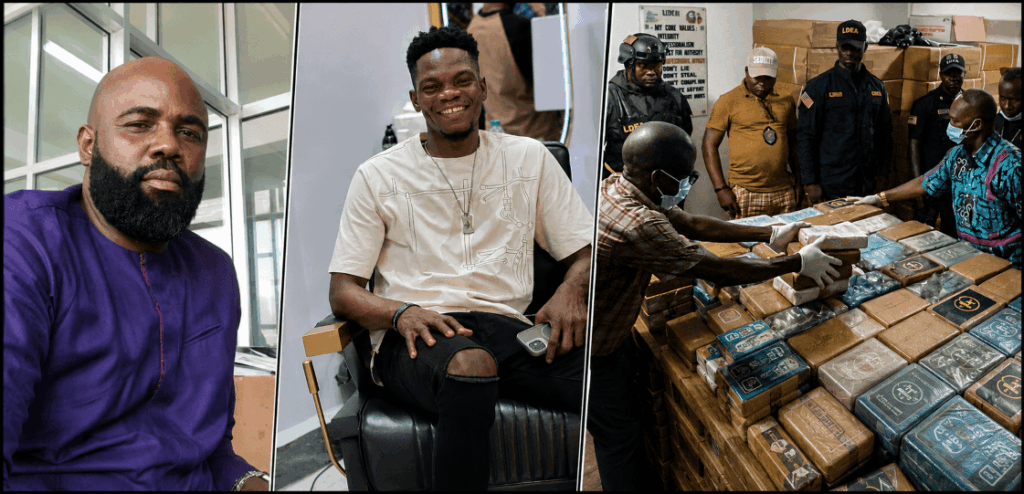
MONROVIA — Police on Saturday charged Paul J. King and Michael U.S. Browne, the suspect whose 2024 prison release the Senate just ordered probed, in the US$19 million cocaine seizure at Roberts International Airport.
King, Browne and three other men, along with the cargo firm Global Logistics Services, were accused of moving the cocaine through the airport disguised as Maggi cubes and lappas. Browne, known also as Rahim or Raheem Bah, was one of four charged in absentia, and police say the three others helped clear, deliver or finance the shipment.
In a statement issued late Saturday evening, Inspector General of Police Col. Gregory Coleman said the June seizure of roughly 237.6 kilograms of cocaine was no accident and no clerical slip, but the exposed tip of an organized criminal enterprise routing drugs through the country’s air cargo system.
“This was not a paperwork error. This was not a routine cargo discrepancy. This was not an innocent shipment gone wrong,” Coleman said. “This was a serious transnational cocaine trafficking operation using Liberia’s aviation and logistics system as a channel for organized crime.”
Coleman said the consignment of six boxes was presented for export as ordinary commercial cargo but was flagged, held and eventually opened at the airport. The boxes were prepared for shipment on Friday, June 5, he said, but discrepancies in the declared weight, suspicious screening images and conflicting shipping documents kept the cargo from leaving that day. When the boxes were re-screened and physically inspected on Sunday, June 7, officers found a white powdery substance concealed inside. It was turned over to the Liberia Drug Enforcement Agency, tested and confirmed to be cocaine, 198 plates with an estimated street value above US$19 million.
The investigation did not end at the seizure, Coleman said. He told the nation that after the cocaine was discovered, members of the network moved to recover it and to compromise the case. The evidence, he said, established “deliberate efforts by operating cells of the cartel to bribe security personnel, retrieve the shipment, and interfere with the seizure.”
Coleman said the Joint National Security Investigation, ordered by President Joseph Nyuma Boakai and supervised by the Ministry of Justice, traced the cargo trail, the money trail, communications data and digital evidence, and uncovered an earlier shipment moved in May 2026 under the same false description and linked to the same network. That, he said, made the June interception part of a pattern rather than a single event.
“We are not treating this as a closed-file seizure,” Coleman said. “We are treating it as a network investigation aimed at identifying every participant, financiers, organizers, handlers, couriers, facilitators, insiders, and foreign links.”
The suspects were charged under the Amended Controlled Drugs and Substance Act of 2023 and Chapter 10 of the Revised Penal Code of Liberia. The counts include unlicensed exportation of controlled drugs, unlicensed transportation and trading in transit, unlicensed possession, illicit trafficking and criminal conspiracy.
Coleman said Paul J. King, identified as operations manager of Global Logistics Services, and the company itself conspired to accept, store and move the six-box consignment through the airport cargo chain, with GLS providing what he called substantial assistance to the scheme. Browne, alias Bah, was linked to the organization of the shipment, the use of bogus front companies, the coordination of cargo falsely declared as Maggi cubes and lappas, and the attempts to recover the cocaine after it was exposed.
The police chief said Oscar J. Browne scanned and cleared a similar shipment on May 22 and made repeated calls about the seized cargo in an effort to secure its release after its contents had been discovered. Emmanuel Kpah, he said, delivered the shipment and the cash tied to the transaction, while Usman Ali was named as the consignee based in the United Kingdom. King, Browne, Oscar J. Browne, Kpah and Ali all face the same core trafficking and conspiracy counts, with a criminal solicitation charge added in at least one instance.
Coleman said suspects who are in hiding, outside the country or otherwise evading the law are being pursued through arrest warrants, international law enforcement cooperation, extradition requests and mutual legal assistance. He said the investigation into the May shipment and related consignments remains open.
The police chief framed the case as a test of whether Liberia can keep its institutions out of the hands of traffickers, and warned that connections would not shield anyone.
“Liberia cannot and will not become a safe transit corridor for trans-national organized criminal organizations,” he said. “We will not allow criminal networks to hide behind company names, false airway bills, airport access, political connections, or cash inducements.”
He continued: “If you traffic drugs through Liberia, we will pursue you. If you facilitate drug trafficking, we will charge you. If you try to bribe officers to release narcotics, we will expose you. If you abuse public trust to shield traffickers, we will bring you before the law.”
Coleman said every person named remains entitled to the presumption of innocence “until proven guilty by a court of competent jurisdiction,” adding that the duty of law enforcement was to investigate thoroughly, charge lawfully, preserve the evidence and place the matter before the court.
The charges land after a week of mounting pressure on the joint security. On July 1, the Senate summoned security leaders to a special session over the slow pace of the case, following a communication from Bomi County Senator Edwin Melvin Snowe Jr. and Gbarpolu County Senator Amara M. Konneh demanding an independent, transparent probe. During that session, senators pressed for King’s arrest and questioned Browne’s reappearance, and Senate Pro Tempore Nyonblee Karnga-Lawrence ordered the Judiciary Committee to investigate how Browne had walked out of prison after a 2024 drug charge, a release The Liberian Investigator detailed from the court file this week.
Coleman closed with a promise aimed at the network the police say they are still tracing.
“Liberia is closed to drug traffickers. Our airport is not your corridor. Our institutions are not for sale. Our officers are not your brokers,” he said. “This investigation will continue. This network will be pursued. And this case will not be buried.”




Discussion about this post