


Published: June 26, 2026
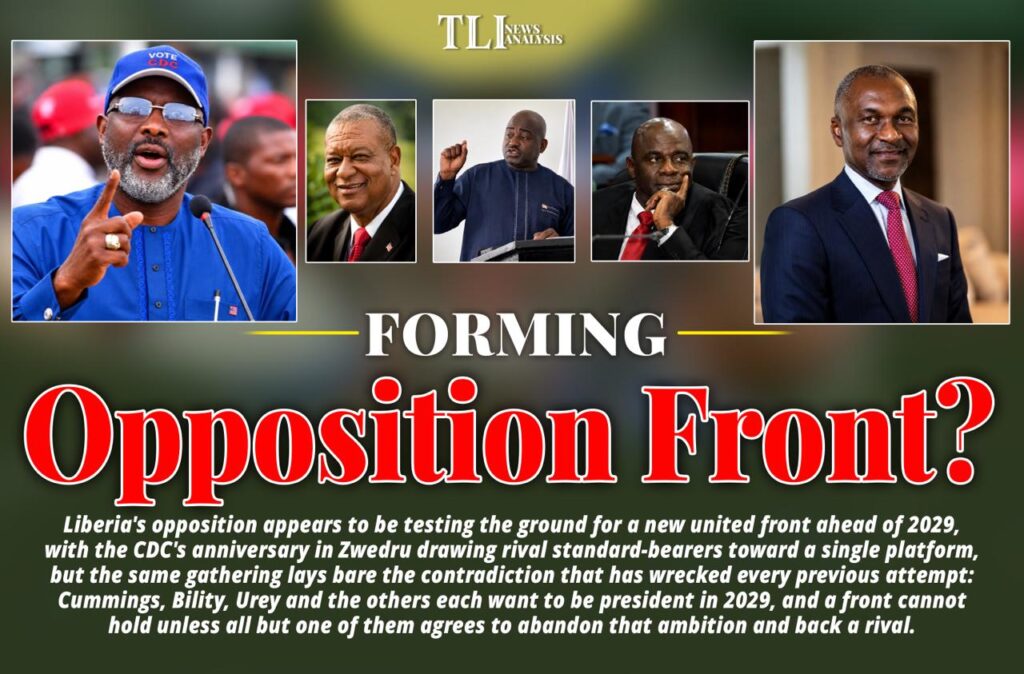
MONROVIA – A political party that lost power less than three years ago is using its anniversary to gather the very figures who helped take it away.
When Alexander B. Cummings speaks in Zwedru on Saturday to deliver the keynote address at the Congress for Democratic Change’s 22nd anniversary, the seating chart will matter more than the speech itself. The leader of the Alternative National Congress is the main name on an invitation signed by CDC National Chairman Atty. Janga A. Kowo. However, the people expected to be around him, including Citizens’ Movement for Change leader Musa H. Bility, businessman Benoni Urey, and Cllr. Kabineh Ja’neh, are the ones who will turn the simple party celebration into a political event worth paying close attention to.
The CDC has presented the gathering, which runs from June 23 to 27 under the theme “Zwedru Rises: 2029 Victory Is the Final Destination,” as something more than a birthday rally. In its letter to Cummings, the party described this year’s celebration as a national political renewal and policy dialogue aimed at promoting reflection, accountability, and democratic engagement. It also stated it would bring together political leaders, former officials, civil society, and traditional authorities from across the country.
The unspoken focus of the Zwedru gathering is consolidation. After George Weah’s loss in 2023, the CDC returned to opposition status. Having Cummings as the keynote speaker and inviting opponents from the 2023 contest enables the CDC to reframe itself from a struggling incumbent to a facilitator of a wider anti-establishment coalition. The theme points clearly to 2029, and the guest list shows that preparations are already underway. Several of the figures now expected in Grand Gedeh were aligned, in one form or another, with the constellation of forces that delivered President Joseph Boakai to office in 2023. Cummings himself ran against that constellation under a Collaborating Political Parties banner that finished far back in the first round.
Boakai’s victory in the November 2023 runoff was one of the narrowest in Liberia’s recent history, a margin of roughly 50.6 percent to 49.4 percent. An opposition that splits its vote across three or four standard-bearers in 2029 gives the ruling Unity Party a path to reelection without having to win an argument. An opposition that consolidates behind a single candidate, or even a credible two-party arrangement, directly threatens that margin. Every serious actor in Zwedru understands this. The question is whether understanding the math has ever been enough.
The historical record says it has not. Liberia’s opposition has rehearsed this exact scene before, twice in the last decade, and both performances ended the same way.
In 2016 and 2017, Liberty Party leader Charles Brumskine repeatedly urged a single opposition ticket and publicly offered to set aside his own ambition to get one. He told reporters there was no path that would tie his party to the ruling establishment, and he pressed for unity among all opposition parties. Then-Vice President Boakai declined to partner with him. Weah, Cummings and Urey ran independently. After the first round, the Unity Party and Liberty Party cooperated only narrowly, to challenge vote tallies in court, and that challenge failed. The fragmented field cleared the way for Weah, who won the runoff and took office in 2018.
The 2022 to 2023 cycle was supposed to be different because this time there was paper. In February 2019, four parties, the Unity Party, Liberty Party, the ANC and Urey’s All Liberia Party, signed a memorandum of understanding and formed the Collaborating Political Parties, a bloc certified by the National Elections Commission and built explicitly to remove Weah from power. For a moment, it looked durable. Then it did what Liberian coalitions do. A dispute between Urey and Cummings over the CPP’s framework document escalated into accusations of tampering and a police case, and by early 2022, both Urey and Boakai had walked away from the alliance. Boakai went on to win the presidency the following year, not through the grand coalition but through a narrow, pragmatic deal with Prince Johnson in Nimba. Cummings ran on under the CPP label that his former partners had abandoned and finished in the low single digits.
This is the inheritance the Zwedru gathering carries into the room. Two of the most consequential figures in that collapse, Cummings and Urey, are both expected in Grand Gedeh this week. Whatever warmth the anniversary produces will be measured against a litigated falling-out that neither man has fully accounted for in public.
The personalities now involved make the new front story even more complicated. Cummings has consistently called himself coalition-friendly, but on his own terms. He says he is ready to lead and build unity, willing to work with any opposition figure who shares a commitment to good governance, accountability, and economic change. He has also warned, in a pointed way, that past coalitions failed because they fought over offices instead of focusing on an agenda. That positions him as someone who sees himself as the natural center of any consolidation, not as someone preparing to step aside for it.
Bility is the hardest piece to fit. After breaking from the Liberty Party and launching the Citizens’ Movement for Change, he outlined what he calls a third lane, deliberately outside both the Unity Party and the CDC. In a 2025 letter, he declared that the two main parties no longer deserve voters’ trust and urged Liberians to look beyond the old establishment entirely. He launched his 2029 presidential bid in Saclepea and has focused on building the CMC rather than courting rivals. His likely presence in Zwedru is, therefore, the most interesting data point because his entire brand is based on the refusal to do exactly what attending a CDC anniversary seems to endorse.
Saturday could be the start of a conversation rather than the announcement of a bloc. There is no memorandum on the table, no shared platform, and no public sign that any of these leaders has agreed to subordinate their ambition to another’s. In a fractured opposition, getting the principals to occupy the same physical space is not easy, and the CDC is facilitating it. The party gets to play host and broker, which restores some of the relevance it lost at the ballot box, and the visiting leaders get to test each other’s intentions at low cost.
For the Unity Party, the calculus is simpler and more comfortable. A divided opposition is the ruling party’s most dependable asset, and history suggests the divisions in Zwedru run deeper than the handshakes. The UP can watch the anniversary with the confidence of a frontrunner who has seen this film twice and knows how it ends. The risk to Boakai’s party is not this gathering. The risk is what this gathering could become if, this time, the principals do the unglamorous work that every previous effort skipped, namely settling in advance who carries the ticket and binding themselves to an agreement that survives the first insult.






Discussion about this post