


Published: October 16, 2026
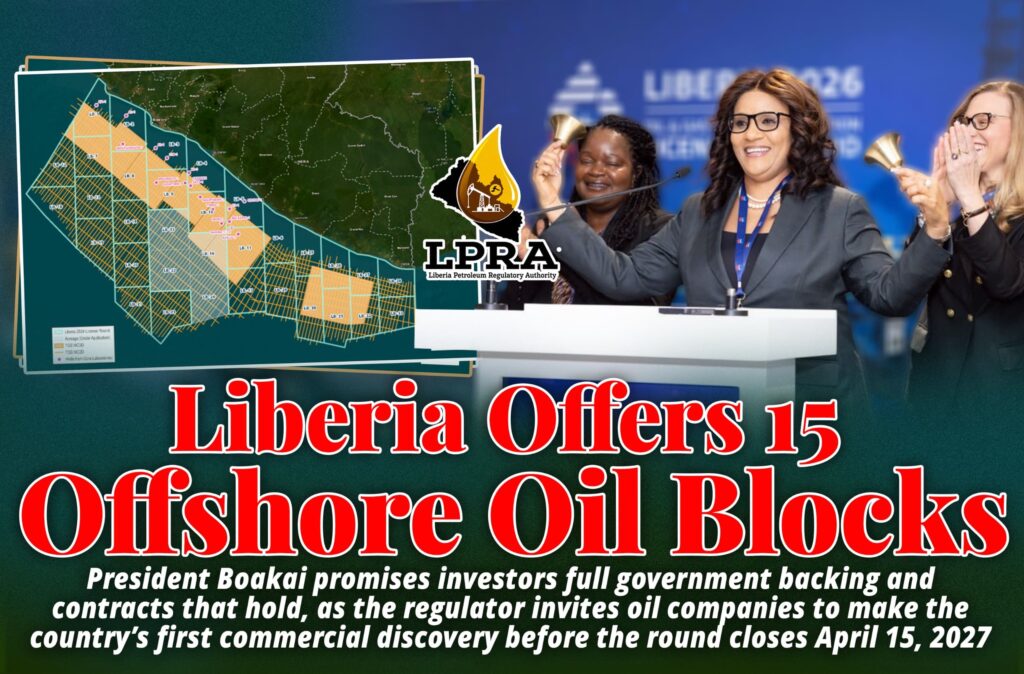
MONROVIA – Liberia has opened 15 offshore blocks to international oil companies, giving explorers a new chance to make the country’s first commercial oil discovery. President Joseph Nyuma Boakai promised the round the full backing of his government and told investors their contracts would hold.
By Lennart Dodoo
The Liberia Petroleum Regulatory Authority launched the 2026 Offshore Direct Negotiation Licensing Round on Wednesday at African Energy Week in Cape Town, South Africa, before government officials, oil company executives and industry representatives. It covers 12 blocks in the Liberia Basin and three in the Harper Basin. The window closes April 15, 2027.
“Today, I assure you that the journey you are about to begin with Liberia, through the LPRA, carries the full support of the Liberian government,” Boakai said in a video message.
The president said Liberia’s laws are clear and enforceable, and agreed terms would remain valid “today and in the future.” He also said every deal has to serve the country as well as the companies.
“No agreement is worth signing unless it works for all parties to it,” Boakai said.
LPRA Director General Marilyn T. Logan told the gathering that the geology is there for the company willing to drill.
“Our petroleum system works,” Logan said. “Whichever company makes the first discovery will play a significant role in the history of our country.”
That confidence has a basis in the record. In 2011, Anadarko Petroleum’s Montserrado-1 well recovered a sample of light oil from offshore Liberia. The find was not commercial, but it established a working hydrocarbon system in the Liberia Basin, Oil & Gas Journal reported at the time. A commercial discovery has still not followed. The best-known later attempt was ExxonMobil’s Mesurado-1 well in 2016, which was unsuccessful, according to Ecofin Agency.
The round on offer covers blocks LB-1, LB-2, LB-3, LB-7, LB-12, LB-13, LB-14, LB-18, LB-19, LB-20, LB-21 and LB-23 in the Liberia Basin, and LB-25, LB-28 and LB-33 in the Harper Basin.
Companies bidding for them will have a large body of data to work from. The LPRA said the round is backed by more than 50,000 line-kilometers of two-dimensional seismic data and about 31,000 square kilometers of three-dimensional seismic coverage. Technical data provider TGS has reprocessed about 12,000 kilometers of the 2D data and 5,100 square kilometers of the 3D data to sharpen images of the subsurface.
Jason Robinson, managing director of ENARJI, a geoscience firm, said at the launch that the geological evidence shows a working petroleum system offshore Liberia, with significant deepwater opportunities along the Atlantic margin.
The round builds on a breakthrough year for the sector. Liberia signed eight production-sharing contracts in 2025 with two companies, its first new offshore deals in years. TotalEnergies took four blocks covering about 12,700 square kilometers, LB-6, LB-11, LB-17 and LB-29, with a firm commitment to a 3D seismic survey, World Oil reported. Kevin McLachlan, TotalEnergies’ senior vice president for exploration, said at the time that the company was “enthusiastic to be part of the resumption of exploration activities in offshore Liberia.”
Atlas Oranto Petroleum took LB-15, LB-16, LB-22 and LB-24, according to Drilling Contractor. The Legislature ratified the agreements around the turn of the year, with the Senate concurring by a two-thirds majority, AllAfrica reported in January.
Under the direct negotiation model, the government does not run a competitive auction. Instead, companies first prove they have the financial strength, technical skill and offshore exploration experience the work demands. Those that qualify then negotiate exploration programs and contract terms block by block under the 2014 Petroleum Exploration and Production Act, as amended in 2019.
Logan said the LPRA will enforce an “Explore or Release” principle. Companies that win blocks must meet their agreed exploration commitments or give up acreage under their contracts and the law. The approach is meant to stop companies from sitting on blocks and to keep acreage open for those ready to explore.
Robert Sonkarlay, the LPRA’s deputy director general for finance, said Liberia’s terms are competitive and benchmarked against international industry practice.
“Investors are not just looking to find attractive fiscal terms; they’re also looking for fiscal predictability,” Sonkarlay said.
LPRA board member Kou Dorliae said a company’s prequalification stays valid for five years, so companies have room to pursue opportunities over that period.
Investors have been building toward the launch for months. The LPRA held a Liberia Investor Day in Houston on Aug. 19 and opened prequalification Aug. 28. FrontPage Africa reported that ExxonMobil, TotalEnergies, Woodside Energy and GeoMark were among the companies at the Houston event, along with industry analysts Westwood Global Energy Group and Welligence Energy Analytics.
With 15 blocks on the table, two majors already working offshore and seismic coverage that keeps improving, the government is betting that this round brings Liberia closer to the discovery that has escaped it for more than a decade.






Discussion about this post