


Published: September 23, 2026
NEW YORK – In 2003, Leymah Gbowee walked into a room of prospective donors wearing a white T-shirt, a white hair tie, rubber slippers and a lappa, and some of the people there asked her to leave. The man who had brought her took her outside, pooled cash with two other men and told her to keep going.
By Lennart Dodoo
This week at the United Nations, Gbowee told that story to a room of foreign ministers, ambassadors and UN officials, then named the man: President Joseph Nyuma Boakai.
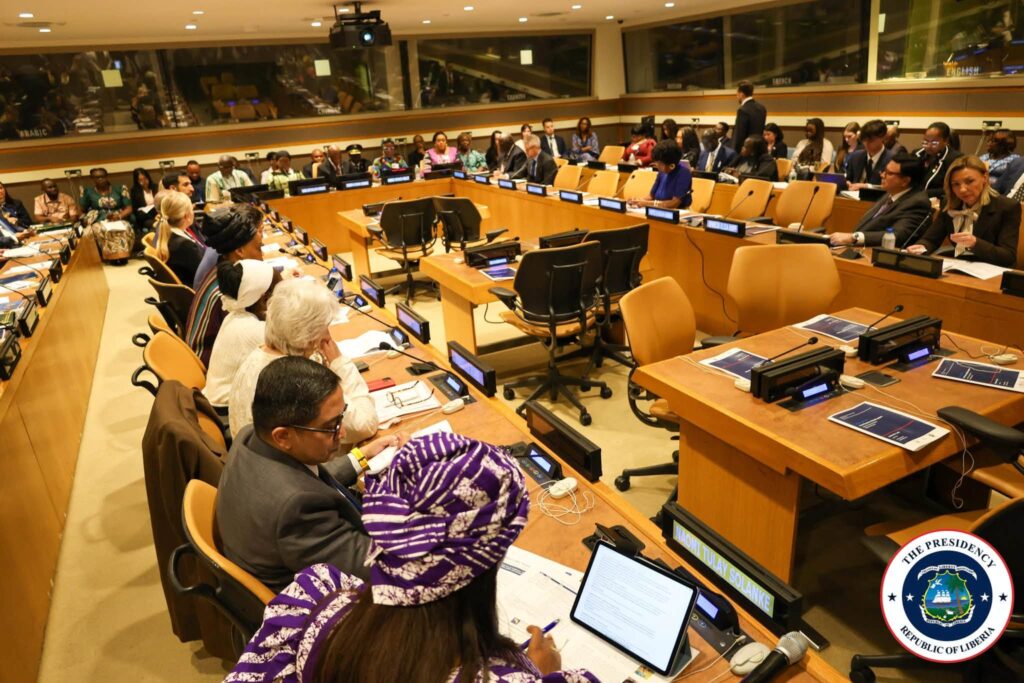
The moment came during a side event on the margins of the 81st UN General Assembly at which Liberia launched its third national action plan on women, peace and security, covering 2026 to 2031. Held under the theme “From Pioneers to Global Leaders,” the gathering turned into a sustained tribute to the market women, church and mosque women, and grassroots networks who pushed Liberia’s warring parties to peace in 2003. Ministers from Austria, Morocco, Sierra Leone and Serbia, envoys from Sweden, France and Costa Rica, and senior UN officials took turns crediting them, while women gathered at the peace hut in Monrovia’s Fish Market joined by link.
Boakai opened his remarks with a line that drew the room.
“In Liberia, men make the big decisions, the women make the small decisions, but the women decide which decisions are big and which decisions are small,” he said.
He then turned to history. Liberia’s war, he said, did not end only at the negotiating table in Accra; it ended in the markets, churches, mosques and streets of Monrovia, where women refused to go home until leaders listened.
“They were not invited to the peace process. They made themselves impossible to exclude,” Boakai said.
The new plan, which Boakai said he signed personally, is built around five areas: prevention; protection and access to justice; participation; relief, recovery and resilience; and coordination, accountability and financing. Boakai tied the justice pillar to his Executive Order 131 of 2024, which created the office preparing a war and economic crimes court, and said women advocates had pushed for gender-sensitive provisions addressing sexual violence committed during the war.
He said the Armed Forces of Liberia aims to reach 15 percent female representation by 2028, as part of a broader national goal of 40 percent by 2030, and that Liberia does not intend to press for women’s participation abroad while failing to make room for them at home.
“A seat is an opportunity, not an achievement. What we do with it is achievement,” he said, referring to Liberia’s place on the Security Council.
Foreign Minister Sara Beysolow Nyanti said women, peace and security had been Liberia’s first priority when it drew up its campaign for the council seat, and she pointed to the country’s two Nobel peace laureates.
Gender Minister Gbeme Horace-Kollie, who presented the plan, said it sets activities, responsible agencies, baselines, targets and indicators for each pillar, and creates a National Steering Committee chaired by her ministry with the ministries of justice, foreign affairs, national defense and finance. She addressed the women of the peace movement directly.
“You challenged governments to listen to women,” she said.
But the morning belonged to the pioneers.
Gbowee, who led the Women of Liberia Mass Action for Peace, said the women were dismissed at the time as lacking strategy, and later given a harsher nickname for their persistence: “the crazy people who took crazy tablets every morning.” After the 2003 peace agreement was signed, she said, the movement took it back to Liberia, explained its contents to women in the communities and set benchmarks, promising protests wherever implementation lagged.
The peace huts grew out of that effort. Gbowee said she reasoned that if every community had a palaver hut, every community could also have a peace hut, and she described it as her exit strategy for the movement. After land fell through in Monrovia and elsewhere, the first peace hut was built in Totota.
She closed with a request to Boakai: that the government declare Aug. 18, the anniversary of the 2003 Accra peace agreement, as Liberia Peace and Security Day, and that schools use the day to teach the country’s recent past.
A woman from the Totota peace hut then gave the room its most vivid testimony. She described women pooling cassava, potatoes and small sums of money to feed pregnant women fleeing fighting; a candlelight vigil outside the Accra talks during which, she said, rain fell for about 45 minutes without putting out a single candle, a sign the women took as a promise; and the days after the war, when women cut the hair of young fighters too ashamed to come into the market, gave them clothes and food, and urged them to disarm. She said the women walked for hours toward a front line near Totota, telling their families the fighters would not harm them because they were their own children.
Ophelia Hoff Saytumah, a former mayor of Monrovia who said she led the Liberia National Red Cross Society from 1991 to 1999, recounted the Mano River Women’s Peace Network’s work. She said the women carried a letter from Charles Taylor to Guinea’s President Lansana Conté at a time when the two leaders had recalled their ambassadors and were not speaking. Conté at first refused to see them, she said, and when he did, one of the delegation, Mary Brownell, told him the women would not leave until they got what they came for. The network then pressed ECOWAS and Mano River Union leaders to find neutral ground for the two presidents, and she said the King of Morocco agreed to host them.
Saytumah praised the number of women in Boakai’s cabinet but said it was not enough, and she urged the government to fund the gender ministry properly and to teach children to resolve conflicts.
“And when you move one woman, put another woman there,” she told Boakai.
Cllr. Yvette Chesson-Wureh described the Women’s Situation Room, which deploys all-female observer teams, a youth-run call center and senior women she called “eminent women” to head off election violence, and which she said has since been used in Senegal, Sierra Leone, Ghana, Nigeria and Uganda.
“Peace does not happen by accident. It must be deliberately built, protected, and sustained,” she said.
The international tributes returned repeatedly to the same point. Austrian Foreign Minister Beate Meinl-Reisinger, whose country joins the Security Council in January, quoted a phrase she attributed to Liberian activists: “Long before Resolution 1325 came into being, we were already doing 1325.” She noted that Liberia became the first post-conflict country in 2009 to adopt a national action plan on the resolution.
Moroccan Foreign Minister Nasser Bourita said Liberia had gone from being a problem for its region to a pole of stability, and proposed that the roughly 30 African countries with action plans begin sharing their experience.
“Today Liberia is a source of inspiration for many,” he said.
Sierra Leone’s representative, speaking for a fellow Mano River Union country, described the two neighbors as nations that “have literally been to hell and back.” Ruhakana Rugunda, a former prime minister of Uganda who visited Liberia with a Security Council delegation two decades ago, said the missing ingredient in failed peace efforts elsewhere in Africa may be women’s participation, and called for it to be studied.
The discussion also turned to money. Finance Minister Augustine Kpehe Ngafuan said a national priority must eventually appear in the national budget rather than depend on donor project cycles.
“Plans without budgets are assumptions. Budgets are where governments reveal their real priorities,” he said.
Ngafuan said the gender ministry’s budget has risen from 2.35 million in 2023 to about 4.21 million, which he called a 78 percent increase, and that his ministry has begun sessions with the gender ministry to reflect the plan in the next budget. The Women’s Peace and Humanitarian Fund said it has channeled US$3.6 million through UN Women to 44 Liberian civil society organizations across 21 projects. An official of the UN Peacebuilding Support Office said the Peacebuilding Fund has invested more than US$100 million in Liberia since 2007, with 40 percent going to women and gender equality, and has committed to send 40 percent of its latest support directly to grassroots groups such as the peace huts. The same official recalled watching Nyanti, then the UN’s resident coordinator in Nepal, visit political leaders’ homes night after night to break a decade-long deadlock over transitional justice.
Nyaradzayi Gumbonzvanda of UN Women, who said she served in Liberia with the UN during the war, pointed to falling aid alongside rising military spending.
“Real peace is human security. It’s not just guns and drones,” she said.
Closing the event, Ambassador Lewis G. Brown II, Liberia’s permanent representative, said he had been in one of the rooms the women barricaded until the peace agreement was signed. He said Liberia was staging its priority events during the General Assembly because its council presidency falls in December, when many delegates leave early for the holidays.
“Every peace agreement that locks out women writes the preamble to the next conflict waiting to happen,” Brown said.






Discussion about this post