

Published: November 4, 2026
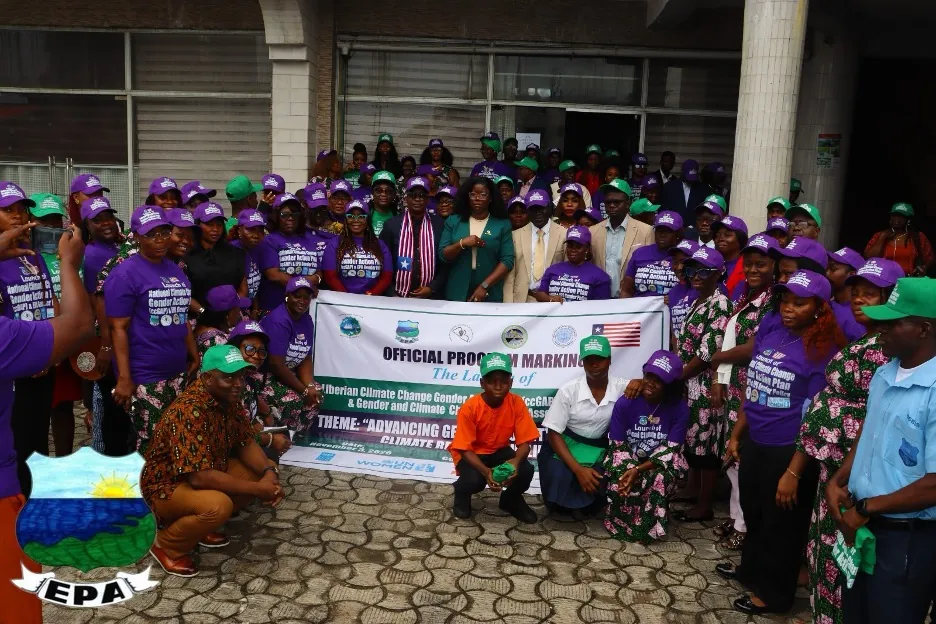
\MONROVIA — The Environmental Protection Agency (EPA) has pledged to strengthen gender equality and accountability in climate programs following Tuesday’s launch of three policy documents in Monrovia, with the Ministry of State for Presidential Affairs, ActionAid Liberia and medica Liberia expressing support for their implementation.
The documents, launched Nov. 3, 2026, at the Corina Hotel, are the updated Liberia Climate Change Gender Action Plan (LccGAP), the EPA’s first Gender Policy and the Gender and Climate Change Baseline Assessment Report.
Speaking at the ceremony, EPA Executive Director Dr. Emmanuel K. Urey Yarkpawolo called on the agency’s departments to take responsibility for implementing the policies.
“I expect every department to take responsibility for implementation. Our Gender Unit will guide and coordinate this work, but every manager must carry these commitments into daily decisions,” Yarkpawolo said.
The ceremony was held under the theme, “Advancing Gender Equality for Inclusive Climate Resilience in Liberia.”
Yarkpawolo said the EPA Gender Policy grew out of an institutional gender assessment, consultations with staff and stakeholders, and a review of existing policies.
“The policy gives us practical direction on recruitment and promotion, training, leadership, workplace culture and accountability. It also addresses discrimination and sexual harassment. Every staff member should have the opportunity to develop professionally and work in an environment where dignity and safety are respected,” he said.
According to Yarkpawolo, the updated Climate Change Gender Action Plan was developed through research, stakeholder consultations and training, with support from UN Women. It connects gender equality to Liberia’s national climate commitments under NDC 3.0.
The plan covers eight priority sectors: agriculture and food security, coasts and fisheries, forestry, health, water and sanitation, waste, energy and transportation.
“A woman farmer may understand changing rainfall patterns very well, yet lack the resources to respond. Our climate programmes must draw on her knowledge and help remove the barriers she faces,” Yarkpawolo stated.
He disclosed that the EPA has elevated its gender function to senior management level and is building the capacities of women through international training for female environmental inspectors.
The agency has also employed persons with disabilities, while Madrid Chuka Piah heads its radiation laboratory.
Addressing the Gender and Climate Change Baseline Assessment, Yarkpawolo said the process helped identify gaps requiring attention during implementation.
“We must ask practical questions. Are women benefiting from training and promotion? Are persons with disabilities able to participate meaningfully? Are climate projects reaching the people facing the greatest barriers? Do our budgets support the commitments we make?” he questioned. “Clear responsibilities, adequate resources and regular monitoring will be essential”.
Also speaking, the Ministry of State for Presidential Affairs endorsed the policy documents and pledged continued collaboration with the EPA and other government institutions.
“This historic triple launch marks a significant milestone in Liberia’s commitment to inclusive climate action, environmental sustainability, and gender equality,” the ministry stated.
The ministry reaffirmed the Office of the President’s commitment to gender-responsive climate action under the ARREST Agenda for Inclusive Development, the National Climate Change Policy, the Paris Agreement and the Sustainable Development Goals.
“We look forward to working together to build a climate-resilient, equitable, and sustainable Liberia where no one is left behind,” the statement concluded.
For her part, medica Liberia Director Cllr. Yah Vallah Parwon welcomed the launch and called for the inclusion of women and survivors of violence in environmental programs.
“Women’s safety is linked to their access to land, livelihoods, resources and essential services. Environmental and climate pressures can deepen existing inequalities and make support harder to reach,” Parwon said.
“As this policy and action plan move into implementation, we encourage attention to the voices of rural women, young women, women with disabilities and survivors of violence. Their experiences should help shape priorities and decisions,” she added.
Parwon also called for stronger connections between environmental programs and existing sexual and gender-based violence prevention and response services.
Similarly, ActionAid Liberia pledged continued collaboration with the EPA, the Ministry of Gender, Children and Social Protection, women’s rights organizations and development partners.
The organization committed to strengthening women’s leadership, supporting community-driven climate resilience and advocating for implementation through measurable targets and accountability mechanisms.
“Our position is clear: there is no climate justice without gender justice,” ActionAid declared.
“Women and girls must not only be recognized in climate policies. They must have the power, resources, opportunities, and platforms to shape the decisions that affect their lives and the community.”
ActionAid also called for sustained political commitment, adequate financing, institutional coordination and accountability to communities affected by climate change.
Yarkpawolo thanked EPA Gender Coordinator Grace Biah and her team, the Ministry of Gender, Children and Social Protection, technical experts and development partners for their contributions.
“Let us make these documents useful in our offices and in our communities. Their success should be felt in fairer opportunities, stronger participation and better protection for those most affected by climate change,” he noted.



Discussion about this post