


Published: November 4, 2026
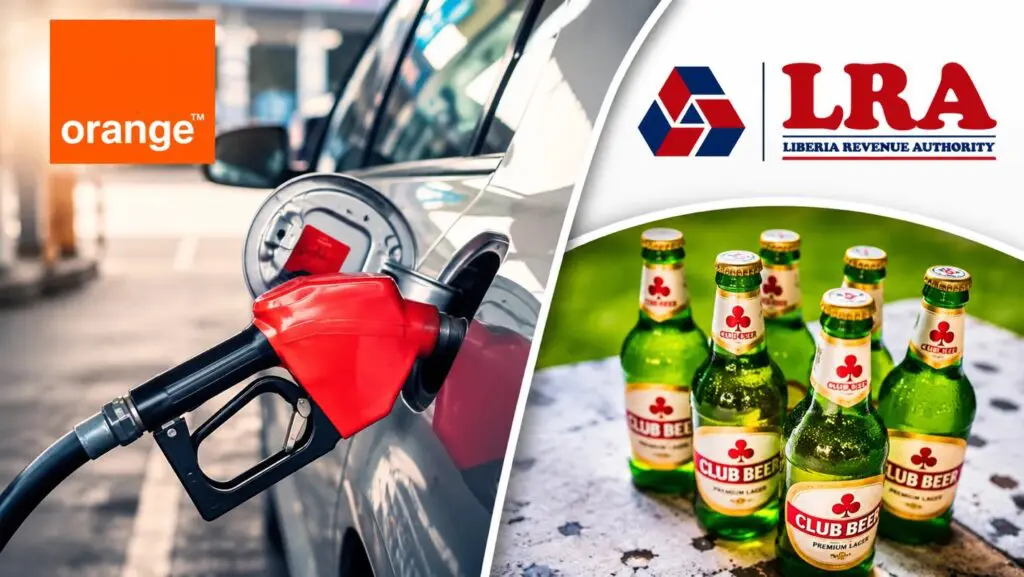
MONROVIA — Liberians who buy fuel, phone credit and beer are carrying much of the country’s record revenue year. The tax rate on what they buy is set to rise for the third year running in January, when a value-added tax replaces the goods and services tax.
By Lennart Dodoo
At first glance, the Liberia Revenue Authority’s list of its 10 largest taxpayers for the 10 months to Oct. 31, reviewed by The Liberian Investigator, points the other way. Two mining companies, ArcelorMittal Liberia and Bea Mountain Mining Company, paid US$401 million of the US$570.7 million the top 10 sent to government, or 70 percent.
Most of ArcelorMittal’s US$276 million came from a single payment. In March, the company paid a one-time US$200 million fee under the third amendment to its Mineral Development Agreement, which extends its concession to 2050. In October, with no such payment, ArcelorMittal paid US$2.7 million. Orange Liberia paid US$6.3 million that month, more than twice as much.
Without the one-time fee, the picture shifts. Five companies whose tax bills are collected largely from customers paid US$100.1 million, or 27 percent of what the top 10 paid. They are Orange Liberia, the fuel importers Aminata & Sons, Conex Petroleum Services and West Oil Investment Liberia, and Monrovia Breweries. Customers pay these taxes in the price of a gallon of fuel, a recharge card or a bottle of beer. In October, six entries tied to consumer spending paid US$14.6 million, against US$19.4 million from the two miners. Besides the five companies, those entries include US$1.3 million from the general merchandise importer A-Z Corporation and US$1.4 million under a line the LRA labels “LTMI Collection.”
The LRA reports each taxpayer as a single total, without separating tax types, so each company’s figure also includes its own corporate income tax and other obligations. Even so, how fuel, telecom, and beverage prices are set means much of what these firms pay is first collected from their customers. The only entry larger than these companies, apart from the two miners, is the government’s own Civil Service Agency, which ranked third at US$41.1 million.
At the pump
For fuel, the rules say outright that the charge goes to the customer. An LRA revenue notice dated Sept. 17, 2025, set the National Road Fund levy at US$0.30 a gallon on all imported petroleum. The notice said no importer was exempt and that the levy “can be passed into distribution or retail prices.” In April, when the government set the retail ceiling for gasoline at US$5.09 a gallon, the road levy alone made up about 6 percent of the price.
Other government charges ride on the same gallon. In September 2025, the government cut the storage fee on petroleum from 35 cents to 2 cents a gallon and added a 5-cent levy for county road equipment, The Liberian Investigator reported at the time. Sen. Prince K. Moye of Bong County, chairman of the Senate Committee on Ways, Means, Finance and Budget, said the money would buy HIV and tuberculosis drugs and road equipment for the counties.
“Every time you buy a gallon of gasoline, you are financing someone’s storage fee,” Moye said.
Customs duty, excise and GST are also built into the pump price. The government does not publish a full itemized breakdown showing how much of each is charged per gallon, and The Liberian Investigator could not find one.
At April’s price, a gallon of gasoline cost nearly a full day’s pay at the minimum wage for unskilled workers. That wage is US$5.50 a day and has not changed since 2015.
Consumers also paid through the exchange rate used to set prices. In July, The Liberian Investigator reported on a joint report by the Senate committees on public corporations and public accounts. The report found that from March 14 to April 3, the Commerce Ministry and the Liberia Petroleum Refining Company converted fuel prices at L$187 to the U.S. dollar, while the Central Bank of Liberia rate ranged from L$184.39 to L$185.13. The committees estimated that consumers were overcharged L$123.7 million to L$131.3 million and called the gap a “poor man tax.”
Importers pay these taxes before the fuel leaves the terminal. The refining company said in February that “lifting cannot occur unless Government taxes have been fully paid to the LRA.”
On the phone and at the bar
Phone users are taxed at a higher rate than other consumers. When the general GST rate rose to 13 percent on May 1 under the Liberia Tax Amendment Act of December 2025, the LRA kept the rate on telecommunications services at 15 percent. Orange Liberia paid US$35.7 million through October, fourth on the list. Its October payment of US$6.3 million was second only to Bea Mountain’s US$16.6 million that month.
A summary of the same law published by the regulatory tracker RegFollower says it set the excise tax on beer, imported or brewed locally, at US$1 a liter. According to the summary, the excise on alcohol, tobacco and sugar-sweetened drinks will rise automatically each year in line with inflation and economic growth from Jan. 1, 2027, without a new vote by the Legislature. Because the beer tax is a fixed amount per liter rather than a percentage of the price, it takes a bigger share of the price of cheaper beer. Monrovia Breweries paid US$14 million through October.
GST went from 10 to 12 percent under Revenue Code amendments approved Dec. 17, 2024, then to 13 percent in May. The VAT that the government enacted in 2024 is scheduled to replace GST on Jan. 1, 2027.
What the budget leans on
The approved budget for fiscal 2026 expects US$272.2 million from taxes on international trade, US$83.7 million from taxes on goods and services, and US$360.3 million from taxes on income and profits, according to the budget watchdog BudgIT’s analysis. Trade taxes include import duties and the GST and excise collected at the border, which importers pay and then build into shop prices. In the first quarter of fiscal 2025, the LRA’s performance report showed taxes on trade and on goods and services together bringing in about 39 percent of collections, about the same share as income and profit taxes.
Meanwhile, the government gives up large sums. The World Bank’s Liberia Public Finance Review 2026 puts tax expenditures, the revenue lost to exemptions and other tax breaks, at US$270.7 million in 2023 and US$240.3 million in 2024. That is 5 to 6 percent of GDP and more than 40 percent of all the tax revenue the government collected. The review puts the sub-Saharan African average at 1.8 percent of GDP, so Liberia’s level is nearly triple it. It says much of the forgone revenue comes from discretionary concessions under Section 16 of the Revenue Code.
The review found that rice import exemptions made up 17 percent of forgone revenue in 2024 and that their “primary beneficiaries are higher-income households and commercial importers.” It also found that corporate income tax made up about 1.4 percent of total mining revenue from 2016 to 2025.
Bea Mountain pays a royalty of 3 percent on gold, The Liberian Investigator reported in April, under contract terms that leave the government about six cents for every dollar of gold exported.
Growth that has not reached households
The World Bank’s latest Liberia Economic Update, launched Monday, found the economy grew 5.1 percent in 2025. Mining expanded 17 percent. Agriculture, where most Liberians earn a living, grew 2.6 percent. International reserves covered about 1.6 months of imports at the end of 2025.
“Liberia needs to build on its macroeconomic progress by addressing the structural constraints that limit productive investment and job creation,” said Gweh Gaye Tarwo, the World Bank Group’s country economist and the report’s lead author.
The International Monetary Fund projects that nominal non-mining GDP per person will fall from US$723 in 2025 to US$708 in 2026, even as the government collects record revenue. The most recent official poverty count, the 2016 Household Income and Expenditure Survey, found 50.9 percent of Liberians below the national poverty line. Results from a new survey begun in 2025 have not been released.
President Joseph Boakai has described this year’s revenue, which passed US$1 billion in September, as “earned, not borrowed.” The figures behind that total show where much of it came from: at the fuel pump, on the recharge card, and at the bar.




Discussion about this post