


Published: June 22, 2026
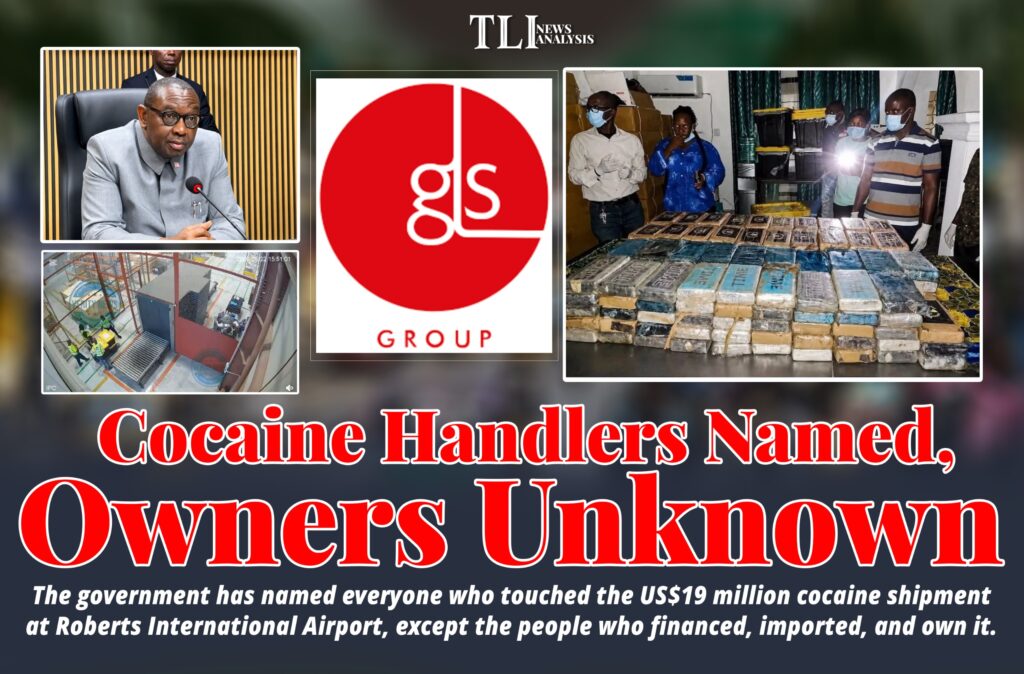
MONROVIA – When Justice Minister and Attorney General Cllr. N. Oswald Tweh named 10 persons of interest Friday in the US$19 million cocaine seizure at Roberts International Airport, he listed cargo handlers, scanner agents and security men. He did not name a single financier, importer or owner. And in that silence sits the only question Liberians have asked since June 8: who owns the drugs.
By Lennart Dodoo & David Menjor
That gap, between what was disclosed and what was withheld, is now the real story. And it is a gap that a former senior drug enforcement officer says he has seen swallow cases whole.
In a Facebook post that has rippled across Liberian social media, Hassan Fadiga, former Deputy Director for Operations of the Liberia Drug Enforcement Agency (LDEA), noted that he does not believe the state can be rescued from this drug saga under present conditions
Fadiga: “The drug cartel is deeply entrenched, well-connected, and protected by a system that has yet to demonstrate the resolve necessary to dismantle it. Under the present conditions, I do not believe it can be defeated.
“Unfortunately, I fear the US$19 million drug case will be resolved the Liberian way rather than through the rule of law. I sincerely hope I am proven wrong.
“I urge every Liberian to pray for our nation. Unless there is decisive intervention, I believe a heavy storm lies ahead over the next 16 months.”
It would be easy to dismiss that as one disillusioned man’s pessimism. The trouble is that recent history is on his side.
In October 2022, Liberian security forces, working with the United States and Brazil, intercepted 520 kilograms of cocaine valued at about US$100 million, one of the largest seizure in the country’s history and the equivalent of roughly one-fifth of the national budget at the time. It was hailed as one of Liberia’s greatest victories over drug traffickers. Then it collapsed. A jury acquitted all four defendants, and the court ordered that US$200,000 seized from the men be returned to them. Within 24 hours of their acquittal, all four had fled the country, leaving the money behind. The presiding judge later explained the men walked because the government’s indictment did not properly match the offenses committed. The then justice minister, Frank Musah Dean, conceded the verdict fed a widespread perception of compromise in the courts, and pointed openly to the practice of bribing juries in such trials. The U.S. State Department’s human rights reporting for that year found Liberian judges prone to influence and that prosecutors and defense lawyers alike directed defendants to pay bribes for favorable outcomes.
This is the institutional memory behind every skeptical social media comment made during Attorney General Tweh’s press conference, whether the commenter mentions it or not. When Mark Karpoleh Gontor commented that the named figures are merely local intermediaries and asked the critical question of who imported and owned the drugs, he highlighted the exact point at which the 2022 case failed. Anna Sherman, also in a social media post, dismissed the list as ordinary people and demanded the names of those who paid them.
Cllr. Tweh insisted that designation as a person of interest is not a finding of guilt and reflects evidence still being examined. He pledged that no one would be exempt because of position, influence, occupation, political affiliation, social standing or economic status, and warned those still at large to surrender. The investigation has been elevated by the National Security Council into a Joint National Security probe, signaling the government wants the matter treated as more than a narcotics case. There are also signs of genuine movement. Some media reports have named EMRE VENN Group of Companies as the consignor and a man identified as Usman Ali in Birmingham, United Kingdom, as the consignee, placing part of the trail abroad. Margibi circuit court, through Resident Judge Victoria Worlobah Duncan, has subpoenaed airport waybills, cargo records and CCTV footage, and ordered airport authorities to appear on June 22, with investigators reaching back to records from late May to reconstruct the chain of custody. The cargo was reportedly bound for Europe aboard a Brussels Airlines flight.
Commenting on social media, Mark J. N. Kollie argued that a cargo handling firm primarily moves goods and relies on the documentation shippers provide, and that the discovery of contraband in a shipment does not by itself prove the company knew. He cautioned specifically against treating Express Handling Services as guilty by association, absent evidence of knowledge, concealment, or direct participation.





Discussion about this post