


Published: February 18, 2026
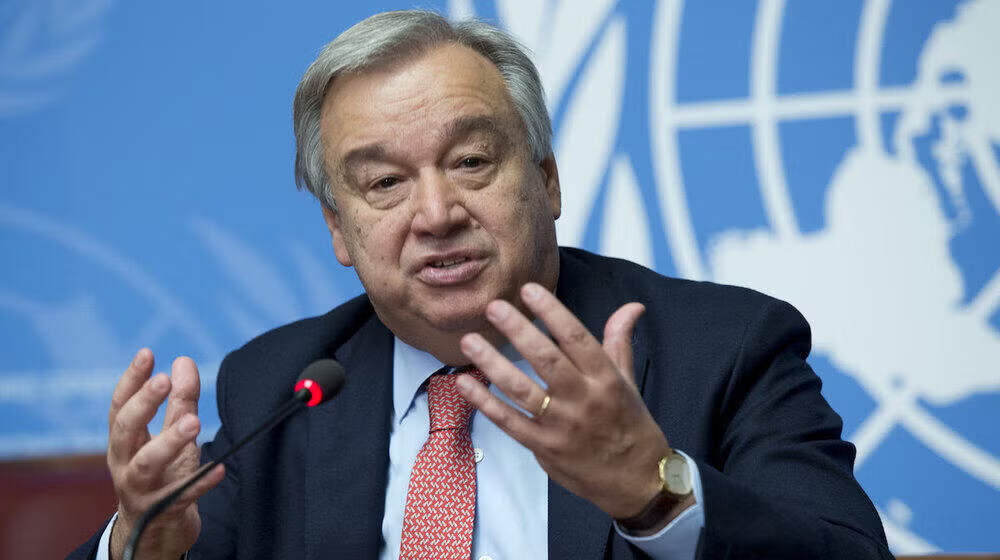
Addis Ababa, Ethiopia – In a forceful address at the 39th African Union Summit, United Nations Secretary-General António Guterres delivered what many observers are calling one of his most direct endorsements yet of Africa’s long-standing demands: permanent representation on the UN Security Council and full economic sovereignty over its vast natural resources.
Standing before African heads of state in Addis Ababa, Guterres praised the African Union as a “flagship for multilateralism” in a world increasingly fractured by division and mistrust. But beyond diplomacy, his message was unmistakably political: the global order must change — and Africa can no longer remain on the margins of decisions that shape its destiny.
“This Is 2026 — Not 1946”
Perhaps the most striking moment of the speech came when the Secretary-General addressed reform of the United Nations Security Council. “The absence of permanent African seats in the Security Council is indefensible,” he said. “This is 2026 — not 1946. Whenever decisions about Africa and the world are on the table, Africa must be at the table.”
The statement echoes a demand that African leaders have made for decades: that the continent, home to 54 nations and over 1.4 billion people, deserves permanent representation with veto power on the Council. Currently, Africa holds only non-permanent rotating seats, while permanent authority remains concentrated among five powers reflecting the geopolitical realities of the post-World War II era.
For many African diplomats, Guterres’ blunt acknowledgment signals growing international recognition that the global governance system is outdated — and structurally unjust.
Africa’s Wealth, Others’ Gain
Yet the speech went far beyond institutional reform. Guterres tackled one of the continent’s most painful paradoxes: immense resource wealth coexisting with poverty and underdevelopment. “Africa, with 60 percent of the world’s best solar potential — can become a clean energy powerhouse,” he said. “Yet Africa receives only two percent of global clean energy investment.”
The Secretary-General highlighted the continent’s critical minerals — cobalt, lithium, rare earth elements — which are indispensable to the global energy transition. But he warned against repeating patterns of extraction reminiscent of colonial exploitation. “No more exploitation. No more plundering. The people of Africa must benefit from the resources of Africa.”
It was a line that resonated deeply in a continent still grappling with the economic legacy of slavery, colonialism, and unfair trade regimes. While Africa exports raw materials in abundance, value addition and manufacturing largely take place elsewhere — leaving African economies dependent on volatile commodity prices.
Guterres endorsed fair and sustainable value chains that ensure African countries move up the industrial ladder, develop manufacturing capacity, and retain greater profits from their own minerals.
A Broken Financial System
The Secretary-General also criticized what he described as a structurally biased global financial architecture. African countries, he noted, face borrowing costs up to eight times higher than advanced economies. Meanwhile, the continent loses more each year in debt repayments and illicit financial flows than it receives in aid.
The Sustainable Development Goals face a $4 trillion annual financing gap for developing countries. For Africa, the burden is compounded by climate shocks, conflict, and fragile institutions. Guterres called for: Tripling the lending capacity of multilateral development banks; Reducing borrowing costs for African nations; Reforming international financial institutions to give developing countries full voice and participation; Cracking down globally on money laundering, tax evasion, and illicit financial flows.
Without such reforms, he warned implicitly, Africa will remain trapped in a cycle of dependency — rich in resources, poor in outcomes.
Climate Injustice and Opportunity
Climate change formed the third pillar of his address. Africa has contributed almost nothing to global emissions, yet faces faster-than-average warming and devastating climate impacts. Developed countries, he insisted, must triple adaptation finance and mobilize $1.3 trillion annually for developing countries by 2035. The Loss and Damage Fund must be scaled up, and early warning systems expanded.
But he also framed climate as an opportunity: Africa could become a renewable energy superpower — if global investment shifts decisively toward the continent. The message was clear: Africa should not merely supply minerals for other nations’ green revolutions. It should lead its own.
Peace, Stability, and Sovereignty
Guterres also addressed ongoing conflicts in Sudan, South Sudan, the Democratic Republic of the Congo, Somalia, Libya, and across the Sahel. He reaffirmed UN support for African-led peace operations and expressed regret over the Security Council’s failure to reach consensus on predictable funding mechanisms.
Peace, economic reform, and climate resilience, he argued, are interconnected. “Without peace there can be no development; without development, peace remains fragile.”
A Strategic Partnership — and a Personal Pledge
In closing, Guterres dismissed suggestions that his appearance at the summit marked a farewell. Instead, he pledged that Africa would remain the UN’s “priority number one” until the end of his mandate — and beyond.
His remarks were both institutional and personal — a recognition of what he described as the unwavering solidarity of the African Group at the UN.
The Larger Question
The speech leaves a fundamental question hanging in the air: Will the world act? For decades, calls for Security Council reform have stalled amid geopolitical rivalries.
Promises of climate finance have often fallen short. Commitments to reform the international financial architecture move slowly. Yet the demographic, economic, and geopolitical weight of Africa continues to grow. By 2050, one in four people on Earth will be African.
The continent’s markets, minerals, and youth population will shape the global economy. The demand articulated in Addis Ababa was not framed as charity — but as justice. As Guterres put it: when decisions about Africa are made, Africa must not be spoken about — it must speak for itself. And when Africa’s minerals power the world, its people must power their own future.




Discussion about this post