


Published: May 21, 2026
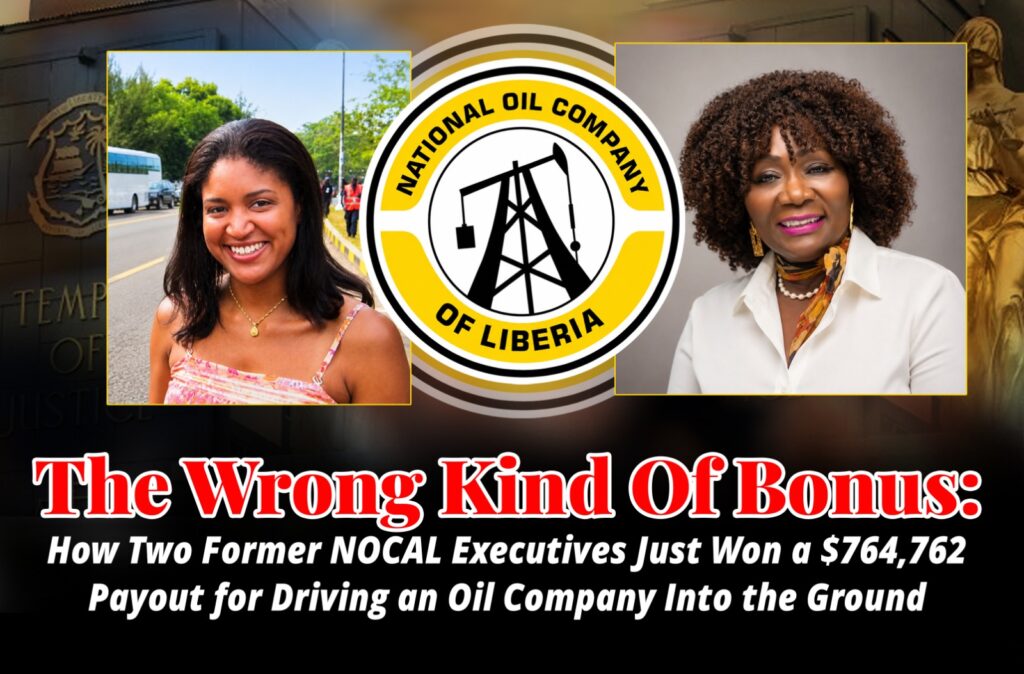
MONROVIA – A Commercial Court ruling has awarded nearly $800,000 to two former executives of the National Oil Company of Liberia (NOCAL), members of the management team whose decisions led the state-owned oil company into bankruptcy in 2015, a decade after President Ellen Johnson Sirleaf ordered their retirement and cut their severance by half for mismanaging the entity into financial ruin.
A Company Bled Dry
By August 2015, NOCAL was in freefall. Revenue had collapsed, but instead of cutting costs, management kept hiring, bringing on new staff at what Sirleaf’s office later described as “an alarming rate.” The benefits attached to those positions were so generous that they drove the annual wage bill to a staggering $7 million. The money flowing out bore no relationship to the revenue coming in. When Sirleaf personally reviewed the books, she found an entity that was, in her own words, financially “scrapped,” a corporate shell still drawing executive salaries while the institution itself was functionally dead.
She immediately directed NOCAL’s board to retire the entire senior management team, reduce all severance payments by 50%, and implement deep staff cuts across the organization. The stated reason was “mismanagement,” a formal finding that was never contested and that placed direct responsibility for NOCAL’s collapse on the executives who ran it.
Most Took the Deal
The majority of NOCAL’s departing executives accepted the reduced severance. Given that the company was insolvent and that a head of state had publicly attributed its failure to their leadership, accepting half of what their contracts stipulated was a reasonable concession. They signed, collected their reduced payments, and left.
Two executives refused.
Cllr. Idella Cooper, who served as NOCAL’s Legal Advisor, and Vida Mensah, the Vice President for Administration, rejected the 50% reduction outright. They demanded their full contractual severance of approximately $170,000 each. NOCAL, operating under Sirleaf’s directive and with almost no liquidity, offered $85,000 each. The difference between what the company offered and what the two women demanded was $85,000 per person, a gap that could have been bridged through negotiation. Cooper and Mensah chose litigation instead.
It is worth noting that even at the full amount, the combined claim was less than $350,000, subject to applicable taxes and deductions for the book value of their government-assigned vehicles. These were not trivial sums, but they were not extraordinary ones either, particularly for executives who had drawn senior salaries from a state-owned enterprise.
A Decade of Waiting
For ten years, the case drifted through the system while NOCAL’s condition did not improve and Liberia confronted far larger emergencies, among them the post-Ebola economic recovery and then Covid-19. Cooper and Mensah waited.
Then the case landed at the Commercial Court. That a labor severance dispute between departing employees and a bankrupt state entity arrived at the Commercial Court, rather than a labor tribunal, a full decade after the underlying events, is itself a question worth examining. The jurisdictional path the case traveled has not been publicly explained.
The Ruling
The Commercial Court found in favor of Cooper and Mensah and awarded them a combined $764,762. That figure is nearly eight times the $170,000 they were originally refused. It is roughly 4 and half times the combined $170,000 NOCAL had offered them. Interest, penalties and the passage of ten years transformed what was once an $85,000-per-person dispute into a nearly $400,000-per-person windfall.
The ruling effectively penalizes every executive who accepted the compromise in good faith and rewards the two who refused it, held out for a decade, and allowed the claim to compound. The court’s logic, if applied consistently, suggests that rejecting a reasonable settlement from a bankrupt state entity and waiting long enough is a sound financial strategy.
The Can of Worms
NOCAL’s management during the years of decline was not a small group. Many executives served during the period when the “alarming” hiring continued. Many signed off on the benefits packages that produced the $7 million wage bill. Many presided over the revenue freefall that Sirleaf ultimately attributed to mismanagement. A significant number of them accepted the 50% severance reduction and considered the matter closed.
They are reconsidering now.
Fiscal experts warn that the Commercial Court’s ruling has effectively issued an open invitation to every former NOCAL executive with an unresolved grievance. If Cooper and Mensah can walk away with $764,762 from a decade-old severance dispute, the precedent for similar claims is now established. The cumulative liability could run into tens of millions of dollars if multiple former executives pursue parallel suits and the court applies the same reasoning, paid from the public purse to the people most directly responsible for NOCAL’s collapse.
What the Court Chose Not to See
The Commercial Court had the full record before it. It had the presidential finding of mismanagement. It had the documented offer of $85,000 per executive, made in the context of a bankrupt entity operating under a head-of-state directive. There was a 10-year gap between the cause of action and the filing. It had the jurisdictional question of whether a labor severance dispute belonged before it at all.
The court could have dismissed the case for lack of jurisdiction. It could have upheld the 50% reduction as a lawful exercise of executive authority over a failing state asset. It could have taken note of the decade-long delay and the changed circumstances of an entity that has only deteriorated further since 2015. It chose none of those options.
Instead, it awarded Cooper and Mensah $764,762 and sent a clear signal to every failed executive in the country about what the Commercial Court considers just.






Discussion about this post