
Published: June 29, 2026
One of the greatest casualties in any major criminal investigation is often not the evidence itself, but the truth.
Liberia’s ongoing US$19.2 million cocaine investigation has become a case study in how social media speculation, selective leaks and premature conclusions can overwhelm facts before investigators or the courts have an opportunity to establish them. Long before investigators could show or link any evidence, competing narratives have been tried and convicted in the court of public opinion.
That should concern every Liberian.
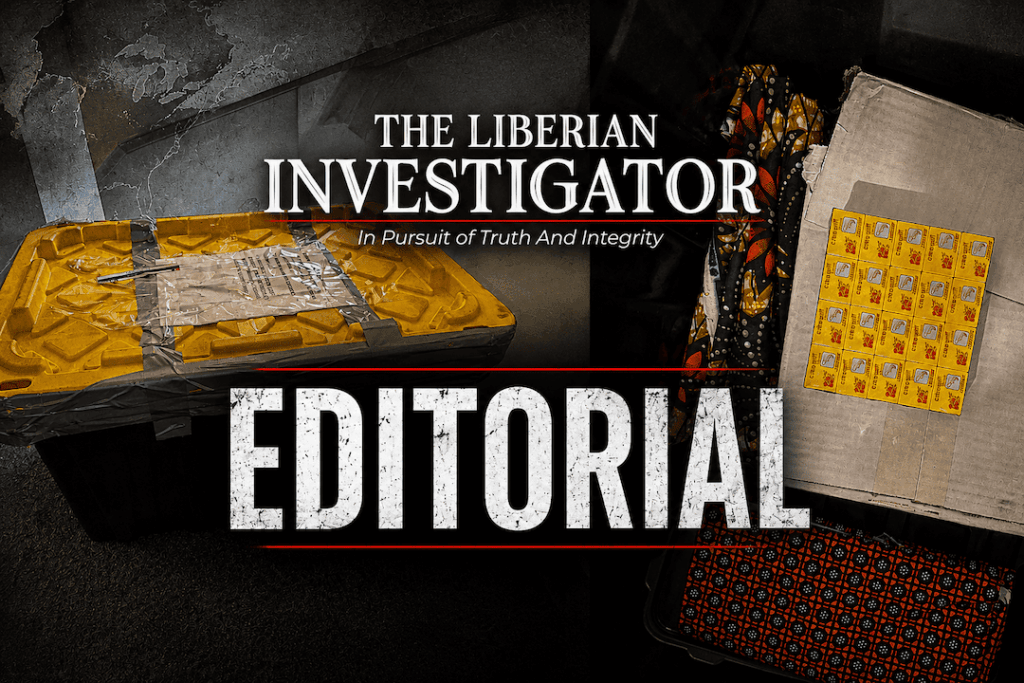
The latest findings published by The Liberian Investigator introduce documents that challenge one of the central claims that has circulated since the June 8 drug seizure—that a previous shipment on May 22, allegedly containing 100 kilograms of cocaine, successfully escaped Roberts International Airport and entered the United Kingdom undetected. According to shipping documents, Heathrow cargo records, and customs release paperwork obtained by this newspaper, the May 22 consignment was processed through Heathrow, released by British authorities, and collected by its documented recipient. Those records raise significant questions about whether the shipment that became the subject of intense public speculation was, in fact, the cocaine shipment many had assumed it to be.
Those documents do not automatically answer every question.
Nor do they absolve anyone involved in Liberia’s broader narcotics investigation.
But they remind us of an essential principle that should never be controversial: allegations must be supported by evidence.
This newspaper has consistently argued that the Liberian government owes the public transparency regarding one of the country’s largest narcotics seizures. We have criticized unnecessary secrecy, questioned delays in releasing information, and demanded accountability from every institution involved in airport security and drug enforcement.
That position has not changed.
Transparency, however, is not the same as speculation.
Investigative journalism carries enormous responsibility. It exists not merely to ask difficult questions but also to test every claim, especially those that appear to confirm popular suspicions. When new documentary evidence contradicts an accepted narrative, ethical journalism demands that it be examined with the same vigor as the original allegation.
Credibility is earned not by defending previous reporting but by following the evidence wherever it leads.
Equally troubling is the manner in which confidential investigative materials have steadily found their way into the public domain. Surveillance footage, photographs, internal recordings and other sensitive materials have circulated widely on social media while authorities simultaneously insist they cannot release official information because the investigation is ongoing. Such contradictions undermine confidence in the integrity of the investigation itself.
If information is genuinely too sensitive to disclose publicly, then government agencies must identify and stop those responsible for leaking investigative materials. If those materials continue to circulate unchecked, officials cannot selectively invoke confidentiality only when facing legitimate public scrutiny.
Justice cannot operate through anonymous Facebook posts and viral WhatsApp messages.
It must operate through evidence.
The documents referenced in this investigation also point investigators toward questions that deserve serious attention rather than political rhetoric. Who authorized the shipment? Who received it? Who paid the associated cargo charges? Who stood at each end of the logistics chain? What do financial records, customs declarations and communication records reveal?
Those are investigative questions.
They require forensic answers—not assumptions.
Liberia has experienced major narcotics prosecutions before, only to watch cases collapse because investigators failed to establish an unbroken chain of evidence or satisfy the burden required in court. That history should serve as a warning. Every careless leak, every unsupported allegation and every premature declaration risks weakening prosecutions that should instead be strengthened through meticulous investigative work.
None of this diminishes the seriousness of the June 8 seizure. If criminal networks exploited Liberia’s air cargo system, every participant—from financiers to facilitators to public officials—must face the full force of the law.
But if separate shipments are being conflated without proof, investigators, journalists and the public alike must resist the temptation to accept coincidence as evidence.
Truth is not determined by repetition.
It is established by proof.
In an era when misinformation travels faster than official investigations, Liberia cannot afford to allow social media to become the country’s principal investigative authority. The courts—not viral narratives—must ultimately determine guilt. Journalists must remain skeptical of every claim, regardless of its source. Government must communicate honestly and consistently. And citizens must remember that accountability built on false premises ultimately serves no one.
The fight against international drug trafficking is too important to be compromised by rumor.
Only facts can secure justice.
Only evidence can sustain convictions.
And only the truth deserves to prevail.
This is The Liberian Investigator, In Pursuit of Truth and Integrity.




Discussion about this post