


Published: September 9, 2026
By David Menjor
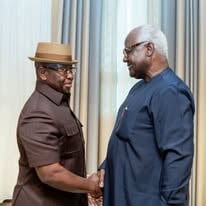
R-L (Koroma meets President Bio)
Abuja, Nigeria — The Economic Community of West African States (ECOWAS) has commended Sierra Leonean President Julius Maada Bio for facilitating the return of former President Ernest Bai Koroma to Sierra Leone, describing the development as an important step toward national reconciliation, unity and lasting peace.
In a statement issued September 6, 2026, the ECOWAS Commission praised the Sierra Leonean government for its decision to drop charges against Koroma, which paved the way for the former president to return home.
The regional bloc said the decision demonstrated a commitment to resolving political differences through dialogue and reconciliation rather than allowing disputes involving former political leaders to deepen divisions within the country.
“The Economic Community of West African States Commission commends … the Government of the Republic of Sierra Leone, in particular His Excellency President Julius Maada Bio, for facilitating the return of former President Ernest Bai Koroma to Sierra Leone,” the commission said.
The development marks a significant moment in Sierra Leone’s recent political history, where tensions between political actors have periodically tested the country’s democratic institutions and social cohesion.
Koroma, who served as Sierra Leone’s president from 2007 to 2018, had been outside the country amid legal proceedings brought against him. His return follows the government’s decision to withdraw the charges, with national reconciliation cited as a key consideration.
For ECOWAS, the decision represents more than the resolution of an individual legal and political matter. It also reflects the broader regional concern over political stability, democratic governance and peaceful transitions of power in West Africa. The commission emphasized that reconciliation can play a central role in preventing political disputes from escalating into prolonged instability.
Sierra Leone’s experience has drawn regional attention because the country has worked for decades to consolidate peace and democratic institutions following a devastating civil war that ended in 2002.
Against that historical backdrop, the return of a former head of state under an arrangement supported by the sitting government carries broader implications for national unity.
ECOWAS also expressed appreciation to regional leaders who contributed to resolving the situation, particularly Nigerian President Bola Ahmed Tinubu. According to the commission, Tinubu played a key role in hosting Koroma in Nigeria and helping facilitate his safe return to Sierra Leone.
“The Commission also expresses its gratitude to ECOWAS leaders, particularly His Excellency Bola Ahmed Tinubu, President of the Federal Republic of Nigeria, for his leadership and support in hosting former President Koroma and facilitating his safe return to Sierra Leone,” the statement said.
Nigeria’s role underscores the country’s continuing influence in regional diplomacy and conflict resolution within ECOWAS. Abuja has historically played a central role in efforts to mediate political crises and support peace and democratic stability across West Africa.
The ECOWAS statement did not provide details about the circumstances surrounding the dropping of the charges or outline any further legal arrangements involving Koroma. Instead, it focused on the broader political significance of the decision and the importance of reconciliation.
President Bio’s government has previously faced political tensions with the opposition, making the latest development particularly significant for Sierra Leone’s political landscape.
Koroma’s return could provide an opportunity for political actors to reduce tensions and strengthen confidence in the country’s democratic process, while also allowing national institutions to focus on governance and development.
For ECOWAS, the development offers a potentially positive example at a time when West Africa continues to confront political instability, constitutional disputes and disagreements between governments and opposition movements. The regional body’s endorsement signals its preference for dialogue, political accommodation and peaceful resolution of disputes where possible.
As Koroma resumes his life in Sierra Leone, the government’s decision and ECOWAS’ public support could help open a new chapter in the country’s political relations.
The commission’s message ultimately places national reconciliation at the center of Sierra Leone’s next phase, emphasizing that lasting peace requires political leaders to address differences while preserving national unity and stability.




Discussion about this post