


Published: July 3, 2026
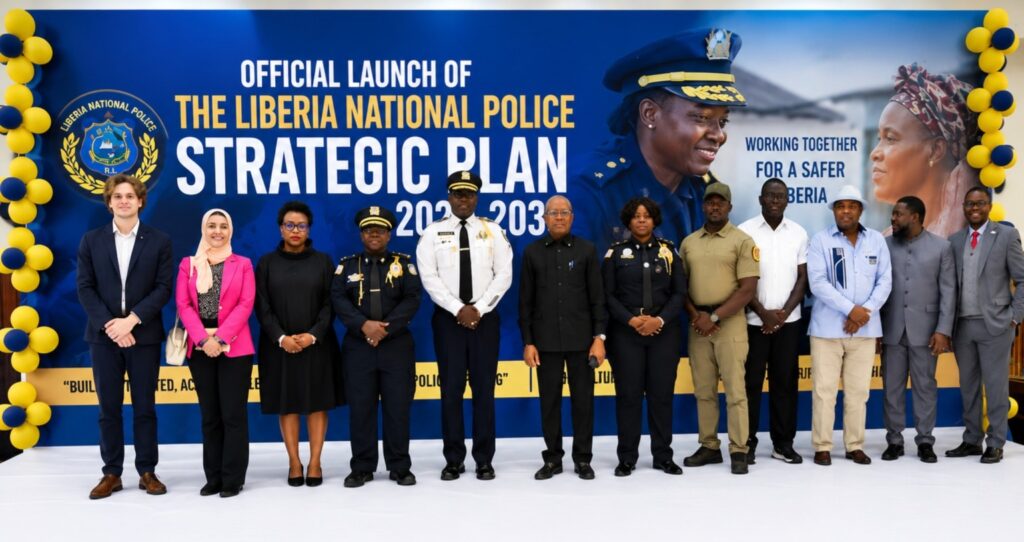
MONROVIA – Inspector General of Police Gregory O. W. Coleman unveiled a five-year strategic plan Thursday aimed at professionalizing the Liberia National Police, calling on the government, Legislature, and development partners to fund reforms he said are needed to rebuild public trust in the force.
The Strategic Plan 2026 to 2030, launched in Monrovia before law enforcement officers, government officials and international partners, outlines commitments to safer communities, accessible justice and policing built on professionalism, accountability and public trust.
Coleman acknowledged years of public frustration with policing and said the plan is meant to answer those concerns with action rather than promises.
“For too long, many citizens have looked at policing through the lens of frustration, delay, mistrust, and unmet expectations,” Coleman said. “We hear those concerns. We acknowledge them. And today, we respond not with words alone, but with a structured path for reform, service, and measurable progress.”
He said the strategy centers on the safety of families, protection of businesses, crime prevention, road safety and peaceful communities, and rests on three pillars: stronger laws and policies, stronger accountability and stronger operational effectiveness.
“The true measure of policing is not force. It is trust; it is not fear but it is legitimacy; it is not power but it is service,” Coleman said.
Coleman said reform depends on investing in officers’ welfare, including training, healthcare, housing, mental wellness support, fair salaries and career advancement opportunities.
“An officer asked to protect society must not be abandoned by society,” he said. “An officer asked to respond with discipline must be equipped with training; an officer asked to uphold calm under pressure must have mental wellness support; and an officer asked to resist corruption must be paid fairly and treated with dignity.”
He said improving officer welfare would strengthen morale, reduce misconduct and improve service delivery.
Coleman appealed for increased government funding, saying reform requires resources rather than political commitments alone.
“We need stations that function. Vehicles that move. Communications that connect. Technology that modernizes investigations. Training academies that produce excellence. Forensics that strengthen justice. And resources that reach every county,” he said.
“I respectfully call upon the Government, the Legislature, partners, and friends of Liberia: support this plan not only in principle, but in appropriation and execution. Every dollar invested in credible policing is an investment in peace, commerce, tourism, education, jobs, societal confidence and overall national development.”
Coleman also urged citizens to partner with police by reporting crimes, rejecting mob violence, respecting the rule of law and assisting law enforcement.
“We ask citizens to hold us accountable, yes, but also to partner with us,” he said. “The road ahead will require patience, discipline, resources, and courage. But if government supports, officers commit, and citizens cooperate, then this Strategic Plan will not remain just a document, it will become tangible progress.”
Speaking on behalf of Justice Minister and Attorney General Cllr. N. Oswald Tweh, Solicitor General Cllr. Augustine Fayiah called the plan a comprehensive framework for strengthening the rule of law, building police capacity and restoring public confidence.
Fayiah said the plan was developed through consultations involving civil society organizations, police management and security stakeholders, with an emphasis on community partnerships.
“A critical next step is ensuring the plan follows a specific budget layout to facilitate full implementation,” Fayiah said. “Implementation will be monitored at the municipal and town hall levels to ensure the goals benefit society directly.”
A representative of the French Embassy reaffirmed France’s support for Liberia’s security sector, citing ongoing French language training for police officers to strengthen cooperation with neighboring Francophone countries and border security. The embassy said Liberian police and National Security Agency officers are also participating in regional counterterrorism training in Abidjan as part of a broader African security initiative.
The launch closed with messages of support from the Liberia Immigration Service and the Liberia Drug Enforcement Agency, whose representatives praised progress under Coleman’s leadership and pledged continued cooperation on Liberia’s joint security architecture.





Discussion about this post