


Published: June 5, 2026
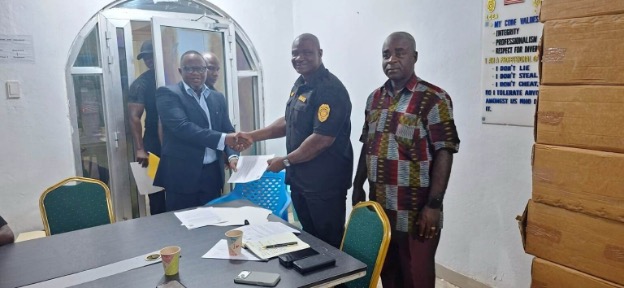
Mr. Francis Konyon (left) exchanges a handshake with DCP Fitzgerald T. M. Biago following the ceremony
By: Nukanah Kollie
The Center for Justice and Peace Studies (CJPS) and the Liberia Drug Enforcement Agency (LDEA) have signed a Memorandum of Understanding (MOU) under the Program for Reducing Organized Substance Proliferation and Enforcing Resilience (PROSPER), marking a strengthened national response to the growing crisis of illicit drug abuse in Liberia.
The agreement comes at a time when drug abuse is increasingly devastating young people across the country, contributing to rising school dropouts, mental health challenges, violent behavior, unemployment, homelessness, and the breakdown of family structures. Communities across Liberia continue to report growing concern over the spread of substances such as Kush and other harmful drugs, which are trapping many youths in cycles of addiction, despair, and social exclusion.
According to the United Nations Office on Drugs and Crime (UNODC), “an estimated 296 million people worldwide used drug with young people representing the most affected group globally, reflecting the widening scale of substance abuse as a global public health challenge.
In West Africa, UNODC further warns that synthetic drug use is rising rapidly, particularly among young people in urban centers and coastal states, including Liberia, where trafficking and local consumption are increasing in parallel with regional drug flows.
Public health experts and community leaders now caution that the drug crisis is no longer only a security issue but a “deep social and economic emergency” affecting productivity, education outcomes, and community stability. In many affected areas, young people struggling with substance abuse face higher risks of exploitation, criminal involvement, and premature death, further weakening Liberia’s human capital base.
National health authorities, including the Ministry of Health and the National Public Health Institute of Liberia, have also linked rising substance abuse to increasing mental health disorders and behavioral health challenges among young people, particularly in Monrovia and surrounding counties. These conditions, they note, are placing additional pressure on an already fragile health system and limited psychosocial support services.
The agreement between CJPS and LDEA seeks to respond to these challenges by increasing public awareness, strengthening citizen participation in the fight against drug abuse, improving accountability within the LDEA, and advocating for stronger national coordination in addressing the crisis.
Under the partnership, CJPS and the LDEA will implement community awareness campaigns, including legal education and sensitization programs on three radio stations across Montserrado, Margibi, and Bong Counties. The initiative will also include stakeholder roundtable discussions aimed at strengthening dialogue between law enforcement, civil society, health practitioners, and community actors.
The MOU further provides for the development of a monitoring tool to track ethical compliance among LDEA personnel, the establishment of a citizen complaint mechanism, the production of simplified versions of the New Drug Law for public education, and the publication of quarterly accountability reports.
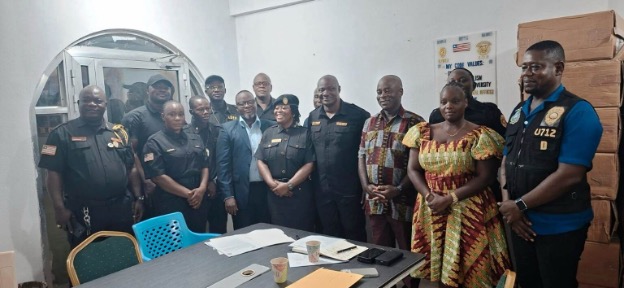
Officials of the Liberia Drug Enforcement Agency (LDEA) and the Center for Justice and Peace Studies (CJPS) pose for a photo following the signing ceremony
Remarking at the signing ceremony, CJPS Acting Executive Director, Mr. Francis S. Konyon, described the partnership as a “practical step toward rebuilding public trust and strengthening community engagement in the fight against drugs.” He emphasized that informed citizens and accountable institutions remain critical in protecting young people and reducing drug-related harm.
On his part, the Officer-in-Charge of the LDEA, DCP Fitzgerald T. M. Biago, stressed that the drug crisis requires collective responsibility, noting that no single institution can address it alone. He warned that drug abuse is “destroying the future of many young Liberians,” weakening families, increasing crime, and deepening poverty in already vulnerable communities.
He further called for a united national response, stressing that the crisis affects all segments of society, including families and children.
The partnership is expected to strengthen public awareness, improve inter-institutional cooperation, enhance ethical accountability within the LDEA, increase citizen reporting, and expand access to simplified legal information on Liberia’s drug laws.
However, despite these interventions, stakeholders continue to stress that awareness alone is not enough. Liberia still faces major structural gaps, including limited rehabilitation centers, weak psychosocial services, and underfunded youth reintegration programs.
Analysts also point to unemployment and lack of skills training as key drivers pushing young people into drug use, arguing that sustainable solutions must combine enforcement with economic empowerment, education, and mental health support.
Since its establishment in Liberia, CJPS has played an increasingly significant role in human rights education, peacebuilding, community empowerment, and social accountability, with programs focused on youth development, gender equality, responsible fatherhood, and civic engagement in underserved communities.
In this context, the CJPS–LDEA partnership represents more than a formal agreement; it reflects a shared national urgency to strengthen institutions, empower citizens, and confront one of Liberia’s most pressing social challenges.
The program will be jointly implemented by CJPS and the Civil Peace Service (CPS) Liberia Network, with support from Bread for the World.






Discussion about this post