


Published: August 1, 2025
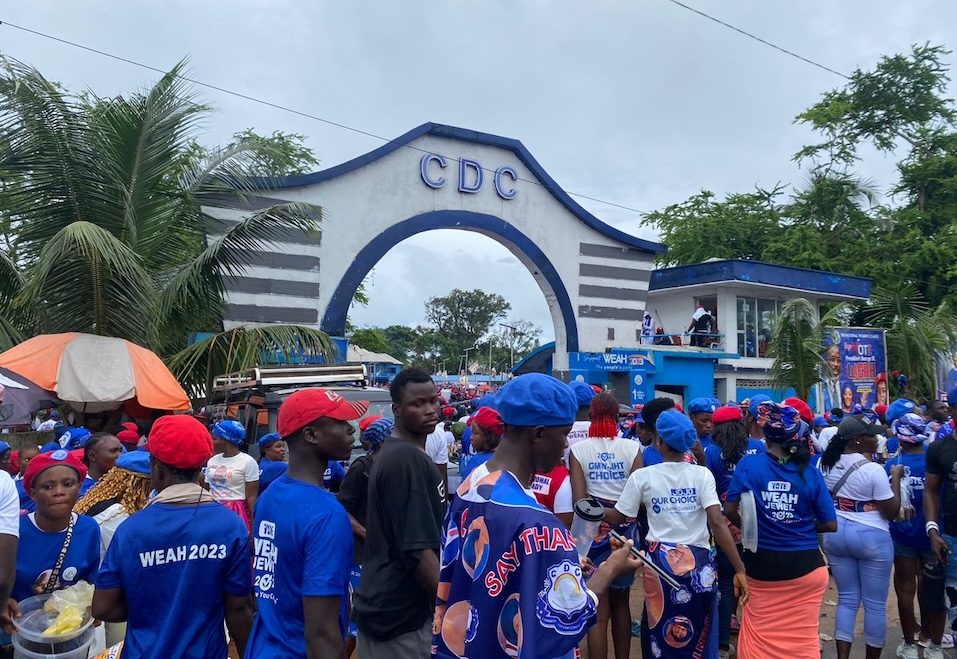
MONROVIA – The Civil Law Court ‘A’ in Monrovia has moved to enforce the Supreme Court’s final judgment against the opposition Congress for Democratic Change (CDC), rejecting the party’s latest bid to halt eviction proceedings from its long-occupied headquarters in Congo Town.
In a ruling handed down Thursday, July 31, Presiding Judge George Smith denied CDC’s petition to dismiss ongoing Summary Proceedings to Recover Real Property filed by the estate of the late Martha Stubblefield Bernard. The Court found that the Summary Proceedings are a separate legal action and are not barred by CDC’s pending petition for Specific Performance.
“The petitioner’s request to recover real property is distinct and independent,” Judge Smith ruled, dismissing CDC’s argument that the eviction matter could not proceed while its Specific Performance case aimed at enforcing an alleged sales agreement remains unresolved.
The enforcement of the Supreme Court’s 2016 ejectment order had been delayed for nearly a decade due to legal entanglements and political interference.
Aligning with the High Court
Thursday’s ruling comes on the heels of a scathing Supreme Court opinion issued in May 2025, in which the nation’s highest court dismissed a Bill of Information filed by the CDC as “preposterous,” “impermissible,” and a “legal charade.” The Court ruled that CDC’s legal strategy amounted to an attempt to circumvent a final judgment and maintain unlawful occupancy of private property.
Associate Justice Jamesetta Wolokollie, delivering the opinion on behalf of the full bench, made it clear that the CDC’s delay tactics could no longer be tolerated. “That the informant’s filing of a bill of information is preposterous and impermissible since the informant cannot question the title of its landlord,” she wrote.
The ruling, which was endorsed by Chief Justice Sie-A-Nyene G. Yuoh and Associate Justices Yussif D. Kaba, Yamie Quiqui Gbeisay Sr., and Ceaineh D. Clinton Johnson, also imposed a $500 fine on CDC’s legal team for abusing court process.
No Valid Sale Agreement
The CDC has argued that it entered into a contract with the estate to purchase the land, a claim now at the center of its Specific Performance petition. But Cllr. Johnny Momoh, lawyer for the Stubblefield Estate, told the court there was no legally binding sales agreement, only rent payments made by CDC between 2018 and 2023 totaling US$360,000.
The Supreme Court considered those payments as evidence of a landlord-tenant relationship, not a transfer of ownership. “That the 1st respondent’s acceptance of US$360,000.00 as rental arrears from the informant… was an implied enforcement of the 2016 Judgment and thereby established a landlord-tenant relationship,” the Court stated.
And under Liberian law, a tenant cannot challenge the title of its landlord. The Court cited its 2013 precedent in Jallah v. Intestate Estate of George S. B. Tulay, reinforcing this well-established principle.
CDC’s Legal Maneuvering Hits a Wall
Despite the setback, CDC lawyers have taken exception to the Civil Law Court’s ruling, vowing to “take advantage of the law controlling,” a clear indication of their intent to file an appeal or seek other legal remedies.
But legal analysts say the path forward for CDC is narrowing. “What’s happening now is procedural enforcement of a final judgment, not a new trial,” one senior legal practitioner told The Liberian Investigator. “The Court is simply giving effect to what the Supreme Court already made clear, CDC’s occupancy is unlawful.”
Background of the Dispute
The land dispute began in 2014 when the Intestate Estate of Martha Stubblefield Bernard filed an ejectment action against both the CDC and the Intestate Estate of William Thomas Bernard. A lower court ruled in favor of the Stubblefield Estate in 2016, and the Supreme Court affirmed that decision.
Yet enforcement was stalled for years, amid speculation of political interference during the tenure of former Justice Minister Frank Musa Dean, who previously served as legal counsel for the Stubblefield Estate.
In 2024, the estate hired new legal representation and resumed efforts to implement the Supreme Court’s ruling. The CDC responded by initiating separate legal proceedings and filing multiple procedural motions, including the now-dismissed Bill of Information.
Court sheriffs are expected to act on the writ of possession in the coming days. Whether the CDC will mount another legal challenge or finally comply remains to be seen.






Discussion about this post