


Published: September 25, 2026
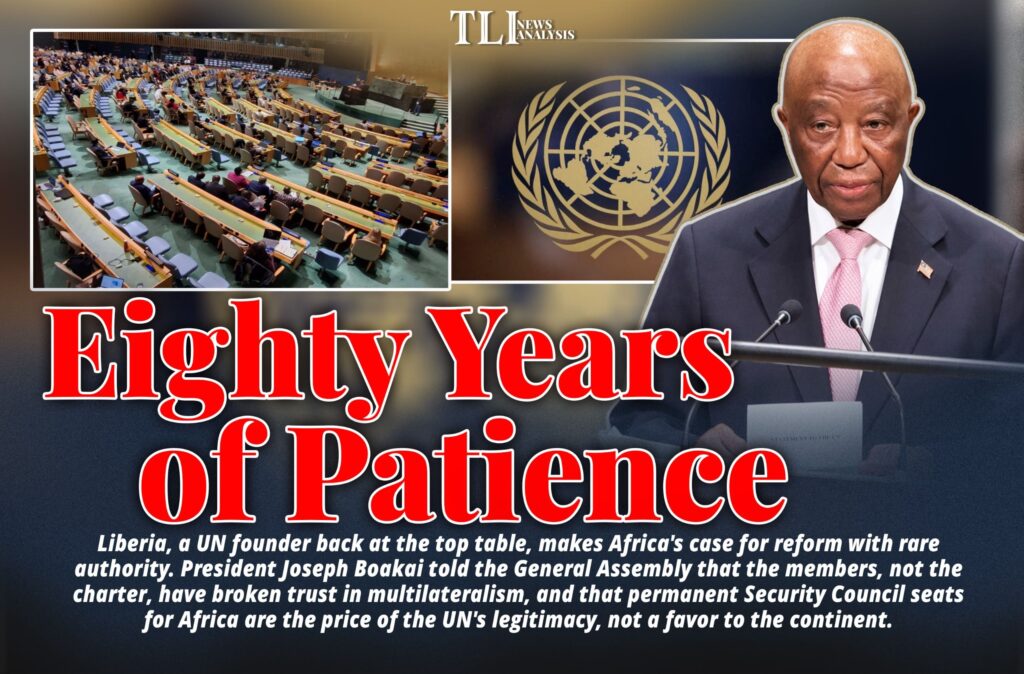
NEW YORK – When the United Nations Charter was signed in San Francisco in 1945, only four African countries put their names to it. Liberia was one of them. Eighty-one years later, Joseph Boakai, Liberia’s president, used that history before the General Assembly on September 24th to press a demand African leaders have made for two decades. “Eighty years of patience is enough,” he told delegates. “The time for structural reform is now.”
By Lennart Dodoo | News Analysis
The demand itself is not new. Every autumn, African heads of state call for permanent seats on the Security Council, and every autumn the council stays as it is. What set Mr Boakai’s speech apart was his standing. Liberia holds one of the council’s ten elected seats this year. That gave him something most speakers at the lectern lack. He was criticizing the council from inside it, not asking for a place at the door.
Africa, he noted, is home to 1.5bn people and makes up nearly a third of the UN’s membership. By his count, 80% of the Security Council’s mandates concern African peace and security, yet the continent holds no permanent seat on the body that writes them. “This historical injustice is no longer tenable,” he said. He restated the Common African Position: no fewer than two permanent seats with every right that comes with them, including the veto “so long as it exists”, plus more non-permanent seats. He also welcomed the recent presentation of the African Model in the intergovernmental negotiations, saying it moves the talks toward text-based bargaining. That procedural shift matters. Reformers have spent years trying to get the talks off general statements and onto an actual negotiating text.
The argument was built to persuade the powerful, not to shame them. Mr Boakai avoided the language of grievance that often greets such appeals. “Correcting this imbalance is not a favor to Africa,” he said. “It is necessary to restore the United Nations’ trust, credibility, and legitimacy.” The line fits the Assembly’s theme this year, “Restoring Trust, Managing Transformation”. It also recasts reform as something the UN owes itself rather than a concession it owes a continent.
Trust in multilateralism is broken, he argued, not because the charter’s principles have aged but because members have applied them “inconsistently and selectively”. He said, “Our answer to that fragmentation cannot be less multilateralism. It must be better multilateralism!” At a time when the UN is cutting costs under its UN80 reform drive, and some of its biggest funders question its worth, a defense of the institution from a small founding member carries weight.
He applied the same logic to money. The governance of the World Bank and the IMF, he said, “still reflects the world of 1945 rather than the world of today”. He called for a fairer voice and vote for developing countries in the Bretton Woods institutions, and for concessional finance and debt relief in place of the high borrowing costs that squeeze poor governments.
Liberia endured two civil wars and hosted a UN peacekeeping mission until 2018. It now sits on the council that authorized that mission. In 2023 it held an election in which the sitting president lost and conceded, which is rarer in the region than it ought to be. Mr Boakai called his country “living proof that dialogue can overcome division and that institutions can be rebuilt”. Few delegates in the hall could make that claim with the same credibility.
President Boakai tied Liberia’s council seat to concrete threats at home, naming narcotics trafficking along maritime routes in the Gulf of Guinea, transnational organized crime and cyber warfare. He asked international partners for specific help: coast-guard surveillance, intelligence sharing and port-security technology. That is the kind of practical request that shows a council seat being put to work rather than merely worn.
None of this means Africa will get its permanent seats soon. Changing the council requires amending the charter, which needs ratification by two-thirds of UN members, including all five permanent members. Each of them has reasons to hesitate. But reform campaigns are won by shifting the terms of debate before they are won by votes, and on that front Mr Boakai did well.
Liberia signed the charter in 1945, when most of Africa could not, because most of Africa was not yet free.





Discussion about this post