


Published: June 15, 2026
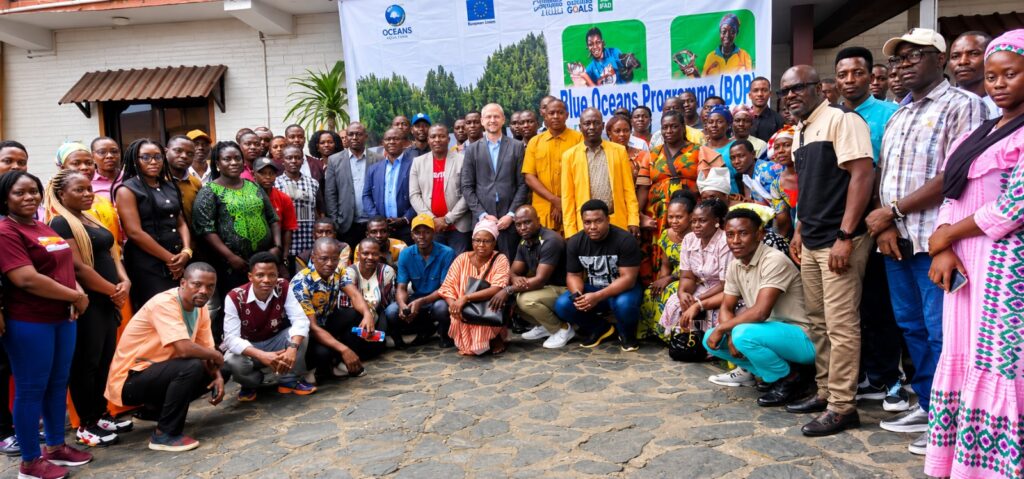
MONROVIA — Emotions ran high Friday as beneficiaries, government officials and development partners gathered in Monrovia to formally close the Conversation International Liberia (CI-Liberia) managed and Swedish-funded Blue Oceans Program (BOP), a six-year initiative credited with transforming livelihoods, strengthening coastal conservation and empowering communities across southeastern Liberia.
While many participants expressed sadness over the program’s conclusion, they also celebrated what they described as life-changing achievements that have improved incomes, strengthened environmental stewardship and empowered hundreds of women and vulnerable households.
The closing ceremony brought together beneficiaries and community leaders from Sinoe, Rivercess, Maryland and Grand Kru counties, along with representatives of the Government of Liberia, Conservation International (CI) Liberia, civil society organizations, development partners and the diplomatic community.
Organized by CI in partnership with the Environmental Protection Agency (EPA) of Liberia, the program was held under the theme, “From Ocean Threats to Solutions: Our Work Builds Sustainable Livelihoods and Empowers Local Communities”. It featured emotional testimonies from beneficiaries whose lives were directly impacted by the project.
Building a Sustainable Blue Economy
Opening the ceremony, Conservation International Liberia Country Director Momodu M. Kemokai said the success of the Blue Oceans Program was rooted in a long-term vision shared by CI Liberia, the Government of Sweden and local stakeholders.
The initiative focused on strengthening the sustainable management of marine ecosystems, protecting biodiversity and improving livelihoods in Liberia’s coastal communities.
“This event marks the conclusion of the Blue Oceans Program, a six-year initiative supported by the Swedish Embassy and Sida,” Kemokai said. “The program has strengthened institutional capacity and supported more resilient fisheries and coastal management.”
He noted that communities were empowered to become stewards of their natural resources while building resilience against climate change.
Although the project has officially ended, Kemokai said its achievements provide a foundation for future interventions and renewed efforts to protect Liberia’s oceans and coastal ecosystems.
CI-Liberia Financial Director Matthias Okoku echoed those sentiments, praising the Swedish International Development Cooperation Agency (Sida) for its financial and technical support.
“To our government partners, especially NaFAA, EPA, FDA, CDA, and National Civil Society Council, your dedication, professionalism, and resilience ensured that every milestone was achieved with excellence,” Okoku said.
Ambassador Highlights Lasting Achievements
Delivering the keynote remarks, Swedish Ambassador to Liberia Karl Backeus reflected on the origins of the initiative, tracing it to the 2019 Blue Ocean Conference, which promoted the idea that oceans and coastal resources can drive prosperity, equity and environmental sustainability when properly managed.
According to him, the program evolved into a broad partnership centered on local ownership, innovation and sustainable development.
Over six years, the initiative achieved several major milestones, including:
Completion of Liberia’s first national mangrove inventory.
Establishment of a Blue Economy Secretariat.
Validation of the National Blue Economy Strategic Roadmap.
Revolving loans totaling US$124,453 to 506 women in southeastern Liberia.
Signing of 19 conservation agreements.
Creation of more than 300 green jobs.
Grants totaling US$641,312 to 23 civil society organizations.
Grants totaling US$110,000 to 18 communities.
Renewable energy support valued at US$112,928.
Development of a Marine Spatial Planning Framework.
Launch of Liberia’s chapter of the Global Mangrove Alliance.
Backeus singled out women’s empowerment as one of the program’s most significant successes.
“One of the most inspiring achievements has been the empowerment of women through fishmongers’ cooperatives,” he said. “These cooperatives have strengthened livelihoods, increased access to markets, and elevated the role of women in coastal economies.”
The ambassador said his visit to Maryland County last year offered firsthand evidence of the program’s impact.
He also praised efforts to protect Liberia’s mangrove forests, describing them as critical natural defenses against climate change and coastal erosion.
“By documenting and safeguarding the mangroves, you are securing both nature and future generations,” he said.
‘Sustainability Is Built Through Commitment’
While celebrating the program’s achievements, Ambassador Backeus reminded stakeholders that long-term success depends on continued local ownership and commitment.
“As we close this chapter, we should remember that sustainability is not achieved through projects alone; it is built through continuity, ownership, and commitment,” he said.
“The success of the Blue Oceans Program lies not just in its achievements, but in the foundations it has laid for the future.”
Backeus also reaffirmed Sweden’s commitment to supporting Liberia’s climate resilience, biodiversity conservation and inclusive economic growth despite the closure of its embassy in Monrovia.
“While Sweden is closing its embassy in Monrovia and this particular program concludes, we remain a committed partner in advancing action against climate change, strengthening biodiversity and fostering inclusive economic growth,” he said.
NaFAA: Communities Now Leading Conservation
National Fisheries and Aquaculture Authority (NaFAA) Director-General J. Cyrus Saygbe Sr. hailed the program as a model for community-driven development and environmental conservation.
According to him, the initiative strengthened NaFAA’s presence in the four participating counties while supporting fisheries cooperatives, conservation groups and mangrove management committees.
Saygbe disclosed that 14 community-based institutions benefited directly from the intervention, while 11 mangrove communities entered formal conservation agreements.
“Through these agreements, communities have become custodians of their own natural heritage, proving that environmental conservation becomes most effective when local people are empowered to lead,” he said.
He further noted that revolving grants ranging from US$200 to US$1,000 helped hundreds of beneficiaries—mostly women fish processors and fishmongers—expand businesses, improve incomes and build resilience against economic shocks.
“This programme has therefore not only conserved ecosystems; it has protected dignity, strengthened livelihoods, and created opportunities for vulnerable households,” Saygbe said.
Women Describe Life-Changing Impact
Perhaps the most powerful moments of the ceremony came from beneficiaries themselves.
Women from Maryland, Rivercess, Sinoe and Grand Kru recounted how the project transformed their lives through access to loans, farming support, savings programs and environmental conservation initiatives.
Felecia, a civil society representative from Maryland County, said the project provided equipment such as wheelbarrows, shovels and rakes that improved environmental sanitation and community development efforts.
She explained that women who once relied on small-scale farming now manage large cocoa and cassava farms.
“The grants facilitated the creation of village savings and loans programs,” she said. “This has empowered women to control their own finances, support their families, and engage in trade, such as selling fish.”
She added that many families are now using earnings from project-supported activities to pay university tuition and construct homes.
Other beneficiaries credited the initiative for introducing rice mills, improving fisheries management and creating economic opportunities that enabled them to provide for their children and support their households independently.
Several women recalled initially believing revolving loans were “free money” before learning the value of repayment and financial discipline.
One beneficiary described her transformation from poverty to financial stability through the support received under the program.
Others highlighted how new conservation measures and community security systems have helped restore mangroves and protect fish breeding grounds.
EPA Calls for Expansion
Environmental Protection Agency Deputy Executive Director for Administration Anthony S. Kollie Sr. praised Sweden and Conservation International for helping strengthen environmental governance, community fisheries management, waste management systems and gender-inclusive participation.
“On behalf of the EPA management team, the Government, and the people of Liberia, I extend our profound gratitude to the Government and people of Sweden,” Kollie said. “Your visionary funding made this transformation possible.”
While applauding the achievements, Kollie urged development partners to consider expanding similar interventions to additional coastal counties, including Grand Bassa, Montserrado and Grand Cape Mount.
“The project may be closing, but our duty to protect our oceans and empower our coastal communities remains absolute,” he said.
Looking Beyond the Program
As the Blue Oceans Program comes to an end, stakeholders say its legacy will be measured not only by conservation gains but also by the lives transformed across Liberia’s coastal communities.
From women-led businesses and village savings groups to mangrove protection and green job creation, participants agreed that the initiative has demonstrated how environmental protection and economic empowerment can go hand in hand.
For many beneficiaries, the program’s conclusion marks not an ending, but the beginning of a new chapter built on self-reliance, community ownership and sustainable development.






Discussion about this post