


Published: June 29, 2026
MANBOR TOWN, Nimba County – Farmers across several communities in Nimba County are urging the government to move beyond policy commitments and invest in the machinery, financing and market systems they say are essential to expanding food production and reducing Liberia’s dependence on imported rice.
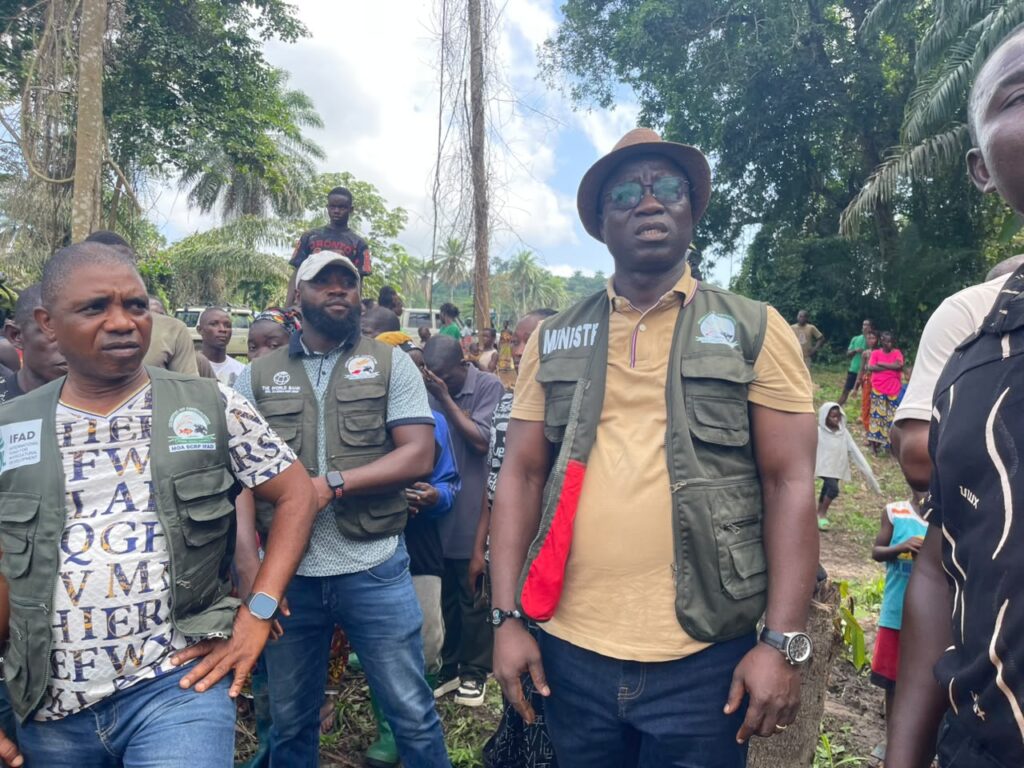
Their appeal came over the weekend as Agriculture Minister J. Alexander Nuetah toured farming communities in Manbor Town, Goopea Swamp, Zahn Gahnpa, Zorganaglay and Gbedin, where he met with cooperatives, inspected projects and pledged greater government support for the agriculture sector.
The tour is part of the Boakai administration’s broader strategy to increase domestic food production, promote commercial agriculture and improve national food security.
At Manbor Town in Gbehlay Geh District, Nuetah visited the Kwakerseh Multi-purpose Farming Group, where he inspected cassava fields, oil palm plantations and a 5.6-hectare lowland rice project under development.
Members of the Zodiah Farmers Cooperative said limited access to markets remains one of their biggest challenges despite increasing production.
“We are looking for buyers,” cooperative members told the minister, noting that many farmers struggle to sell their harvests after investing months of labor.
Speaking for the Kwakerseh group, Chairman Elisha Burh said the cooperative was established to fight poverty and hunger through collective farming and income-generating activities.
“We believed that if we came together and worked hard, we would be able to eliminate poverty, fight hunger and improve our community,” Burh said.
He said the group initially focused on beans but ran into marketing problems because there were few buyers. Members sometimes sold only a few cups of beans a day while much of the harvest went unsold, he said. The situation improved after a private buyer, Justin, agreed to purchase the group’s bean harvest, allowing members to earn higher incomes and expand their activities.
Today, Burh said, the cooperative runs beekeeping, fish farming across nine ponds, piggery, cassava cultivation, oil palm production and lowland rice farming. But every project remains small because members cannot afford machinery, he said.
“Everything we are doing is on a low scale because we do not have the financial strength to operate at a higher level,” Burh said. “Seeing the minister here today gives us hope that our concerns will finally receive attention.”
Nuetah commended the farmers and described them as the driving force behind the government’s effort to strengthen food production.
“I want to thank all of you for making farming your business,” the minister said.
He acknowledged postponing earlier visits to the county but said President Joseph Nyuma Boakai had instructed him to leave his office regularly and engage farmers directly.
“My coming here is an order given to me by the President,” Nuetah said. “He told me that when farmers see the Minister of Agriculture, they are motivated to work. My responsibility is not only to stay in the office but to come and understand your challenges.”
Firsthand engagement helps officials understand rural realities and design interventions that respond to farmers’ needs, he said. He reaffirmed the administration’s commitment to making agriculture a pillar of economic development but said success ultimately depends on the farmers.
“We can prepare policies and allocate money in the budget, but agriculture will never work unless the farmers make it work,” he said.
Nuetah urged women and young people to stay in agriculture, warning that more young Liberians are abandoning farming for commercial motorcycling and small-scale mining. He said Liberia’s fertile land, heavy rainfall and many rivers give the country a comparative advantage in production.
“There is no reason why we should continue importing rice when we have the capacity to grow it ourselves,” he said.
The minister announced plans for a national conference to bring together women and young farmers to discuss ways to raise productivity and draw more youth into farming.
Addressing a request for a cassava processing machine, Nuetah said the ministry would work to provide the equipment. Budget limits may delay it, he said, but he promised to determine whether resources could be secured before the end of the fiscal year.
“If we can find the money this year, we will do it,” he said. “If not, you can be assured that next year you will receive a cassava processing machine.”
In Zorganaglay and Zahn Gahnpa, residents said it was the first time a sitting Minister of Agriculture had visited their communities. They thanked Nuetah for engaging them directly and urged the ministry to maintain regular contact with rural farmers. In Gbedin, the minister continued discussions with farmers and pressed for higher production.
Nuetah later traveled to Goopea Swamp in Kparblee District, where he toured a large-scale lowland rice project being developed by the Liberia Farmers Development Corporation. The swamp spans about 1,000 hectares, with roughly 200 hectares under cultivation, according to LIFADCO.
Chief Executive Officer Bories B. Barlea said the project could become one of Liberia’s major rice-producing areas with more investment.
“This swamp has the capacity to transform rice production in this region,” Barlea said. “We have started with about 200 hectares, but with greater mechanization and support, we can significantly increase production and contribute to Liberia’s food security.”
Barlea and other managers cited inadequate equipment, limited infrastructure and insufficient financing as the main barriers to expanding cultivation.
Nuetah thanked the farmers and called them the foundation of Liberia’s agricultural transformation.
“I want to thank all of you for making farming your business,” he said. “Agriculture is the backbone of our country’s development, and I am confident that more young people and women will become involved because the future of Liberia depends on what we produce ourselves.”
Throughout the tour, farmers said they hoped the visit would translate into concrete support that expands production, improves rural livelihoods and advances the government’s goal of food self-sufficiency.






Discussion about this post